Covered in mud and breathing hard as I climbed up the third Scottish mountain of my Highlands roadtrip, I was thunderstruck by a thought: “I seek discomfort when I’m on vacation.” Obviously this is the opposite of what normal people want from vacation. We talk a lot about leaving the comfort zone while traveling, and for me that zone is physical as well as psychological. In daily life I fall into the traps of convenience and comfort wherever possible, with my blankets and sushi to-go and stretchy house pants. So when I’m on the road I like to test my body’s actual physical limits, which are so far beyond where I think they are. I also like being reminded that neither intense effort nor inclement weather will (probably) kill me.
My hike up Stac Pollaidh that day in early September, though, was going to test even me.
During the long drive in down the one-lane Highland road, the whale’s fin of the Stac Pollaidh peak had been bathed in sunlight. I’d laced up my freshly-dried hiking boots in the parking lot while the sun flickered through a persistant rip in the cloud. It’s true the wind was howling when I started my ascent up the rather soggy hillside, but that’s hardly news in Scotland. Across the treeless Highlands I could see for miles. Wild granite balds and tiny lochs the color of molten mercury stretched all the way to the northern horizon. I could also see there were only five of us hiking up the hillside: one couple was just ahead of me, another was just behind, and I was tucked safely between them in the middle.
It all lulled me into a false sense of security.

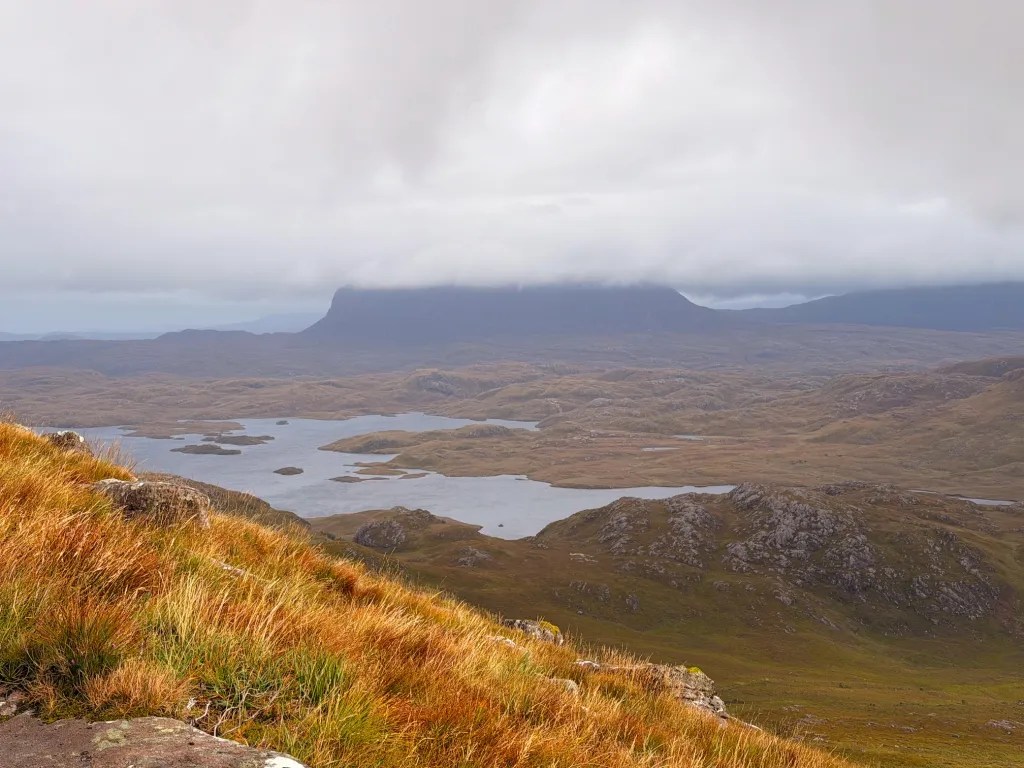
The peak of Stac Pollaidh and the nice eastern path up // The view north
I caught up to first couple on the backside of the peak while they were standing at a crossroads and disagreeing in Spanish about which way to go. There were only two options beyond them: a flat trail leading west around the base of the peak, and a switchbacking trail up to the summit. I had the same choice to make, but the silent debate in my head was shorter than theirs. The skies were darkening but still dry, the wind was weaker than I, and I could still see all the way to the Northern horizon. I picked my poison: up.
The summit path was unforgiving in its pitch, and the mountainside filled my entire field of vision. I had no concept of anything else existing in the world for ten whole minutes, which is rather a luxury if you think about it. Even the southerly wind had quieted to a whisper as the peak took the brunt of it. Just a few meters shy of the summit I noticed a little cave in the rock face, and I thought to myself oh, that would make a nice emergency shelter in a storm.1
That, my friends, is called foreshadowing.
I had just turned around to tackle the final switchback when a vortex of wind howled at me from around the cliff. It felt like a great hand pushed me back towards the rock. I looked north towards the wild open landscape and instead found a void of white. Far below I could see the Spanish couple on the flat trail, and dimly I realized that their crossroads debate might have had something to do with the weather. Well, it was too late now, and I was so close to the peak! I had to know what was on the other side. I kept calm and carried on up to the top of the saddle, making sure to keep two feet and one hand on the mountain, or at least two hands and one foot. Belly to the Earth, I peaked over the peak. Alas: what should have been a lovely view over Loch Lurgainn was just a depthless soup of fog. The tempestuous wind on this side of the peak was making the rain fall upwards. The raindrops, now that you mention it, were fattening up like so many Alaskan bears. I wedged myself against a boulder and took stock of my situation.
What exactly does a person do when they’re alone on an exposed summit in a sudden Scottish squall? Presumably you’re reading this from the comfort of your normal life, and you might think the answer is obvious, like when you’re watching a movie heroine trying to hide from an axe murderer and screaming at her to run. Just get out of there!, you might think. The thing is, I was protected where I was, and standing up into the wind seemed insane. I was at the furthest possible point from my car, so no matter what I did, I wouldn’t be getting out of there anytime soon. The only trails I could see led west along the exposed spine of the saddle or back down east the same way I’d come (which in hindsight would have been the right answer, ding ding ding). Admittedly a small part of me wanted to wait it out and see if I could get the view I’d climbed up there for, so I used my handheld crystal ball called an iPhone to forecast the weather. It said there might be a break in the rain, or there might not, try again later.

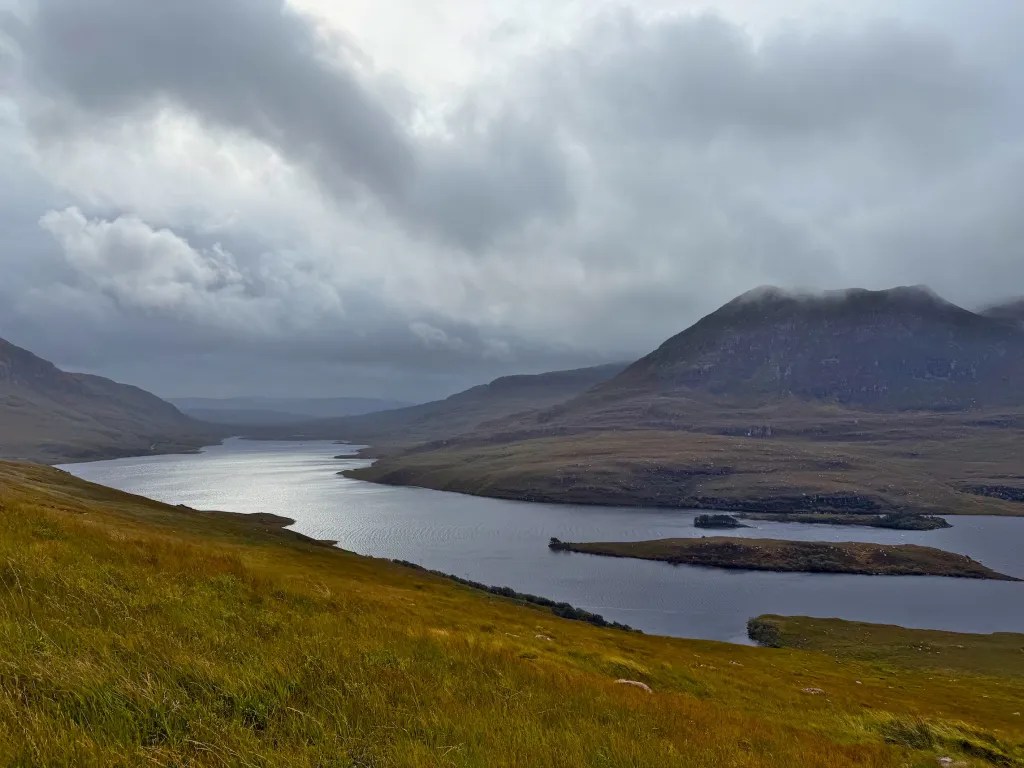
Me hunkered down at the saddle, with the saddle path behind me // what the view SHOULD have looked like (taken during the dry hike up)
In record time, I accepted both that I wasn’t going to get any kind of view and that walking west along the exposed saddle path would be a death wish. I crept Gollum-like on all fours back down the way I’d come. Lo and behold! A third path had been hiding in the folds of rock and mist, and it led in the direction I wanted to go: back to the car, semi-protected from the wind, and west so it wasn’t the same path I’d walked in on. You see, I’m a sucker for a loop trail rather than an out-and-back, and I still held out hope that the thickening rain would be a short-lived affair. I did stop long enough to put on my rain pants, though, having learned that lesson the hard way just two days before.
Normally, I’m a cautious hiker. I hike with intent, which is to say without much speed, and I like to avoid large puddles of water or mud because I ~loathe~ wet socks. The harder the rain fell and the louder the wind screamed, though, the less care I took. Soon I was stomping my way through ankle-deep mud puddles like a disgruntled child. I felt the bog waters creep into my socks almost as fast as the rain waters were creeping down my back. I more skied than hiked down the hillside, so slick was the peat-rich mud.
I cleared the steepest boulder-strewn part of the path with a lot of swearing but no falling on my ass and found myself on somewhat flatter ground, which I thought was good news at first. But do you know what happens when centuries of endless rain falls onto somewhat flat ground? It turns into an actual bog.
My right foot landed on a patch of muddy trail that looked like every other patch of muddy trail and I expected to keep going in a mostly forward direction, so imagine my surprise when the Earth tried to swallow me whole instead. It felt like I’d stepped into a lake. My leg disappeared up to the knee in deep chocolate mud and my arms, when they caught the rest of me, sank up to the elbow. As soon as I fell in this clever trap, the ground became quicksand. I had to lean and twist my leg while praying that my boot would stay on. Once extracted, I picked my way gingerly down the trail for a few minutes, testing each footfall before I put any weight behind it, but the cold sideways rain once again convinced me to hurry.
The second time I fell into an Earthly trap, there was pure unadulterated rage in my heart and on my tongue. Fortunately the wind swallowed all my blasphemies against Scotland and Mother Nature, and none of it reached the ears of the Spanish couple who were a few hundred meters in front of me again. After I’d extracted myself from the second bog, I abandoned all caution. I all but ran down the trail, favoring any rock I could find over the capricious mud. My boots were both caked with mud and filled with lakes, so I briefly stopped and swished them around in a deep clear burn2 to try to clean them off.
I suppose this is a good time to mention that ever since childhood, I’ve never enjoyed being wet when I’m clothed and on land. Or being muddy, ever. But realizing I was soaked and muddy and deeply physically uncomfortable and also technically just fine, I made an uncharacteristic move: I spoke out loud to myself. “OK, this officially sucks,” I calmly said, as if to placate my very upset inner child and frankly rather displeased inner adult. It seemed to do the job and I struck off down the trail again.
The warm clean water in the sink at the parking lot toilets was one of the most beautiful things I’ve ever experienced. I resisted the urge to just climb into the basin and only washed myself up to the elbows. Watching that chunky thick black mud swirl down the drain felt like a tiny victory-cherry on a shit-cake of a morning. I scrubbed at my skin three times with soap and managed to get most of it off, but my cuticles would remain black through my next three daily showers and I fear my once bright yellow rainjacket will never recover.
I went looking for discomfort, and hoo boy did I find it. Did I enjoy it? Maybe not so much at the time, but now I know more about what I can actually endure without harm. And it drove me into the arms of a cute little roadside teashop, where I watched the sheep and tried to learn what, exactly, was their secret to being so unbothered by a little bit of mud and rain.
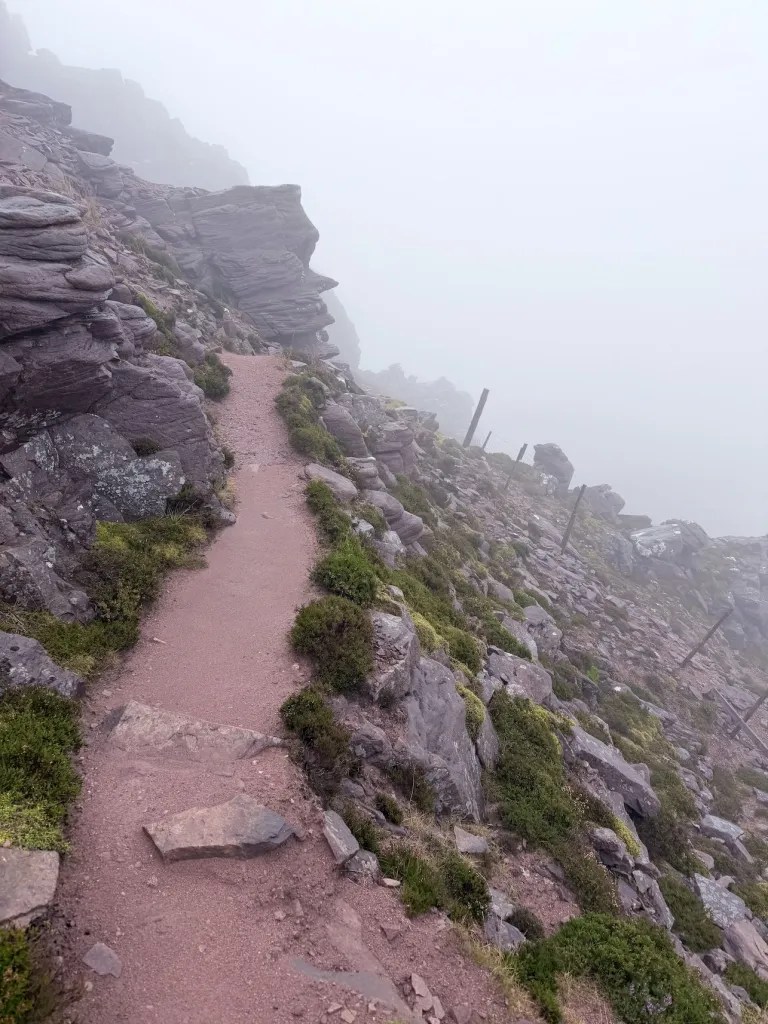

The final picture I took during the expedition: the third path leading down from the summit // SOUP.
Leave a Reply