I have done a lot of crazy sh*t in the name of Science over the past 15 years. I’ve trapped birds using Looney-Toons-style boxes propped up on sticks, and detonated explosives to launch a net buried in the sand to catch migrating Red Knots (an endangered American shorebird). I’ve hauled land-surveying devices around forests to precisely record locations of trees so they could be cross-referenced with drone photographs and we could link each tree’s genetic composition with the amount of seeds they produced that year. None of those things compares to the absolute lunacy of dangling 20 meters (65 feet) off the ground from a single rope slung over a tree branch, which I was attached to with knots I’d tied myself, more specifically with knots I’d just learned how to tie that morning.
Let’s return to Earth for a second and I’ll take you on the full journey of how I’d ended up there (in the canopy, not a lunatic). In some ways, it was inevitable. When I’d moved to Germany 6 years earlier to start my PhD, I’d immediately met tree-climbers, because my forest-genetics advisors liked to ask questions about tree canopies. Nearly every fresh hire was enrolled in a Tree Climbing for Science and Research course, until I was virtually the only obligate-terrestrial researcher left in my working group. Then I took an offered job as a staff postdoctoral researcher and stuck my fingers into as many projects as I could, and it was finally time to ascend into the climbers’ ranks.
When I arrived in the forest for Day 1 of the 4-day course, I’d never touched climbing equipment before, and I’d only really used knots to tie friendship bracelets, and the only kind of climbing I’d tried was in a bouldering gym on routes that were designed for literal children. None of that seemed to matter. By lunchtime, our instructor had shown us how to strap ourselves in, and she scampered off into the canopy, demonstrating the technique and expecting us to follow. There was no discussion with either her or myself about whether I could do this, and believe me when I say I had my doubts leading up to the course, in no small part due to the miscellaneous sports/overuse/idiocy injuries to my shoulders and knees I’d accumulated over the years.
You can imagine that faith and trust are two things I had to haul into the canopy with me, and it started as blind faith. Faith in my soft-spoken Scottish instructor, Vicki, whose black streak of humor I chose to interpret as a sign of intelligence rather than psychopathy. Trust in the engineering of the deceptively lightweight equipment I’d been handed that morning. Trust in my peers’ ability to get me out of the tree if it all went sideways. Mostly, faith in myself, that my physical and emotional strength (ha), general grasp of physics (haha), and excellent decision-making skills (hahaha) would conspire to keep me alive. Do, or do not, as Yoda said, and that’s the short version of how I found myself in the canopy.
The longer version is that the act of climbing the rope is called “rope walking” because it places most of the workload on your legs and feet, which make little 3-6” steps up that are each naturally accompanied by a little kick, like if you were climbing a snowy or sandy slope and making your own footholds along the way. You’re not so much pulling your weight up with your arms up as you are pushing up with your legs. This nomenclature is deeply misleading, though, because your upper body absolutely does not get to rest like it would if you were walking on the ground. While your feet do the climbing, you also have to hold yourself vertically upright against the forces from both the rope and harness that want you to be horizontal instead (calling to mind my general fights to get out of bed in the mornings and off the couch in the evenings). The expert had made it look as simple as climbing a ladder, but at first I could only manage 20 or so tiny steps at a time before my fingers screamed and my biceps threatened to fail, and I had to “sit down” into the harness and breathe. I’d twist gently in the breeze, enjoying a slow panoramic of the lower canopy, constantly squirming a bit so the harness couldn’t choke out the blood flow to my legs. At the same time I tried to let the sense of accomplishment and wonder choke out my fear. Heights don’t scare me but I am afraid of freefall, which some people might argue are two sides of the same coin, but here’s the critical difference: I can stand on an open-air glass floor at the top of a skyscraper and look straight down 100 meters without adrenaline rush, but if I jump into water from any higher than 3 meters up, I will legitimately scream. Twisting on rope over empty air, I found out that day, was decidedly closer to the latter.
After the final push I’d made it high enough to sit on a branch and plant my feet against the massive trunk. Our main jungle gym was a healthy enormous European beech (Fagus sylvatica) whose base was over a meter in diameter. A breeze tugged at the leaves on my branch and I felt it sway, even as the smooth silvery trunk beneath my feet stayed where it was. It was an odd but not unpleasant sensation to experience the tree’s movement, and to my mammalian brain it was the most convincing evidence I’d found yet that trees are alive. Feeling the waist-thick branch bend one way and immediately back also let me know that the healthy branch, which had existed for decades and probably outweighed a car, was effortlessly held up by the steadfast trunk. My added weight was nothing to this tree. For the first time since leaving Earth, I felt safe.

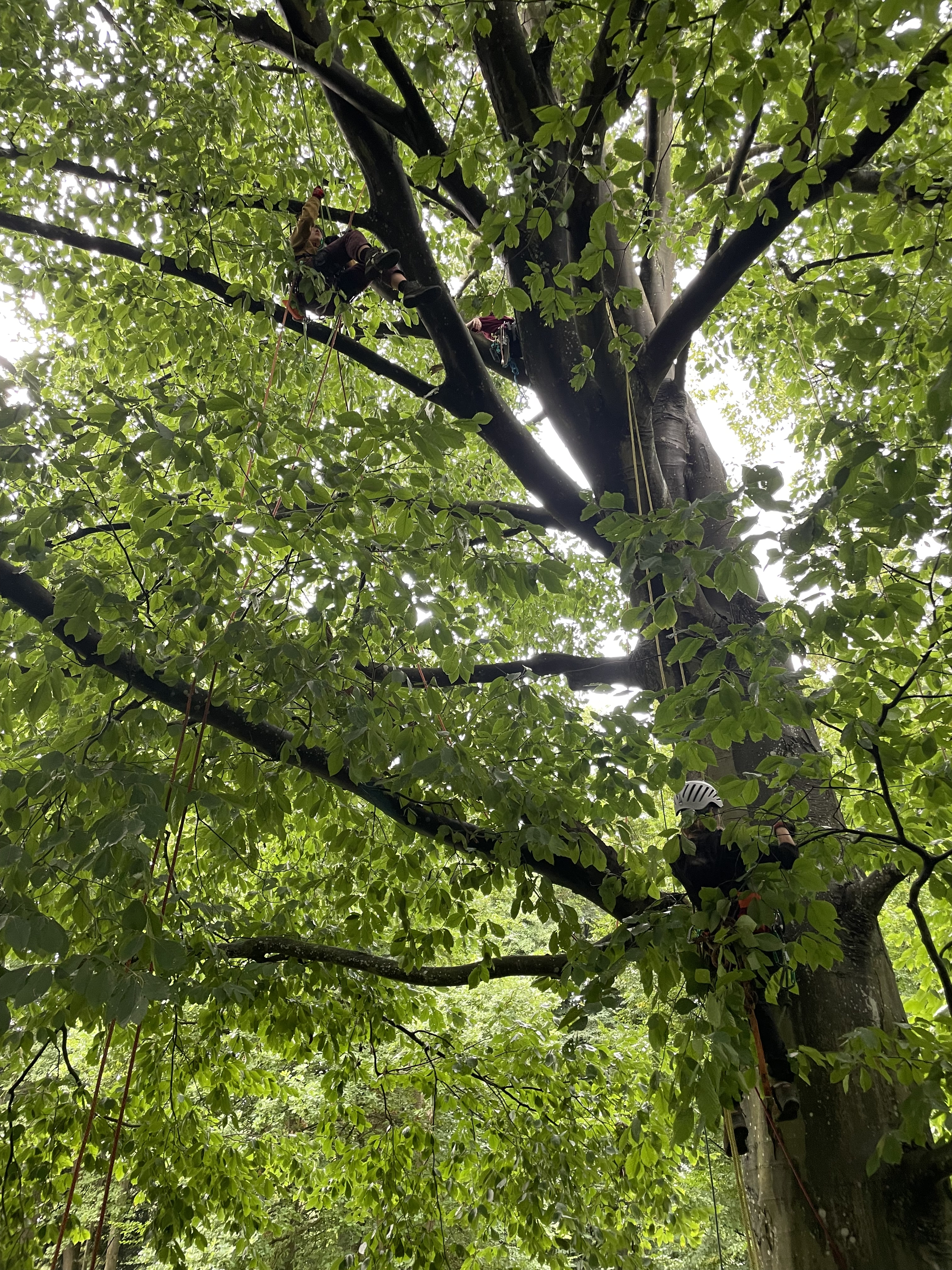
Then the real fun began, because getting up to the canopy is only step 1. Most research (and arborist) tasks require you to move away from the trunk and monkey around. Within minutes of receiving my first assignment to reach a specific branch, I’d said out loud that “I forgot there was a third dimension.” This sounds bat-shit, and I promise I’m not a flat-earther, but hear me out. We terrestrial creatures are usually bound to Earth. While I know that there are three dimensions across two planes, most of my daily movement is along the single plane of the ground. Think of geographic coordinates: we only need two pieces of information (latitude and longitude) to locate any place on Earth, because we don’t really care about that third dimension unless we’re flying or scuba diving or bragging about how high up a mountain we climbed. All of that changes the moment you’re suspended in air and you exist completely in both planes. Imagine: while rope-walking up away from Earth, you find that your rope passes through a narrow branch fork that your body won’t fit through. You can’t just move sideways in midair and expect to stay over there, like you might if you were walking or even diving. You have to push with your hands against the branch fork to move yourself away, and then continue rope-walking up, worming your body around to keep the fork away and make space for your knees to move until your whole body has cleared it. And yes, it’s extremely undignified. For everyone. Even the expert going through a branch fork looked like a baby snake birthing itself.
So you can also imagine that intentionally moving outwards in the canopy requires a delicate mix of mind-bending, gymnastics, and lost dignity. “Branch walking,” the act of moving along branches, is a lot like “rope walking” in that it made me question whether the inventors of tree climbing actually know what the word walking means. To branch walk, you swivel your body parallel to the ground, which also means you’re perpendicular to the rope you’re hanging from. You climb out like a monkey lengthwise along the branch, using two or three limbs while balancing between dual pulls (gravity pulling you down, the rope pulling you up and back towards the trunk). It makes absolutely no sense. Our species left the trees long enough ago that the very idea of branch walking made my brain go “no no, we will not be walking along this palm-wide branch that’s twenty feet up when there’s nothing between us and the ground,” forgetting again about the multiple ropes I was attached to. The caution is somewhat warranted because that second plane is still in play: should your grip on the branch fail for any reason, the trunk now has its own form of “pull,” and you’ll swing towards it. We all carried a shorter mobile rope for lashing onto branches, which holds you in position against the trunk’s pull, and it was nice but it introduced a third direction of pull I had to mentally keep track of.
Understanding these forces threatened to break my terrestrial brain, and one of the first soft climbing skills I taught myself was to either stop overthinking or even forget. Forget that my feet must point towards the ground. Forget that if I let go of the branch, I shouldn’t fall down, but I’d swing sideways. I forgot the traditional appendage roles that my feet and hands play when I’m on the ground, and I started grabbing branches with whatever end of me was closest: a boot hooked around a branch is often just as good as (and less tiring than) a bicep curled around it. As a bonus, all that forgetting made more space for learning. I learned to feel the tension of the ropes and treat them like limbs, keeping them tense like muscles. At one point, the other student Anna said she momentarily forgot that she even had arms, like the brain can only keep track of so many appendages at once. I started trusting the knowledge of my body. My hands knew how to correctly tie the knots, although sometimes my brain disagreed and insisted they looked wrong (shut up, brain!). More than once I noticed that my eyes had completely unfocused, so hard was I concentrating on learning a new bodily sensation instead.
Four solid days of theory and practicals and knots and rescues left me both absolutely wrecked and inspired. As much as I love field work, my day job is basically data analysis, so my hands are weak and soft like a baby’s. By Friday my fingers had swelled up like tiny strong sausages, and even at rest, the muscles in my forearms rose gently from my skin like a tiny topographical map. It seemed a small price to pay for having learned I was maybe not so terrestrial after all, which is a question I’ve been asking ever since I noticed I’m a coordinated swimmer but can’t reliably walk through doorways without running into the doorjamb. I’d had a much closer relationship with the third dimension as a gymnastics-obsessed child, but re-exploring it as an adult felt something like discovering a new continent.
And of course, suddenly I saw an entirely new dimension for research.


Now I’ll address the elephant in the room and answer the question I can hear you thinking: why?
Why would researchers want or need to climb trees? Especially now that we have fancy toys like canopy cranes, and tiny drones, and huge drones with robot arms that can wield scissors and chainsaws (yikes)?
Canopies are one of the most active and biodiverse parts of the forest, where birds nest and insects feed and epiphytic plants hang out, and it’s easiest to study their ecology and diversity by visiting their habitat. Seeds, too, are also mostly found in the canopy (go outside and look for cones on a tall conifer sometime), and if you want to collect seeds from a specific tree for breeding or studying, the only way to be sure they came from that tree is to pick the seeds by hand. An easier method is to use seed-fall traps, which passively collect falling seeds, but it’s not fool-proof because other agents like wind and animals can move seeds from other trees into the traps. Speaking of animals, some tree species depend on them to carry their pollen between flowers, or to eat their fruits and poo out the seeds far away from the mother tree, and some seeds even need to be passed through an animal’s digestive tract before they can germinate. Of course, you also have the cheaters that have figured out how to rob nectar from flowers without pollinating them, or to just eat the seeds themselves. So how do we know for sure which animal species are pollinators and robbers for different tree or aerial plant species, especially in understudied biodiverse places like the tropics, and is the answer the same across the whole plant? (spoiler: not always). One way we can answer these questions is to install cameras in the canopy next to seeds and flowers to see who’s coming and going.
Cameras can also tell us when flowers and seeds and leaves are forming or falling, and we can ask which environmental factors or genes triggered those changes. For example, seasonal daylight changes were long hypothesized to be a major driver of phenology (biological timing) in temperate forests, and there’s plenty of evidence supporting it now, but what about trees near the Equator where days are always the same length? Precipitation and temperature also play a role, but what will climate change do to those patterns? The longest ongoing phenology record contains 1,200 years of Japanese cherry blossom dates recorded by royal families, which shows that flowers are maturing earlier than they ever have due to climate change. Visual observations are just one tool for studying all of this. We can also measure the day-to-day growth changes of different branches around a tree by installing devices called “dendrometers,” and the data can show you things like when most wood growth occurs, or what happens during a drought, or when the tree shifts its energy from bulking up its limbs to creating new flowers or leaves.
Looking through the genetic lens that I wield, it helps to remember that a tree is alive. Like humans, its cells differ across its entire being. Root and trunk and branch cells all have near-identical DNA sequences, but the expression of that DNA (physical characteristics, or “phenotype”) can differ. Think about leaves, those tiny solar panels that catch light for photosynthesis. Leaves near the ground are usually shaded, while those at the top of the tree get lots of very intense light with strong UV rays, which can damage leaf tissue like it does human skin. Sun-exposed leaves usually grow smaller and thicker than leaves on the same tree that are near the ground, which grow bigger to catch more of the scarcer light. So which genes are being expressed differently to change leaf size? To study that, you need to collect DNA samples from different parts of the tree. It also helps us standardize measurements across trees if all branches are taken from the uppermost sun-exposed parts of the canopy…
As you can see by this never-ending thread that leads from one half-answered question to the next and the next, science is an absolute rabbit-hole. You pull at one thread, and soon you’ve unraveled the whole cozy sweater of what you thought you knew about the world. Climbing is just one tool in the frankly overstuffed and disorganized shed of scientific methods being used to answer biological questions, and it’s one that’s used by only a select trained subset of researchers (who tend to be even more eccentric than most). Learning how to use any one of these new tools can make the world look different.
And then there are the tools that can turn the whole world on its head.

Author’s note: this was on purpose and sanctioned by the instructor.
 Window Seat Odyssey
Wow, that entry took some detailed reading. You be talking complicated science. I’m glad you’re out there taking care of our forests as the earth changes all the other variables we thought we knew!
LikeLike
You continue to amaze me, Jill!
LikeLike