French Alsace’s medieval villages are an archipelago, scattered across a sea of vineyards. Each village is perched in the foothills just above the valley floor, the better to escape any Rhine River floods back in the days of yore. Oddly-named towns like Riquewihr and Eguisheim are still dominated by the spear of a church steeple. Most are watched over by castle ruins lurking along the high points of the Vosges mountain range. Laser-straight vineyards march directly up to these hamlets’ edges, perhaps rudely calling attention to the lack of anything laser-straight in the hamlets themselves: everything leans in at least one direction. Geometric perfection is hardly the only draw of the vineyards, since many of them produce award-winning Grand Cru and AOC wines. Most happily for both medieval pedestrians and contemporary cyclists alike, the villages are all just a few kilometers away from each other, connected by rambling vineyard-hugged paths where cars are banned or, at most, grudgingly tolerated.
Given that last sentence, maybe you can guess where I’m going with this statement: “Last May, I spent a long weekend exploring the French Alsace wine region.” For some, this statement might evoke the dreamy idea of sampling local delicacies on the veranda of a luxurious chateau-hotel, taking leisurely walks down ancient alleys and popping into any wine caves that cross your path. My version was a bit different. I’d biked 40-odd kilometers from the German border into the Alsace region, hauling panniers stuffed with outdoor gear, and spent the weekend tent-camping and cooking gluten-free supermarket pasta over a camp stove. My daily entertainment was biking yet more kilometers as I village-hopped along the Route des Vins d’Alsace à Vélo (Alsace Wine Cycling Route). Maybe the weirdest part was that I was surrounded by award-winning vineyards, yet I never had a drop to drink1. Sacrilège, I know. And yet I was delighted.
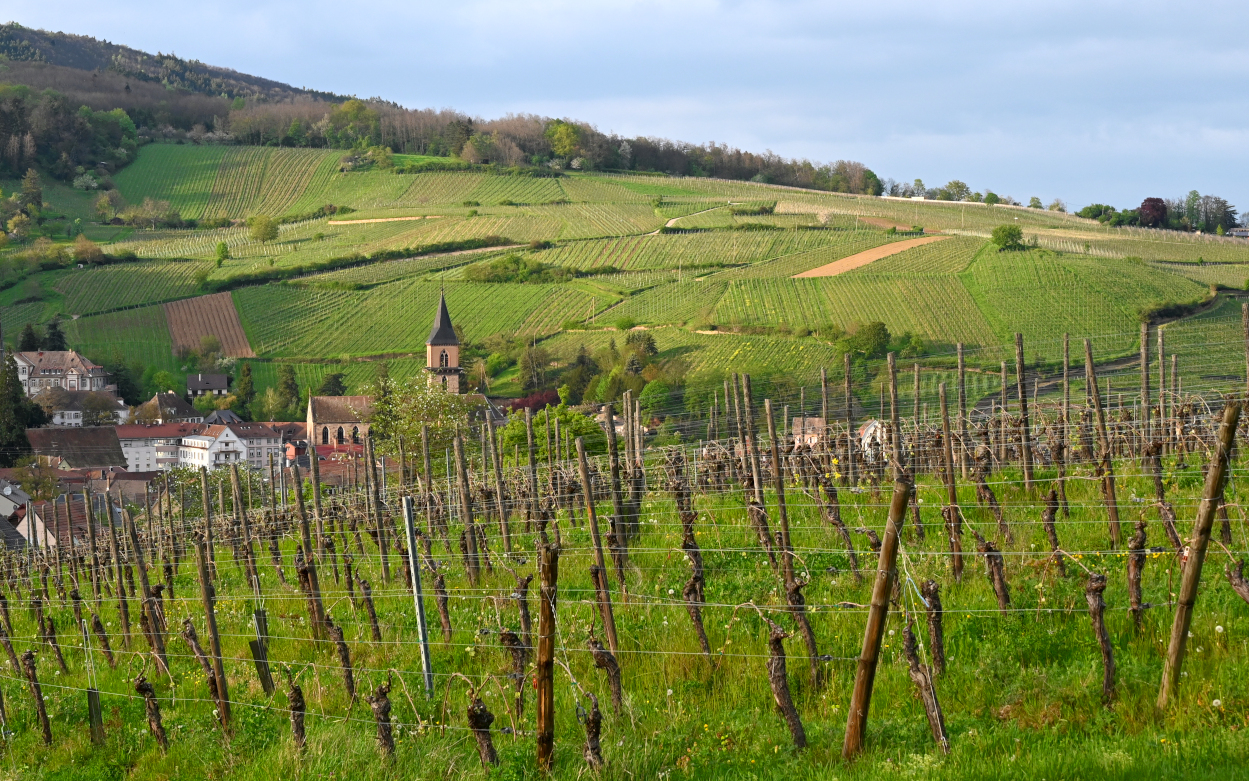
I’m relatively new to the world of cycle-touring, as my gear setup shows. My current ride is a 2006 Gary Fisher mountain bike that was bought new and has since been stolen from me twice, although somehow it always finds its way back to me. It’s seen better days. Its frame was bent by one of the would-be thieves and its paint has been chipped by my rough handling, although that last bit might not be a bad thing since its original white-and-blue paint job is reminiscent of an early-aughts tribal tattoo. Despite its quirks, I couldn’t bear to leave it behind when I moved to Germany for my PhD. It cost more money than the bike is worth to stick it in the plane’s cargo hold, and since then I’d spent the same amount over again, buying all sorts of specialty bike mechanic tools and touring gear and replacement parts, which I self-installed after taking some night courses at YouTube University (and had double-checked by a local bike shop, I’m not insane). It was all a worthy investment since my trusty steed now functions as my car, bringing me to work and vacation and the grocery store and friends’ houses. A few years ago I even used it to move apartments by lashing my rolling suitcase to its new luggage rack and wheeling it back and forth through the city. Clearly, I’m a bit attached.
Like an old childhood friend, its presence by my side had rekindled my childhood love of bike-roaming. My younger brother and I used to bike for hours as kids, building dirt jumps in the woods and pulling each other down the street on roller blades and coasting home only when darkness fell. Since its European immigration, my steed has carried me through Dutch tulip fields, along the vineyards-and-castles UNESCO section of the Rhine River Valley, and down all 185 kilometers of central Germany’s Lahn River, from its humble spring-fed beginning to its spectacular end where it joins the Rhine. Yet I had never biked in France before, even though my current city of Freiburg is only 20 kilometers from the border and you can see France’s Vosges mountains from Old Town. The Vosges are a low-slung mountain range mirroring the hills of the Black Forest, and between them lies a flat tectonic rift. Together these geologic contours create a parenthesis that hugs the upper Rhine River and funnels warm, dry Mediterranean air towards the North. It makes Freiburg one of the sunniest cities in Germany (author’s note: a relative term) and means we can grow cool stuff, like apricots and figs and entire hillsides full of wine grapes.
Technically I could have biked to all the way from my home to the French border, but the route partially follows my familiar work commute, so I took a regional train shortcut for about 5 € and brought my loaded bike along for free 2. The German rail tracks abruptly end at the border town of Breisach, and from there I biked across the mighty Rhine. I chose a slightly longer scenic path by hopping on the EuroVelo 15, one of Europe’s super-cool, international, long-distance, bicycle-only “highways.” I flew along the pancake-flat greenway that followed a few eerily straight canals, first North then West towards Colmar, one of the region’s main cities. I was happy as a pig in mud to be immersed in the sunny late-spring forest, very very far from any cars or towns. My only traveling companions were bikers and dog-walkers and a few pleasure-boaters who had to stop every few kilometers to navigate self-operated locks, the captains tugging on rope handles overhanging the river to open the sluice gates.

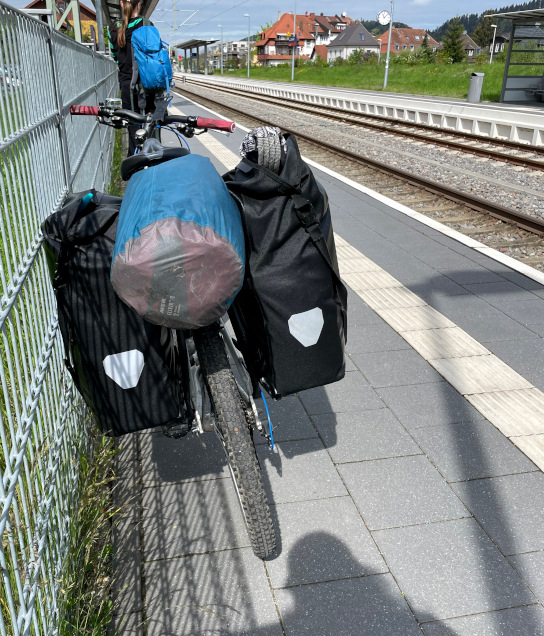
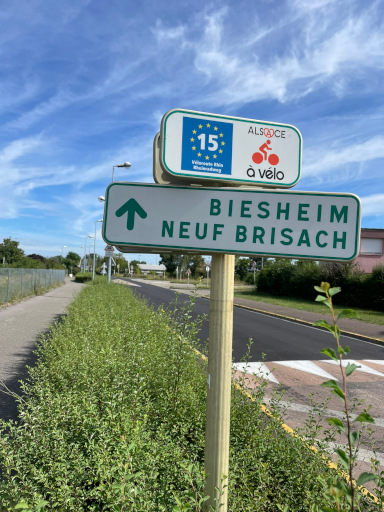


Top: EuroVelo 15 follows this neat canal / My loaded hog / bike navigation signs
Bottom: one of the streetside bike route navigation signs / me and my hog on the middle Rhine River of central Germany
Colmar is a delightful village but my focus was elsewhere that weekend, so I skirted its cute historic district and tried to head straight for the vineyards. I say “tried” because I absolutely bungled the route. I maintain that it wasn’t (only) my fault, and that the French could learn a thing or two from the Dutch about how to label bike routes. My annoyance evaporated when I finally escaped town and was engulfed by rolling vineyards, which flowed down from the foothills, into the valleys, and all the way across the ancient valley to my tires. Spring had fully sprung everywhere but the vines, which were touched with only the faintest blush of green. Each crimped leaflet was no bigger than the tip of my thumb. The year’s flowers and fruits and vintage would follow in good time, but on that day only their promise hung on the vines and in the rapidly warming air. I joined a small herd of joy-riding cyclists and let them lead me deeper into the hills of Alsace.
My campground was perched at the foot of a village called Riquewihr, and I had just enough time to throw my tent up before I scurried into town to catch the last rays of sun slanting down its enchanted alleyways. Through the pastel sky overhead flew gigantic black-and-white storks, creatures so regionally revered that the locals have adopted them as Alsace’s symbol and built dedicated nesting platforms on the rooftops of city halls and cathedrals. Wooden versions of the great birds even decorated the shopfronts, and I couldn’t tell whether they were permanent fixtures or temporary decorations left up since Easter. A curious blend of French and German cultures converge in Alsace, where older locals speak a distinct Germanic dialect and the drunken half-timbered houses are often painted with far more brilliant colors than most Germans would be comfortable with. As golden hour faded into blue I walked from one edge of the hamlet to the other, through drunken alleys and along the still-formidable remains of the city wall. By the time night had fully fallen, I knew I had stumbled upon a spellbound place.


Baby leaves on the vines; a lovely statue next to Riquewihr’s old city wall
Like any archipelago, the Alsatian villages share a common culture and vibe, but each also has its own particular flavor. My meandering weekend route encompassed the section from Ribeauville to Eguisheim and everything in between, which is just a tiny section of Alsace, but it was more than enough to fill three days.
A brief taste of my 3 favorite villages
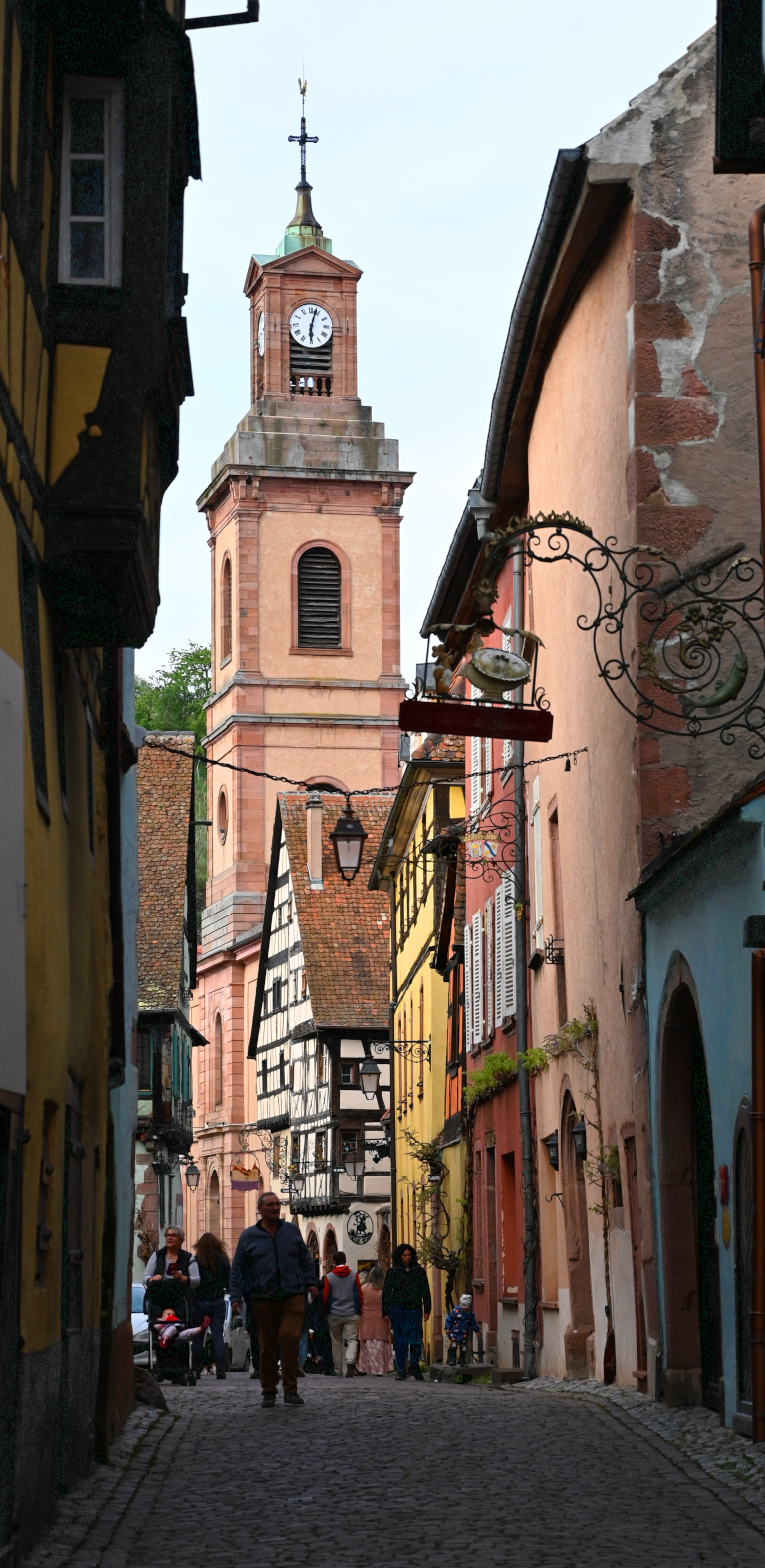
Riquewihr flows downhill like taffy, its half-timbered houses painted in cheerful primary colors. The colors have also seeped into the town’s favorite cookie, the coconut macaroon (not to be confused with the sandwich-like macaron), which seemed to be the main attraction at every third shopfront. Its bustling pedestrian-only main street, Rue du Général de Gaulle, packs a visual punch, yet my favorite street was the perpendicular Rue des Trois Églises, which translates to “street of the three churches.” Two of Riquewihr’s unique steeples were visible from any point along the quiet road, despite all the wonky buildings trying to shoulder their way into view. It’s a tiny town, but I wandered through its alley-maze for many hours on different days, discovering old wells that have since been converted into pocket gardens, deep fountains inhabited by fish, and art woven into everything. Wisteria and lilacs in full bloom crept across ancient facades and uneven archways. Of all the villages, I spent the most time in Riquewihr, partly because of my tent’s proximity, but also because it was my very first Alsatian village, and I’d been smitten from the second I stepped foot onto its cobbled streets.




Kaysersberg was crowned “France’s favorite village” in 2017, and it’s a title well-deserved. It sits in a high narrow valley bisected by a babbling river, and the town has grown up in the thin margin between forested hills and river’s edge. Kaysersberg is the local spelling of a German term meaning “Emperor’s Mountain,” and the serpentine town is closely watched by the formidable ruin of a castle perched just overhead that does have the vibe of an emperor. It was a happy accident that I ended up in Kaysersberg at all. I’d awoken on my first morning too keyed up to sit still for breakfast, and had taken off from my campsite without any caffeine or food on board. Half an hour of uphill climbing later, I was flying down a steep kilometer-long hill that started with a “! DESCENTE DANGEREUSE” sign (which didn’t need translation). During my gleeful descent I passed 20 fit red-faced cyclists going in the opposite direction, and I tried really hard not to gloat at them through the windy tears in my eyes. At the bottom of the hill I came to a T junction and, like a child, I hit the brakes hard enough to send a spray of gravel skittering into the intersection. As I stood there considering my route options, I could feel the adrenaline dump itself from my body and realized that my morning burst of energy was gone. I noticed Kaysersberg and its probable cafes were just a short detour away. I only made it only a few steps into town before I sank down onto a bench to fight off a crashing blood sugar, but I’d happened to sit next to a half-timber house decorated with so much love and care that I lost ten full minutes just staring at the handworked details. The deeper I moved into town, the more entranced I became, wandering over stone bridges and back again, finding tiny shops tucked into even tinier alleys that were occasionally guarded by dozing cats. The dark forest and clear river kept suddenly appearing when I least expected it, peeking at me from the end of a street or through a hole in a wall, and then vanished just as quickly, like playful sprites watching over me as I explored the town.


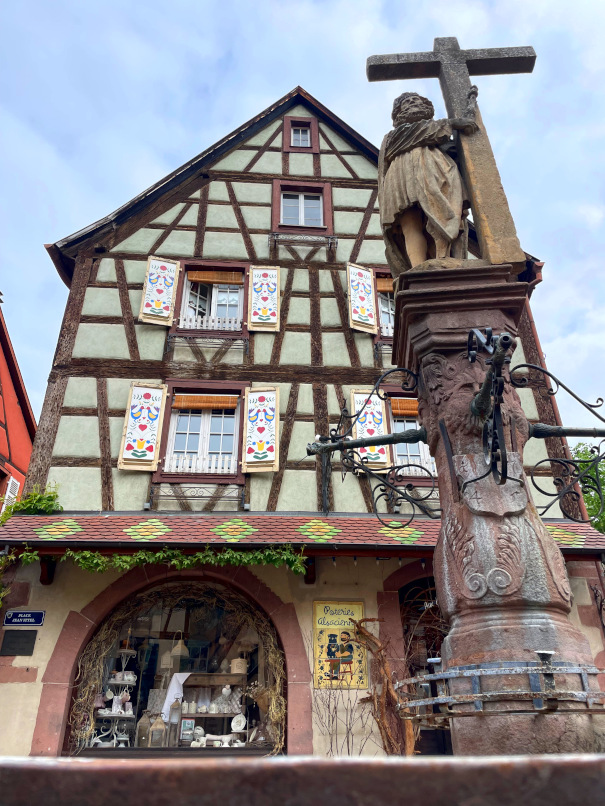
Eguisheim is a tiny circular walled village, but the truly crazy part is that it has three concentric circular walls that are nested within each other like a target, with a church and plaza occupying the bullseye. The result is double-walled streets with an endless curve that you can never fully see around. Your view is truncated to a hundred meters at most both ahead and behind, and walking through its streets is to travel through a slow-moving ticker tape of pastel homes and shops and pocket parks appearing from behind the bend. It becomes wildly dream-like the further you walk, on the street that never ends until you’re suddenly back where you started. Even after you’re standing still, your eyes and feet still want to pull you towards one side. Eguisheim was actually the reason I’d been drawn to the Alsatian villages in the first place, and I noticed that this beautiful village is starting to fall victim to its own popularity, after it too won the “France’s favorite village” award in 2013 and became a social media star. An early-morning or late-evening visit might have given me peaceful streets, but my mid-afternoon visit was clogged with tourists who seemed to have forgotten that Eguisheim is an inhabited village. Yet its charm still shines too brightly to be fully overshadowed by the onslaught, and in the near future, I may camp at its feet instead of at Riquewihr’s just so I can witness the charismatic village at its most serene.


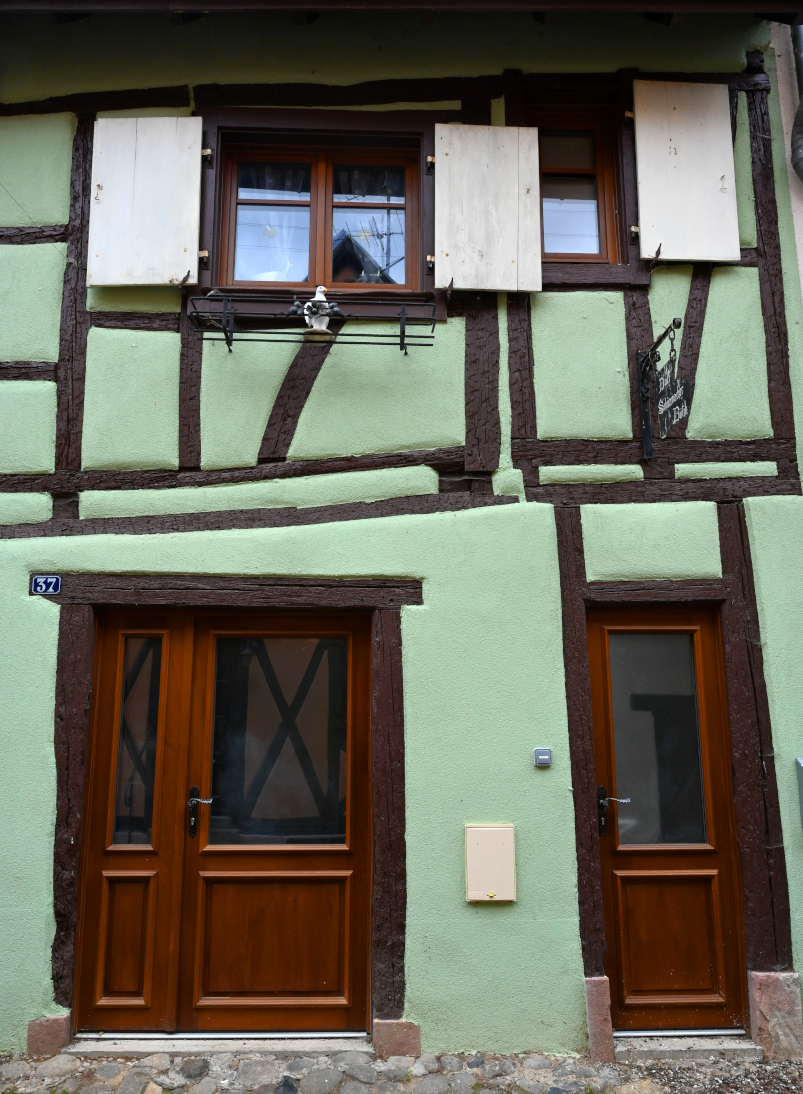
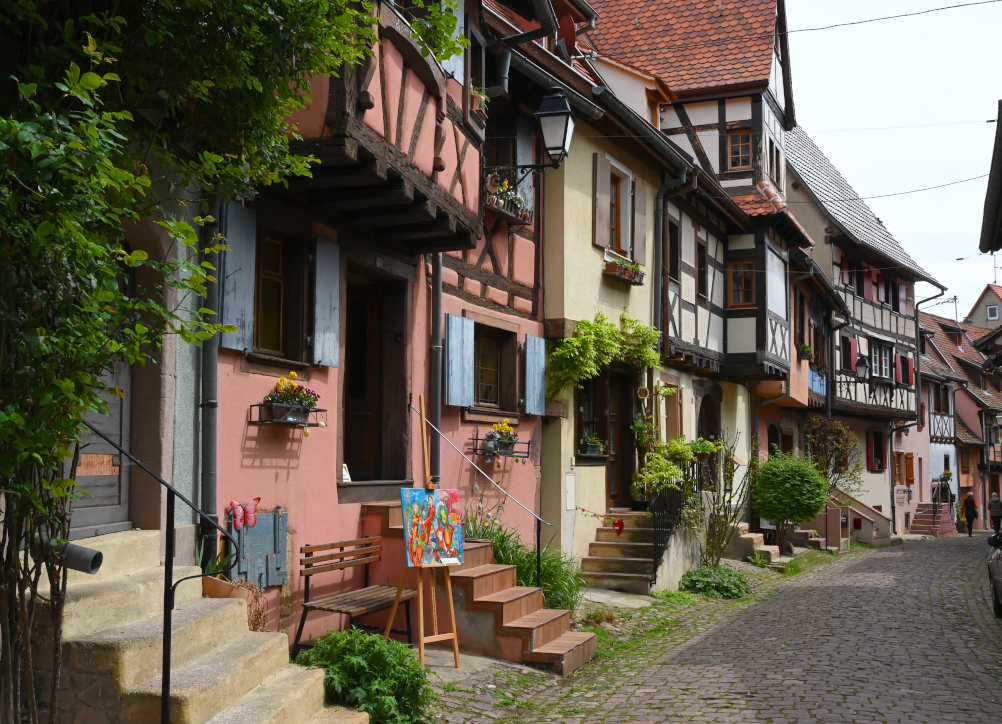


By the time I left Alsace 3 days later, this time taking a more direct but less interesting route through the regular agricultural fields of the Rhine Rift Valley, I already knew I’d have to return someday. I think it’s easy to see why. No matter how you choose to experience the Alsace region, whether you’re a bike-tourer like me or a chateau-hotelling wine-lover or someone in between, I highly recommend you put this place on your list.
The How-To
Bike routes or otherwise getting around
The Alsace region has over 2500 kilometers of cycle paths. This includes sections of 3 EuroVelo routes (transcontinental routes) that pass through this region (Eurovelo 5, 6, and 15), in case you’re interested in a longer journey. The smaller Alsace Wine Route is around 130 kilometers and is part of EuroVelo 5. I biked the section between Ribeauville and Eguisheim. I particularly liked the BL522 sub-route, which wiggles up and down through the vineyards and past a bunch of villages, and I highly recommend the detour to Kaysersberg if you have some juice left. This path can be pretty hilly, but there are other paths through vineyards in the flat valley floor, so you can stick to the flatter sections if you prefer (or spring for an e-bike rental). There are quite a few bike rentals and outfitters around if you don’t have your own bike, and hotels sometimes rent them out too.
If you’re not a biker and don’t have a car, there are also direct (but infrequent) bus routes from the Colmar train station to most of the villages. Check here for route and timetable information.
Bike-train logistics in Germany
Normal road bikes can usually be brought aboard for free with a regular ticket on all regional trains in Germany, meaning every train besides ICE / IC / EC trains (these will say “Bicycle reservations required” online). This also works with all trains serviced by the current 49-Euro Deutschland Ticket offer, which covers all regional trains (and local public transport) in Germany and is valid for 1 month. Technically your bike can be refused if the train is too full, but anecdotally I’ve been on plenty of standing-room-only trains with my bike and never had a problem. I have not tried to take my bike on French trains, so I am not sure about their rules.
A few specific recommendations
Camping: I stayed at Camping de Riquewihr in one of their tent sites and enjoyed it. They have all the amenities of a modern European campground – fancy indoor toilets and showers, washing machines, WiFi, freshly-baked bread deliveries in the mornings – and my tent site faced a forest, with hedges on both sides. There was even a stork pair nesting inside the campground on a special platform while I was there in May 2023! It’s about a 20-minute walk / 5-minute ride from the town of Riquewihr.
Two easy food suggestions: If you like vegan/vegetarian “fast food,” Tasty Veggies is a great burger-and-fries option in Eguisheim. It’s little more than a shopfront so there’s no seating inside, but there’s a pocket park with benches directly adjacent, and the food (and the owner) is great. For macaroons in Riquewihr, Au Petit Délice always had a line. You specify the weight, and can either choose the flavors you want or ask for a random assortment. Traditional macaroons are made without gluten-containing flours, so with my mild sensitivity it was fine, but the shop also sells other regular baked goods so I would steer clear if you can’t do cross-contamination.
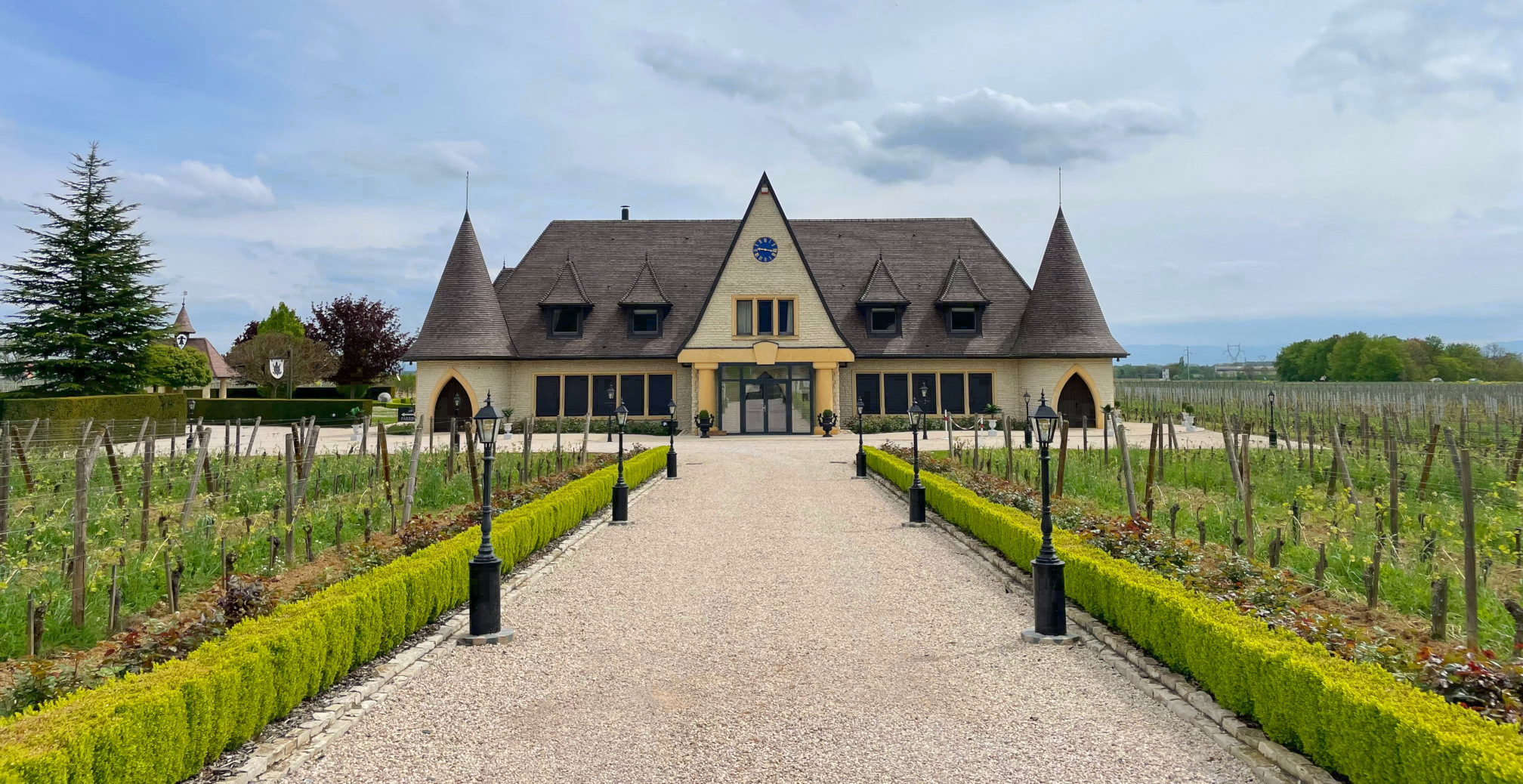
- Alsatian wine is excellent and alcohol is no stranger to me (wine doubly so, ever since my body revolted against gluten-heavy beer), but drinking is one of the few things I won’t do while traveling alone. The lowered inhibitions and awareness is just not something I want to deal with when I’m traveling alone, to say nothing of biking and camping alone! ↩︎
- Normal road bikes can usually be brought aboard for free (with a regular ticket) on all regional trains in Germany, meaning every train besides ICE / IC / EC trains (these will say “Bicycle reservations required” online). ↩︎
 Window Seat Odyssey
Highly useful write-up, Jill! As always, I don’t know how on earth you manage to live internationally and live through multiple changing cultures and regions and keep alert and healthy. You are an inspiration! Love you always 🙂
LikeLike
Okay, now I want to spend a week biking in Alsace too
LikeLike