Waiting in line to board the plane from Basel to Funchal, I suddenly found myself engulfed in a sea of Germans in peak physical condition. Their feet were clad in hiking boots and their were bodies covered in Jack Wolfskin adventure gear (which is Germany’s answer to Columbia or Carhartt). While “Wolfskin Germans” are something of a joke to non-Germans, they’re usually über friendly and outdoorsy people who I always run across on the Black Forest hiking trails. I was thrilled by their presence here: if Madeira was a serious draw for Wolfskin Germans, it was bound to be an excellent place for me, too.
One of the most (quasi) famous attractions on the island is the network of levadas, which is Portuguese for “tiny canal.” Dug and cemented by hand almost a century ago by industrious farmers, levadas are aqueduct-like structures that bring water from the sodden northern coast (whose mountains catch all the rain) to the crops grown on the south (where abundant sunshine nourishes but dries the terraced farmlands). Although levadas cling high to the hillsides, their accompanying trails are wonderfully flat and make for easy walking.
Day 1: Risky Business atop Boca do Risco
It seems the people who made this trail were so proud of their island that they couldn’t make up their minds about which part they wanted to show off the most. At the beginning, the landscape is all deeply-chiseled forested valleys, and every time I glance backwards I can see the pastel corners of Machico peeking out from behind folds in the terrain. Shirtless farmers (in January!) tear apart the rich volcanic earth on the stepped terraces of their isolated farms, each one reminding me absurdly of a tiered chocolate wedding cake that’s been partly frosted in brilliant green. But it’s not all work up here: as I walked past, I spotted one younger man who put down his ancient shovel to sneak a look at his smartphone.
Soon we’re swallowed entirely by the native laurisilva forest, whose winter foliage blurs the view into the valley below and traps me in a pocket of warm humid air. I stumble across more than a few grazing goats, although they’re tied up to stop them from devouring the delicate plants in this UNESCO-listed ecosystem. Eventually I round a fold in the landscape and get slapped rudely in the face by a brisk cool breeze. Bracing myself against the unexpected onslaught, I head for the final peak before me, and with every step the angle of my perspective widens until I can see what feels like the entire North Atlantic spread out below me (although I can’t quiiite see Iceland from here). I edge closer to the 1000-foot drop until it feels like the edge of the earth kisses my boots; absurdly, I want to press my face directly into this azure panorama to make sure it’s real.


The second half of the Boca do Risco trail (which means “dangerous pass” in Portuguese – sorry mom) has literally been carved into the cliff face. The ocean lies 1150 feet below us, but in places the cliffs still soar 500 feet above me. In sharp contrast to the urban sprawl of the southern shore, there are absolutely no signs of human life on this abandoned shore besides the trail beneath my feet and the other hikers (and a few batshit-crazy trailrunners). Or at least that’s what I think, until I look down. Far below, the ocean crashes against jagged cliffs – regular plumes of seaspray explode into the air, brilliant white against the sable-and-ochre rock even from this distance. But it’s a peculiar-looking patch of cliffside, perfectly angular against the chaos of the surrounding forest, that catches my attention. I have to dig out my telephoto lens to confirm what my eyes have tried to convince my brain: waaay down there is a tiny terraced farm, just one landslide away from being swallowed by the sea.
Madeirans, it seems, don’t understand the word “impossible.”


Wind is my constant companion up here on the edge of the world. Occasionally there are enough tree leaves around to grab and strangle it, but usually it screams in at full power from the north. It builds for hundreds of miles across the Atlantic until it abruptly collides with these cliffs, where the sudden change in flow creates eddies, making the wind swirl in a confused tornado around me: first from above, then from the side, and then suddenly I can’t see anything because my hair has been whipped into my face. Just my luck that today is the one day I forget a hair tie, and it’s not long before I’m carrying an unruly rat’s nest on top of my head.
The trail ends in the seaside town of Santa Cruz, where a wide valley funnels down to a tight harbor filled with sea foam and furious waves. Undeterred surfers in full-body wetsuits roam the blackrock beach, looking jubilant in an utterly exhausted way, a feeling that deeply resonates with me after my exhilarating three-hour hike. Although my legs itch to keep moving (and I wonder if it’s possible to hike back to Funchal), the late hour of the day forces me to retreat. But I know I’m in trouble: even before I’ve left my first trail, I know I’m hopelessly in love with this island.


Urban Exploring on the way to Levada dos Tornos
Nearly every single house I passed in the Funchal highlands had a dog standing sentinel, each one a motion-activated alarm that sprang to life barking as soon as it heard me coming. I was the conductor of the dog choir, leading their song up the hillside. Wild packs of dogs roam the island, barking at the wind or sniffing for scraps or sunning themselves in the middle of the roads (once, I stumbled upon a pack of three dogs sleeping on a mountain road, who move only after an incoming bus driver comes to a complete stop). Way up in the hills I also encountered small packs of free-roaming local humans (more often than not, older men), gathered on the sidewalk outside of hole-in-the-wall local bakeries and pubs. They looked at me with bemused surprise, greeting me as I tried to pretend I belonged there. I didn’t pass a single other foreigner, even though I was just a kilometer from old town.


I was headed for a levada trail, which both Google maps and a borrowed German guidebook insisted were in this general direction. But somehow everything is either labeled wrong or completely nonexistent; even though the blinking blue dot insisted I was right on top of the trailhead, I was actually just standing perplexed on a featureless mountain bend.
Am I lost? I asked myself.
Naaah, I know where I am, another (cockier) voice answered, or maybe it’s the same voice, because who can keep track? It’s just not exactly where I expected to be.
I knew I can’t be that far off track; against all odds, just a few hundred meters to my left there was a professional soccer stadium. (Imagine my surprise, after walking through a maze of unlabeled mountain streets and staircases, to stumble upon a brand-new sports facility, chok full of tailgating Madeirans watching their team practice on a Sunday morning!) It only took a few more false starts before I finally saw the levada glittering on the hillside…50 feet below me, right next to an impregnable stone wall of a clifftop luxury hotel. Foiled again! On an instinctual whim I take an unmarked staircase, which dumped me on an old overgrown footpath pointing in vaguely the right direction – I hoped. At long last, I slapped my right foot against the concrete of the mossy levada trail, where I let out a triumphant “Ha!” I didn’t care that there wasn’t a soul around to witness my pride.

Finally sure that I wasn’t lost and was where I intended to be, I put away my useless guides and finally got to enjoy my first real levada walk. There were sections where the path was as wide as I am tall, and others where I could barely put both feet side by side. Sometimes I was above the water level, others the canal wall was level with my knee. Vertigo turned my mind into a tornado a few times as the path plummeted into dizzying valleys just a few feet to my left. The deep eroded scars cut into the Earth are carpeted in silvery steel blue of eucalyptus or the mossy green of the older forests. The forest smelled like I’d just slipped into a bath filled with eucalyptus oil, a warm spice that pulled me back to my days spent in the wilds of Australia.


Everything went just ducky until the last section, where a chest-high barrier plastered with construction symbols said the path was closed past that point. The kicker was, the barrier had been almost completely destroyed from so many people ignoring its warnings and carrying on anyways. I’d been playing hiking-tag with a trio of older English folks for a while, each of us passing the other as we took water breaks (them) or stopped to take photos (me). They led the way through the barrier, and besides a few extra rocks on the path and a small cave-in from erosion, there was absolutely nothing wrong with the trail.
That was, until I reached the end of the trail, where an entirely different problem presents itself: here, at last, was a proper barrier. A three-meter-tall locked chain link gate…wrapped in barbed wire…to its the right was a 5-meter stone wall, and to the left a 2-meter drop off.
Time to use my #1 traveling superpower: panicked problem solving!
Option A: I admit defeat, turn tail, and walk 2 km back to the place where the knocked-down barrier is, and then walk back down to Funchal.
Option B: I stubbornly monkey-climb my way around the fence, hoping I don’t fall and also hoping no one working at the cable car station 100 feet away comes to yell at me.
Guess which one I picked.
Quickly and carefully, I maneuvered my way around, trying not to look down. A couple of bemused tourists waiting for the cable car watched my struggles, and I diligently avoided eye contact, hastily vacating the scene of the crime as soon as I made it around the fence. I didn’t stick around to see what happened to my English companions, and sometimes I still wonder what happened to them. I also didn’t stick around to take a picture of the fence, so you’re just going to have to believe my description of how large and scary it was.
One thing is for sure: maybe don’t ignore the trail warnings in this steep and rocky habitat where landslides are a real threat. The nearby Levada da Serra do Faial, which starts in the nearby Camacha, might be a better alternative until they fix this path!
Ribeiro Frio (PR10)
Tiny waterfalls begin to appeared soon after I started this hike, threading their way through the mossy forest above me to drizzle into the levada. They seemed to grow in size with every step I took. Soon I was screwing up my eyes and half-running through the spray that crashed against my head. The cliffs started to grow, too, until they overhung the trail, and I looked out at the forested valleys through a frosted silkscreen of a rushing water. Then the waterfalls completely overwhelmed the levada, forcing me off the path to find my own trail across the boulder-strewn river just below the trail. Although the winter rains were at bay that day, water is still the reigning king in this part of the world.
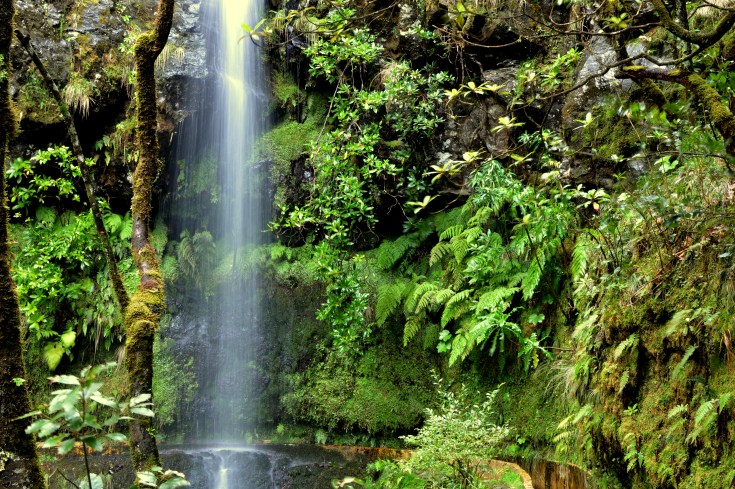
This trail felt more dangerous than the seaside Boca do Risco, but I think it’s mostly because my eyes refused to stay focused on my feet. It’s one thing to be distracted by the scenery when I’m on a flat forest trail, where the biggest dangers are the stray root or rock that catches your toe. But while this levada was technically flat, the trail itself was complicated. When I wasn’t scrambling over rocks or ducking downed trees, the path narrowed until it was no wider than my hips. Sometimes the only thing that kept me from tumbling past the edge of the trail and down into the trees a hundred feet below was the combination of a thin cable railing (which looked nowhere near strong enough to actually catch me) and my wits (which, let’s be honest, could be sharper). I can’t fathom how much courage it must have taken the original levada builders to scramble up here and wrest this trail from the rock.


I knew I should’ve paid attention to all this danger, but I couldn’t, not when I was surrounded by a lush forest filled with so many foreign species that I swore I was in a rainforest. Not when silver-and-saffron chaffinches kept hopping from branch to branch overhead, peeping quietly as they beseeched me for a bite of my lunch. Not when the valley floor down there, 800 feet below my boots, was filled to the brim with spotlights of sunshine highlighting the red earth. My constant iteration of “Holy crap why is it so pretty” must have eventually become grating to my two unwitting hostel companions.


Violent geologic forces made this island, and now just as surely they’re tearing it apart again. Every so often there’s a boulder the size of a golden retriever that’s fallen from the hillside to block the narrow canal, damming the water and sending it pouring over the entire path. Normally when this happens I called upon my early days as a gymnast, and hopped up on the three-inch-wide canal wall to walk along it. Only once did the water get so deep that I admitted defeat, peeling off my boots to wade into the frigid ankle-deep water.


Just when I thought the experience couldn’t get any better, the narrow valley opened up like a stage curtain, swishing back with a flourish to show off the sunlit Santa Cruz and the ocean just beyond. The cliffs became sheer and we had to duck through a string of rugged tunnels. Eventually the levada twisted and disappeared into an enormous dark cleft in the bluff, and I had no choice but to follow, and then to breathe a sigh of relief when I was dumped back into the open forest on the other side.


The one that got away
Somewhat prophetically, the one hike I earnestly wanted to do during my five days on Madeira just didn’t happen. It’s a famous windswept trail that stretches between the island’s loftiest peaks all the way to Pico Ruivo (1860m/6100ft). I had high hopes that the mountaintop weather would be good when I awoke the first morning and saw abundant sunshine, but as our tour van wheezed its way up the dodgy winding roads, the cliffsides quickly became wreathed in low-slung clouds. We finally found ourselves at the top of the world in weather so bad our tour guide wouldn’t even let us out of the van: howling wind, five foot visibility, and snow in the forecast! The seaside was spring in Florida, while the peaks were winter in Michigan. We diverted our plans to the Boca do Risco hike (the first section of this post), and as we drove back down to warmer climes, I vowed to spend the next four days eyeing the weather, waiting for a break in the clouds.
But the wintery conditions never broke, and I never did make it up to the peaks. If you’re planning a winter Madeira vacation, keep your options open; you never know what the weather will let you do.
 Window Seat Odyssey
i am portuguese and i´ve been in Madeira only one time, a long long time ago… after seeing your photos, i think i should return and discover this little paradise 🙂 thanks for sharing! cheers from Lisbon, PedroL
LikeLike