(Just want logistic information? Click me)
My feet were lost in the late-summer alpine meadow. Thousands of blooming wildflowers were being tended by a herd of that particular valley’s species of butterfly, all zooming around doing important butterfly things. My ears filled with the whistles of unseen marmots and the cathedral-like sound of livestock bells that echoed off the distant peaks. White-capped mountains encircled me and blocked out more than half the sky; even though I stood 2,000 meters above sea level, the peaks dwarfed me by that height again. I had on fairly good authority that I was the only human for miles around, because I could see for miles around, far out into a vast wilderness where people are mostly transient visitors. A deep inhalation spurred by exertion brought crisp alpine air into my lungs, and I used it as fuel to continue on up the Via Alpina, a 2,000-kilometer-long hiking trail that curls from one end of the Alps to the other. The spent air left my chest with a startled “ha!” of laughter when a marmot appeared and then waddled off into the nearest rock pile. All of my senses were filled with the mountains’ reality, and I still found myself wondering: are the Swiss Alps even real, or am I dreaming, or am I dead and I’ve somehow weaseled my way into heaven?
I was on my first-ever hut-to-hut hike through the European Alps, and of course I was doing it solo. Since I’m a cautious flatlander, I’d decided to ease into trail life and plotted out a two-night, 20-kilometer loop out and back from the cute car-free village of Mürren. I was so excited and nervous about the adventure that I bolted down my breakfast and was on the trail by 9 a.m. the first morning, where my senses and limbs and lungs shifted into overdrive to take all of it in: rocky switchbacks, heartstopping drop-offs, chubby goats lying in sun-drenched meadows and snacking. I felt inspired by them and sat down in the grass too, gnawing on a granola bar. It was made extra delicious by the alpine air, and more importantly it removed 200 grams of weight from my backpack.
At the end of a high-alpine valley, half-buried into the leeward side of a small hill, stood my first night’s hut, Rotstockhütte. Imagine: you’ve just hiked up a mountain over the past three hours, and now you’re being greeted by a trio of young gingham-clad women who offer to bring you a cold glass of beer or wine or apfelschorle (sparkling apple juice) that’s been poured straight from a tap. These hut wardens, who double as cowherds for the small family-owned dairy farm in the barn next door, have also somehow found the time to prepare fresh soup, sausages, and even cakes for lunch in a gleaming kitchen that wouldn’t look out of place in a cozy city restaurant. (The secret to this oasis, which can’t be reached by car, is a private cable system that’s used to haul goods up from the valley floor; the more remote huts rely on helicopter deliveries).

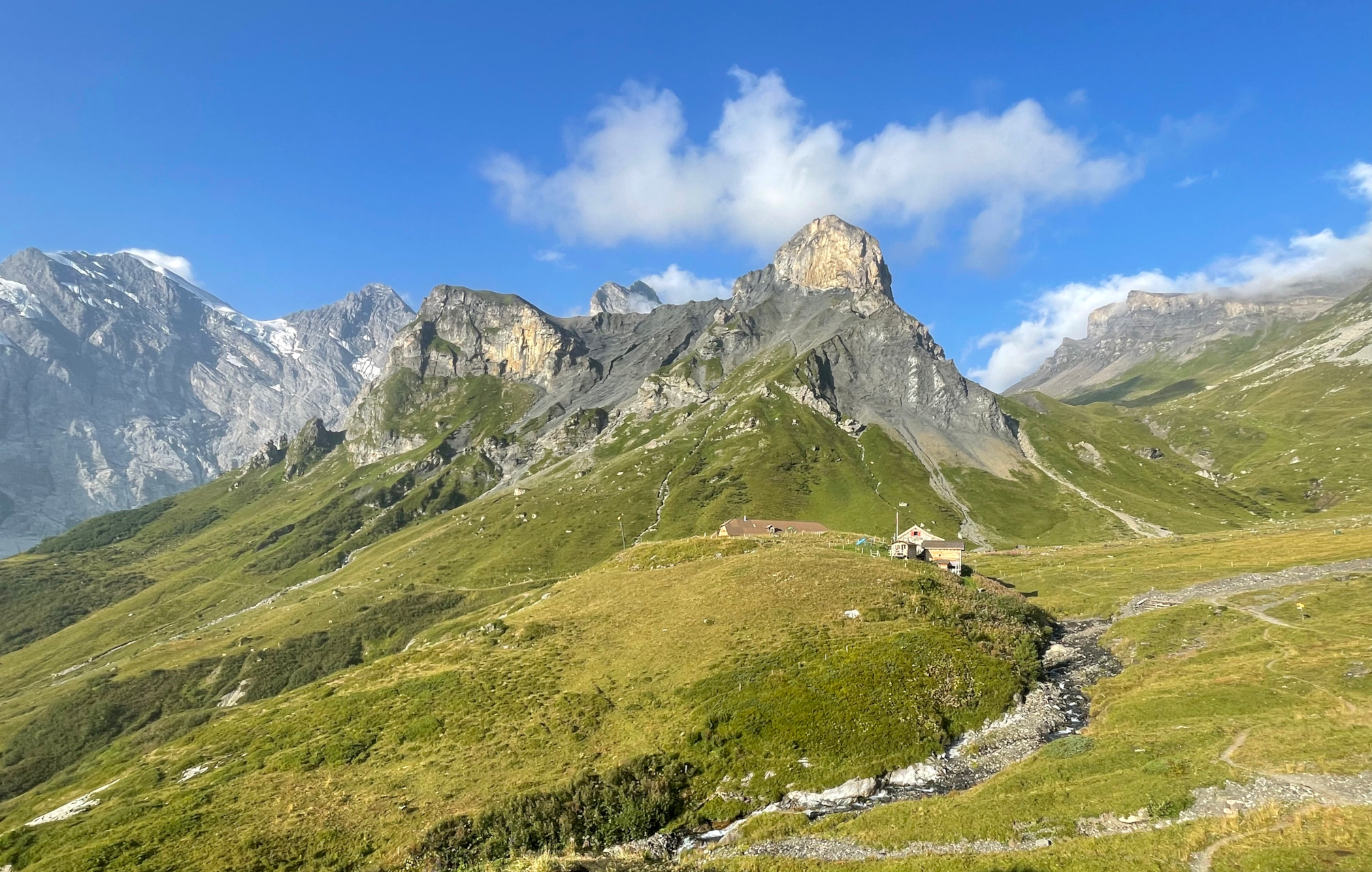

When you’re on an overnight hiking trip by yourself, your main source of entertainment is…well…hiking. I’d been so anxious to safely complete the first day’s hike that I’d rushed through all 6 kilometers and arrived at Rotstockhütte by noon, leaving me with an entirely free afternoon. The Swiss Alps have 5G but very few power outlets, so instead I slipped easily back into the simpler hobbies of my childhood. Alpine meadows in full bloom are one of my favorite landscapes, and I crawled around on my hands and knees in the valley near the hut, looking at all the life. I stuck my feet into creeks so cold I somehow felt the shock all the way up into my teeth. I sat and wrote with emerald ink in a travel diary (the first line begins very on-brand: “The inaugural Swiss hut-to-hut hike. At my age? With these knees? Maybe it’ll be the last time, but at least there is a first.”). Mostly though, I tried to figure out the clouds. Where they came from. Where they went. Which colors, exactly, each one contained. One moment I could clearly see the three lofty peaks of the whimsically-named Jungfrau (virgin), Mönch (monk), and Eiger (ogre) mountains, and the next they were all three hidden behind blooming clouds of lavender and saffron and jade. Just as quick the vapor vanished again, leaving behind only the clean sharp sapphire of the high-altitude skies.
Except: the blue sky flashed white. Thunder followed, reverberating off the naked crags, waves of sound smashing back onto themselves like I was standing in a great and terrible ocean, until the sound was more like a rockslide than a thunderstorm. Everyone sitting at the Rotstockhütte picnic tables turned to look at the thunderheads that had boiled over the closest peaks, and yet we all silently agreed to remain outside. A curtain of rain pulled across the valley far below and erased the distant peaks, while our perch stayed dry as a bone. Minutes later, the peaks reappeared, covered in a latticework of waterfalls that were so swollen with whitewater I could see them from miles away with my naked eye – waterfalls that literally hadn’t existed a few minutes before, and that vanished completely as soon as the fresh rainwater was gone.

A bunch of outdoorsy and introvert-leaning people coming together for dinner is not unlike solitary grizzly bears gathering at an Alaskan salmon buffet. We accept the close company warily, and only because we know we’ll get the opportunity to inhale enough food to bulk up for hibernation. As a solo traveler I’d been assigned to sit at the odds-and-ends table, where I was wedged between an Irish couple and a Dutch couple with a Frenchman and an Aussie thrown in just for fun. Before we even started talking, I knew what we would talk about. There’s an immediacy to trail vacations, and today and tomorrow are usually the main dishes on the conversation menu. How did you get here today and what was that trail like? How far are you going tomorrow? Did you hear there might be storms later? (I’m no great connoisseur of small talk with strangers, but the “now” flavor is one of my favorites.) Our feast prize was hot and filling and salty: great big pots of soup followed by piles of salad and curry rice and bread, even with gluten-free and vegan versions for us special folks.
The twin forces of exhaustion and boredom work quickly to sync all hikers’ circadian clocks with the sun, and most headed for bed as soon as dinner was cleared from the tables. It was an odd position for me, a night owl, to be in. The sky still held color when I curled up in the too-hot loft, lying inside my thin sleeping bag liner but with the hut’s duvet kicked to one side, using it as a makeshift barrier between me and the stranger lying a few inches to my right. I rolled over and dozed. Others seemed more adept than me at fighting the odd bedtime, like the French teen sisters who giggled until actual nightfall. I rolled over again and screwed my eyes shut. The attic’s tiny windows were cracked in a futile attempt to let out the heat from the day and all 40 guests, but mostly they seemed to just let in the steady clang of bells as the cows mowed their way from one end of the valley to the other in search of a juicy midnight snack. I dug the wax earplugs deeper into my ears and rolled over, this time into a proper REM cycle. I can’t say I slept well that night, but I did sleep a lot.
Breakfast arrives with the sun at the mountain huts, and afterwards there’s little incentive to stick around, so everyone quickly scattered to the four corners of the Earth. In contrast to the well-trodden Via Alpina, my second day’s trail towards Schilthornhütte began as a meadow cowpath only about as wide my boots. Fortunately I knew it was the right path thanks to the cheery yellow Swiss navigation signs posted at every possible junction (take notes, Germany!!!). I also knew, just by looking at it, that I would not see another hiker for a very long time. Checking to make sure my location-sharing was on just in case I slid off the mountain, I wandered up into the blue. The way was immediately steep but mercifully dry – the previous afternoon’s thunderstorms had failed to turn the dirt path into a mudslide.

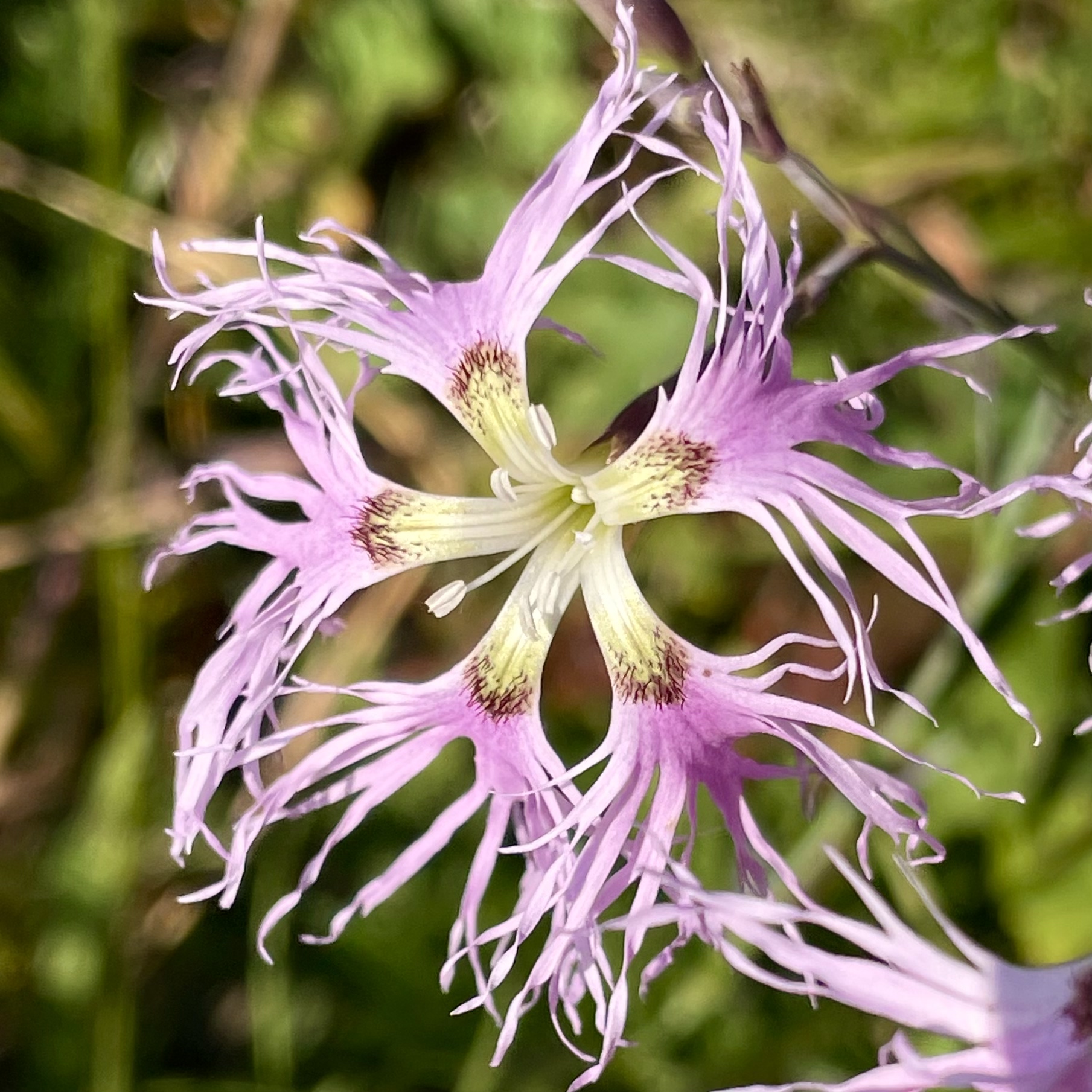
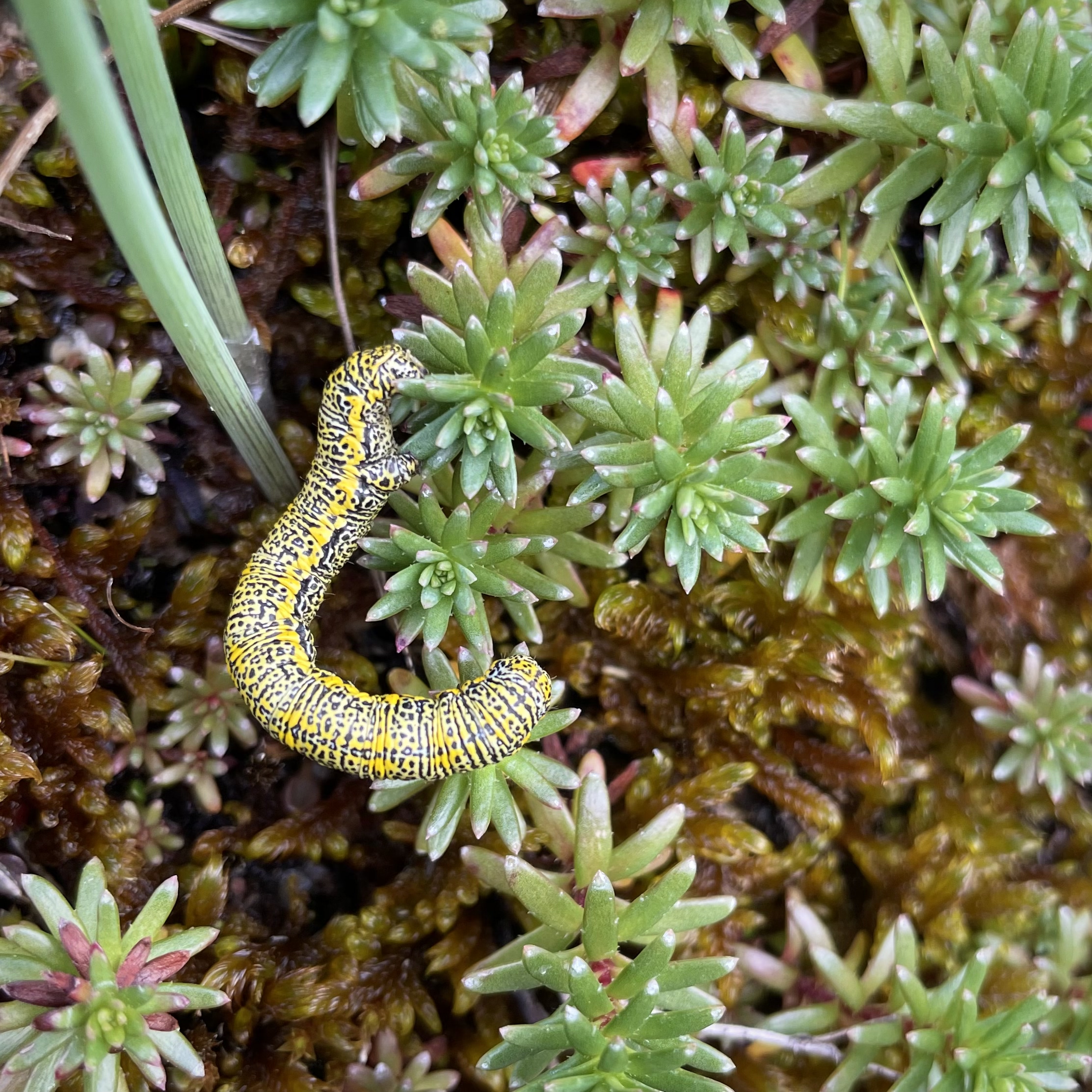

I’m very unpredictable, which really keeps the excitement alive in my relationship with me. On the journey up I made a habit of pausing at most of the red-and-white alpine trailblazes that marked the way, both to catch my breath and enjoy the view. Exactly how long I would pause at each one, though, was impossible for me guess. Sometimes it was just long enough to calm my ragged breathing; other times I would perch for a while and let both breath and pulse recover. In any case, I would surprise myself and end my break by suddenly flinging myself uphill without warning. In fact I surprised myself all the way up to the Wasenegg ridge. I emerged onto a grassy bald and hyperventilated a sigh of relief at the next visible section of trail: a gentle flat-ish path that traversed a valley rather than descending into it. This fold in the landscape, like all others before it, brought change: different wildflowers, new butterflies, unique obstacles. I had just scrambled through a dry boulder-strewn riverbed, one hand following the steel cable bolted into the rock, when I finally came across the first of just three hikers I saw that entire morning.


In addition to being unpredictable, I’m also pretty good at telling myself half-truths that I half-believe. When I’d left Rotstockhütte that morning, I told myself that my main goal for the day was to take a dip in Grauseeli, a tiny alpine lake near the highest point of my bare-minimum route towards the Schilthornhütte. I would just make it to the lake, take a soothing dip in the frigid waters, and then I’d “see how I felt” and decide whether I wanted to continue even more uphill to the locally highest summit of Schilthorn. Didn’t that sound nice? I half-believed this plan.
A long series of switchbacks leading up to the bowl that held Grauseeli had me drenched in sweat and daydreaming about the swim. I crested the bowl’s lip just as a paraglider hooted and threw himself off it, which was a sure sign I’d made it to an impressive elevation. My aching calves relished the first flat ground they’d felt in hours. At the same time, I was smacked by a properly chilly wind that was cooled both by the elevation and a tiny late-summer snowfield hunkering at the far end of the lake. Combined with a stubborn cloud that blocked out the sun, doubt crept into my mind about whether I really wanted to swim after all. But I’d been dreaming of this moment for nearly a week while suffering through central Europe’s latest brutal heat wave. Before I could lose either my remaining nerve or excess body heat, I had stripped to my skivvies and submerged myself neck-deep in the clear cold water, using the same deep-breathing techniques I’d learned a few months before while polar-plunging near the Arctic Circle. Once I was in, I languished and spun in lazy circles, letting the sun-dappled bowl of mountains fill my vision. Afterwards I lay on the shore to let the capricious sun dry me off, and finally checked the time: 10:28 a.m. Nuts. Schilthornhütte was a mere 45-minute downhill walk away. My only entertainment options for the rest of the day were watching clouds or hiking some more, and finally I saw through my own flimsy half-truth to what had been my real plan all along, because I know I’m always drawn to the high points. So I hung my wet skivvies and towel from my pack to dry, and headed for the peak of Schilthorn. More half-truths were told to me by myself as I climbed: Maybe I’d just go far enough up to catch a view. Maybe I’d make it all the way up, but then take the cable car down from the summit. The second half-truth I would actually believe until the second my boot hit the descending trail.
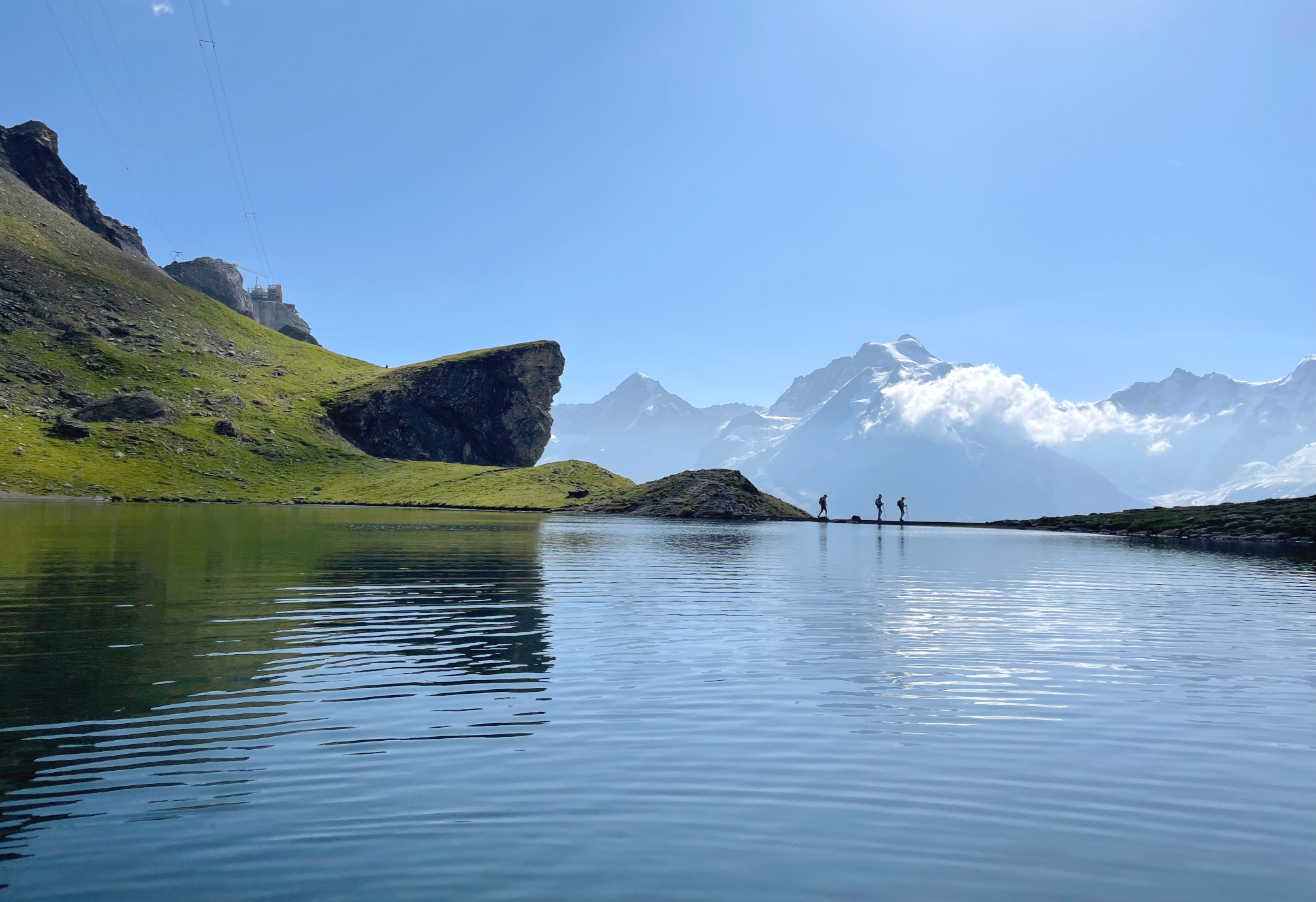
The mountain path was a different beast. Only the meanest of plants can survive at those elevations, and I followed a spine of bare grey rock, scrambling with my hands too. Wayward thoughts began floating through my mind, as they often do when I’m in a deep state of physical exhertion. Dirt is just dry mud, was an actual thought I had while contemplating why dirt is so much slipperier than loose gravel. Is that a chicken nugget? was another, while starting at a brown drumstick-shaped rock in the trail. I have the steady pace of a very confident and determined tortoise when I walk uphill was maybe the most coherent thought. Each footfall and pole plant was solid, and while I got nowhere fast, I did get there eventually. At one point, I stopped again “to admire the view” and heard a whistle not unlike a marmot. It took me a few breaths to notice the sound was actually coming from my own throat, a literal whistling wheeze that accompanied each inhale. You can take the flatlander out of the flatlands…
It was there, in the most unlikely of places, that I saw one of those temporary race-route signs that said ‘INFERNO HALF-MARATHON, 20 KM.’ I know a few people who do extreme races, but never had I been so rudely informed about the exact distance between their physical conditions and mine. To think people could race up this path that I was tortoise-walking and marmot-wheezing up! The next and final half-marathon sign carried a more cheerful message for both the future racers and me: “Just 500 more meters!” Cool, except the final 500 meters were by far the hairiest; an absolute obstacle course for the mind and body. It began with a 20-step “staircase” that had been carved into the vertical shale, where each knee-high step was highlighted with magenta spray paint and paired with a steel-cable handrail. Next came two parallel sheets of rock: a nice one to hold up my feet, and a rude one jutting towards my shoulders that tried to push me over into the valley that dropped away to my right. Then that shoulder-high rock disappeared and I entered a saddle, riding a one-meter-wide spine of rock with a drop to either side that I knew I couldn’t look at directly or I’d risk freezing in place. And then the final ascent, which was the steepest and slipperiest trail yet. Scrambling and sliding up the loose rock, I tried not to think about how exactly I was going to get down again. I kept glancing at the glittering cable car station perched at the summit, letting its promise of a real espresso lure me up through my fear and all the way to the finish line.
I mean that literally: at the summit, a huge inflatable finish line decorated with a devil’s head for the INFERNO race greeted me. I walked through it, victorious – the wheezing tortoise had arrived a full day before all the marathonning hares. But my journey to the espresso was not yet finished, I realized with a cold dread. The cable car station was under construction, and I would have to climb regular stairs, at least 30 of them, before I reached the cafe. I pulled myself together and then up, leaning heavily on the wooden handrails as the adrenaline faded and lactic acid flooded my system. My thighs literally began to shake and I had to stop halfway up. At last civilization appeared: an escalator! Hallelujah.

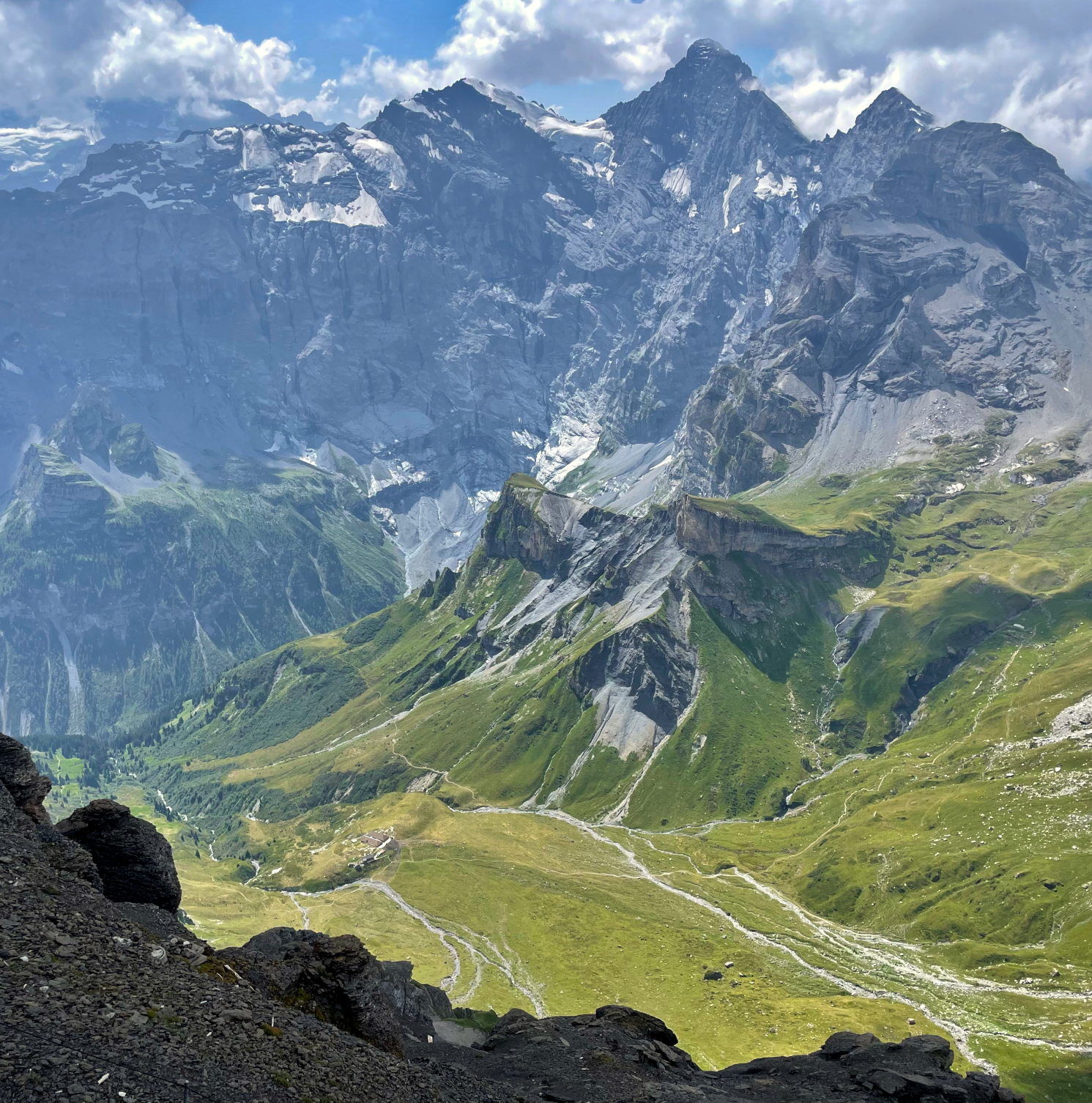
At the tippy-top, I mingled with the usual tourist crowd. Their only exertions to reach the summit had been to work enough hours to afford the Swiss cable car tickets (props), and then to shuffle between the gondolas. They all looked the part: clean, rested, and wearing city things like flipflops and sun dresses. And through it all strode me, a shaky mountain gremlin plastered in dirt and sweat, my backpack dripping with things that were drying after my swim: tea towel, bralet, and yes, underwear. Eventually I remembered they were there and at least put away the panties, lest the cable-car set be scarred by them.
Espresso finally in hand, I leaned over the railing in awe and tried to wrap my brain around what I was looking at. Things in the mountains look close, but it’s an illusion. From the summit of Schilthorn I could see individual umbrellas down at Rotstockhütte, making me think it wasn’t so far away. But the maps told me it was 800 meters straight down, and the hiking sign said it was just shy of 2 hours’ walk downhill, and the clock told me it had taken me 4 hours to hike up, albeit with a swim break and in a longer direction. My end destination of Schilthornhutte was also visible from the summit, and at least I could tell it was a gentle downhill walk for most of the way – assuming I could safely descend the hairy summit path. Yet again, I saw through the half-truths: I am not a chicken, my thighs had stopped shaking, and I had the time and strength enough to tackle another challenge.

Grauseeli (left) from above; Birg is the tiny peak just above it. The switchbacks I took that morning are visible in the sliver of light between Grauseeli and the valley; the previous morning, I passed through the tiny cluster of buildings at the center right near the dark line of forest.
Remember how I said I’m a confident tortoise while going uphill? Well, going downhill, I turn into a newborn giraffe. My hiking poles must brace my full body weight before I’m mentally ready to take the next wobbly-kneed step. My brain likes to focus on how I’m standing on very steep and unstable ground, and my eyes like to trace the exact trajectory my body would take as it slid off the mountain. More than once I became a starfish instead, keeping as much physical contact with the Earth as possible. Fortunately my eyes also got to take in the landscape’s ceaseless beauty, and I realized I could see nearly the entire path I’d taken since the previous morning. From afar the paths looked like little more than scratches on the mountainside. Once safely back across the saddle, I paused to let a pair of uphill hikers pass. Covered in sweat, the first man came to a rest a few meters away from me, and even at that distance I could hear his heartbeat – not directly, but through the brief stutters that punctuated his inhalations. His friend asked me a breathless series of questions about the trail ahead including “Are there any scary parts?,” and I answered in the most honest way I could think of: “I made it up there, so you’ll be fine.”

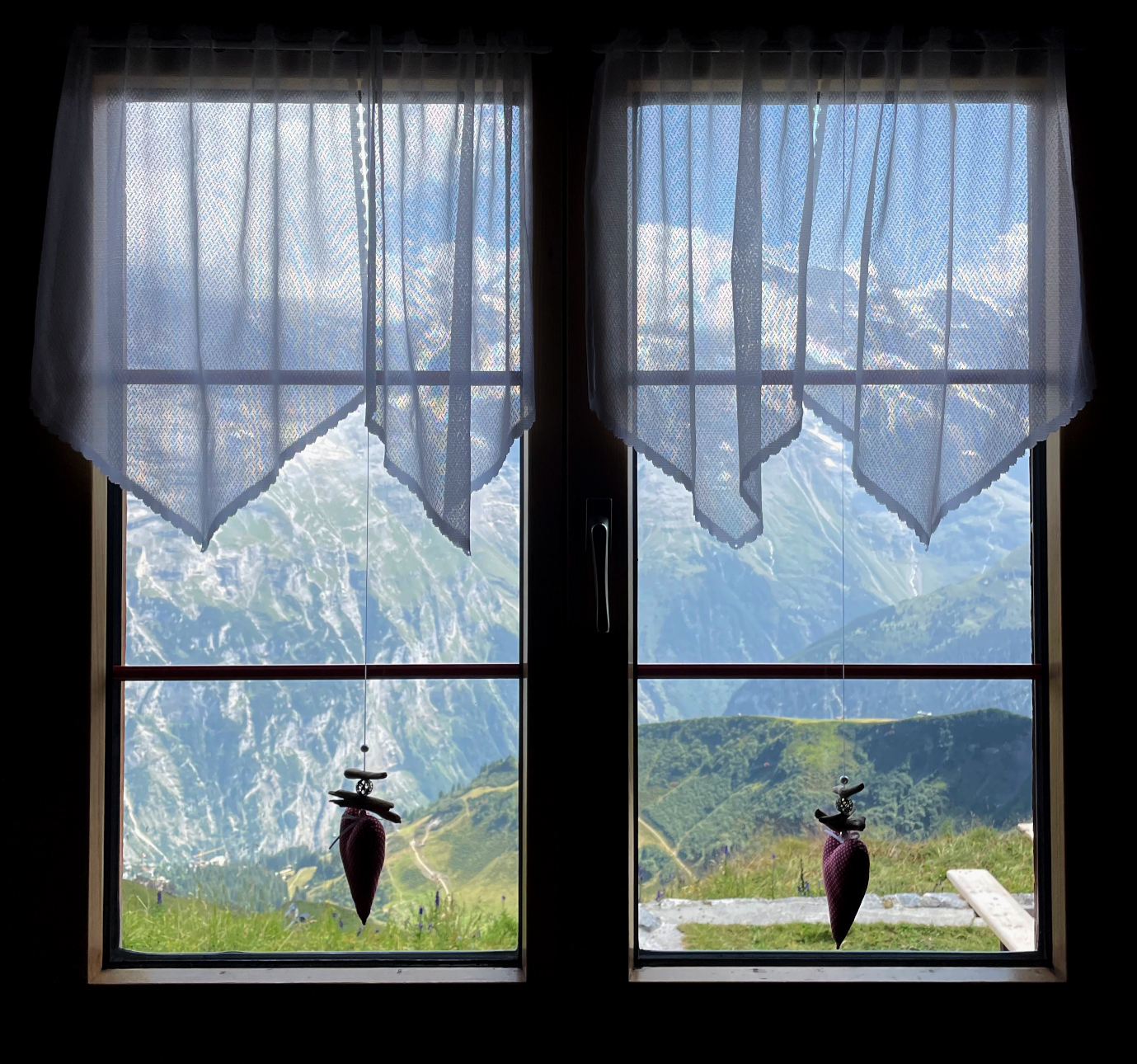
Schilthornhütte views.
Schilthornhütte is a proper Swiss Alpine Club (SAC) hut, meaning it’s populated by Swiss people who know proper hut etiquette: nighttime quiet hours actually began shortly after dinner, red headlights were briefly used and always aimed at the ground, and snoring was kept to a minimum (ok, I made that one up, but it was certainly quieter than Rotstockhütte). I was surrounded by locals speaking Swiss German, which is so strong a dialect of German that it’s basically unintelligible to me, even though I’d reached an intermediate level of German. One of my Swiss dinnermates cheekily said that the Swiss seem to like speaking High German even less than they like speaking English, and I was happy enough to let them all chatter away amongst themselves while I stared out the window, transfixed by the weather-beaten mountains.
My final morning, I watched the sun crest the lip of the Jungraujoch and struck back down to Mürren. A brief Mexican standoff with an oncoming family of sheep ended surprisingly well for everyone involved, and we warily continued on our separate ways without bloodshed. The way down was a knee-burner, and my body was sending distress signals from the prior two days’ hike, but I felt strong and bolstered by my ability to survive alone in the mountains. By happenstance I arrived in Mürren just as the INFERNO hares were coming through. To my eyes they were sprinting, even though they’d already run 10 kilometers, including up the cliff from Lauterbrunnen. “Hop, hop, hop!” encouraged the race volunteers and tourist bystanders, and I had to flatten myself against a fountain as a racer came barrelling by me and shoved her hands quickly under the flow to get a drink, since most of them carried absolutely no supplies with them, including water. Although the sun shone brightly and it was only noon on a Saturday, and I could have taken any one of a dozen more hiking paths like the flat river path in the direction I was headed anyways, I could feel in my bones that I was done. I quit while I was ahead, one useful skill I’ve picked up in my 30s, and reversed my train-to-cable-car-to-train journey back into the still-sweltering city of Interlaken. Resting my aching feet in the cool turquoise waters of the Aare River, I watched a steady stream of paragliders as they whirley-gigged back to Earth. I guessed it was time for me to come back to Earth, too.
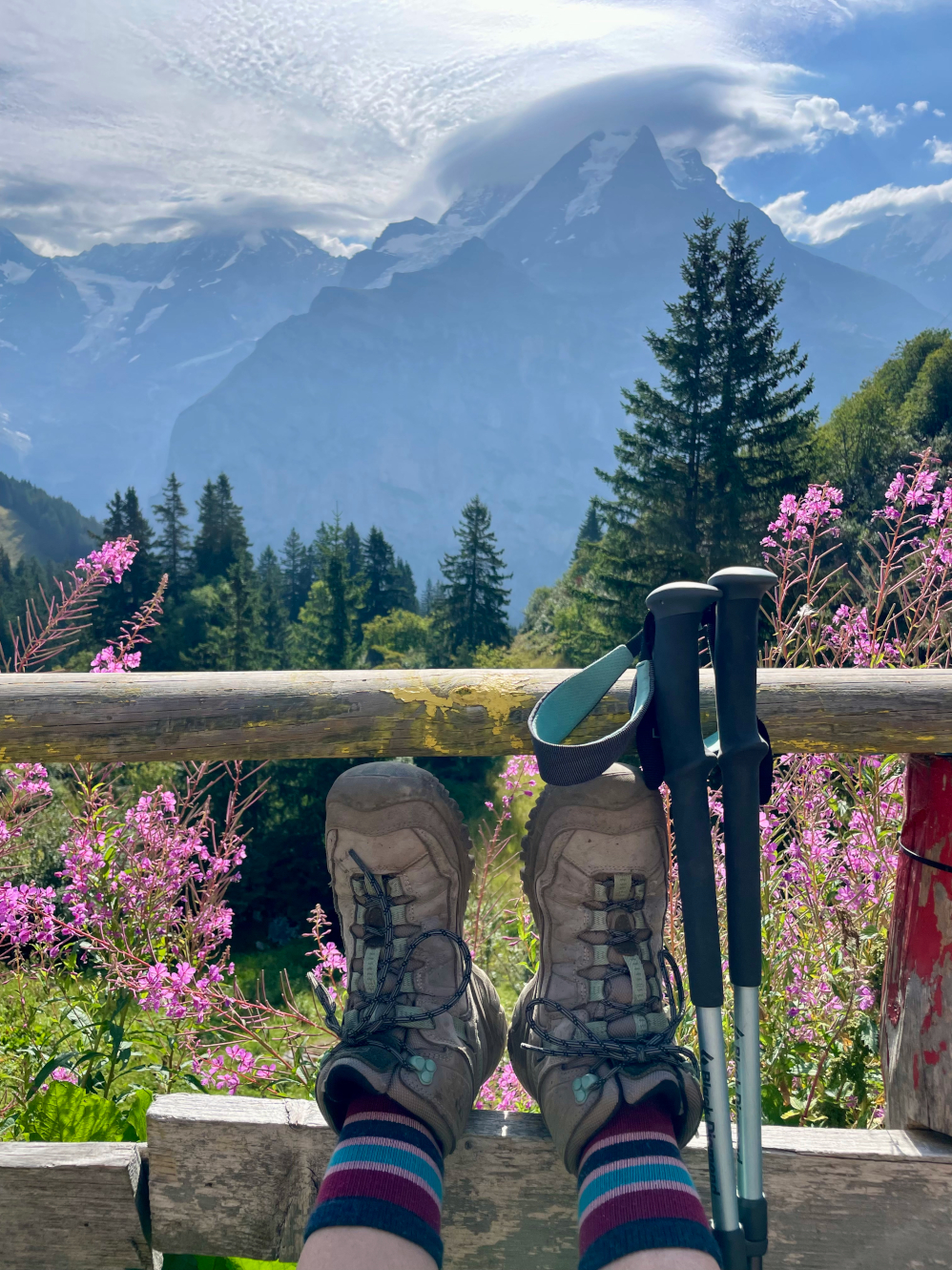
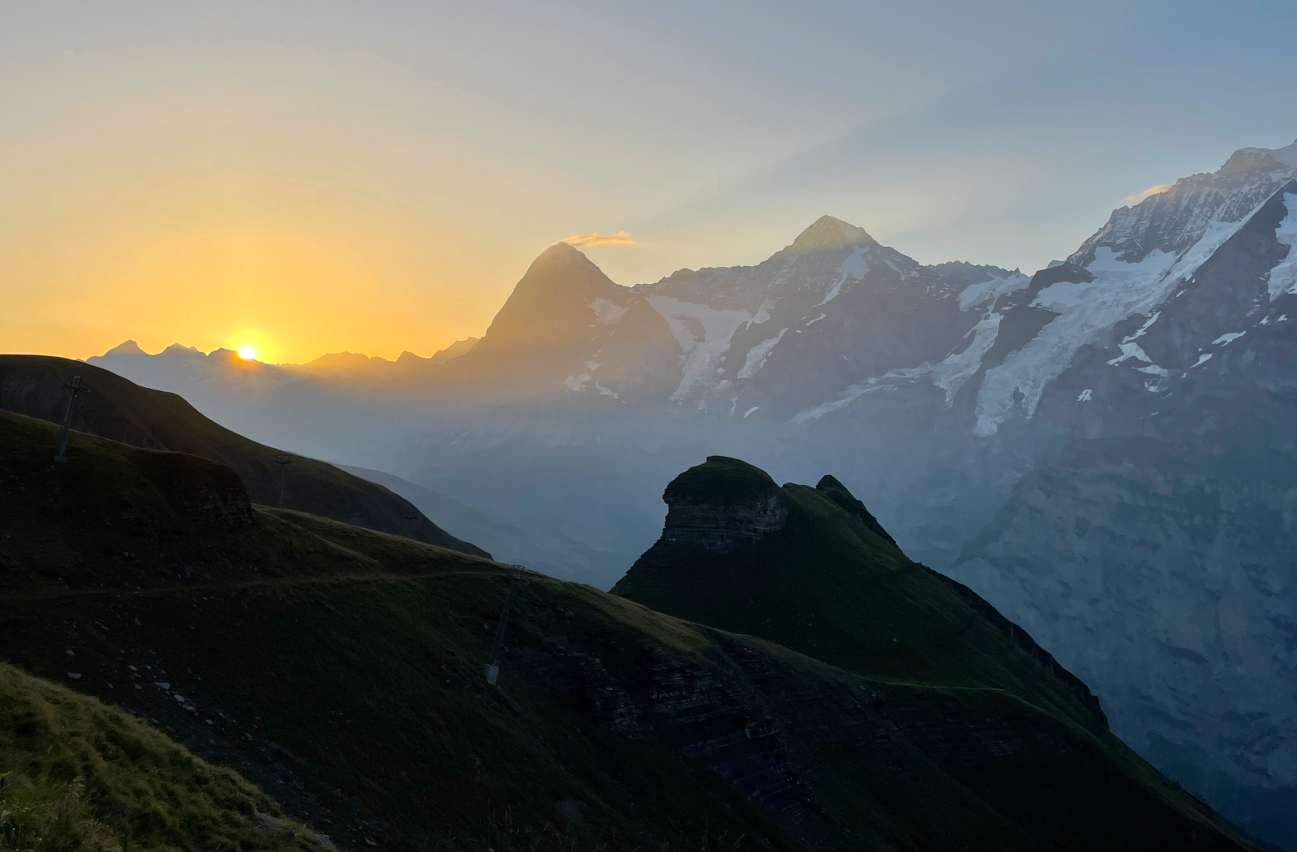

How-to
There are hundreds of Swiss alpine huts that can be daisy-chained into whatever configuration suits you. This is but one humble suggestion:
The route I took was a leisurely 20-kilometer, 2.5-day loop from and to Mürren, which is a car-free village on the cliff above Lauterbrunnen. You can reach Mürren by public transport (trains and cable car) from anywhere in Switzerland – “Mürren BLM” is the end station you want. The yellow line in the map below shows my route, with kilometer lengths per day, and the purple circles are where I slept.

My route, in yellow, with day kilometer lengths written in black. Base map is not mine, and is borrowed from the Piz Gloria Schilthorn Bahn. The black lines show the cable car routes you can use if desired.
Route notes:
- Day 1 — Mürren to Rotstockhütte — 6.4 km — approx 3:00 hike time — Elevation: 430m uphill
- Mostly easy hike, with some switchbacks about halfway through
- Half an hour before Rotstockhütte, you’ll pass through a wide flat meadow that’s a great picnic or rest spot.
- Day 2 — Rotstockhütte to Schilthornhütte + side quest to Schilthorn peak — 9 km — 5:30 active hike time — Elevation: 900m uphill + 520m downhill
- This stretch was mostly uphill, with a few sections of traversing.
- The Schilthorn summit trail from this side is still classed as intermediate skill level, but you should have a good head for heights and probably some experience on alpine trails. Some rock-scrambling with your hands is required.
- Day 3 — Schilthornhütte to Mürren — 4.7 km — 2:00 hike time — Elevation: 780m downhill
- I liked this stretch the least – it’s mostly a steep knee-burner route on a slippery two-track road.
- A tiny detour to Pension Suppenalp is worth it for a drink/lunch break.
To make this loop more downhill than up, reverse the loop and go to Schilthornhütte first. If you’re a hiking beginner, you can also take the cable car from Lauterbrunnen/Mürren to Birg station, and then it’s an easy 45-minute walk down to Schilthornhütte. Days 2 and 3 to Rotstockhütte then Mürren would then also be mostly downhill, although Day 2 will be on a proper alpine trail where I’d recommend sturdy shoes and maybe hiking poles.
Hiking signs usually give time estimations rather than distance. This takes into account elevation change, meaning downhill estimates will be shorter than uphill for the same trail. I was slightly slower than the posted times because I had nice weather and wasn’t trying to get anywhere fast.
All about the huts
Mountain huts are basically hiker hostels. Many huts are wardened (staffed) in summer, and they’re pretty well-stocked with cold drinks and prepared food for sale. That means they give you pretty much everything you need – meals, toilets, bed – so you only need to carry things like water, snacks, and personal gear. An important consideration is the hostel aspect. You will still be sleeping in a loft with dozens of strangers, which requires some patience and consideration, a few particular items to pack, and no expectations about anything fancy. A few huts do have private rooms available too if shared sleeping arrangements don’t appeal to you.
Swiss Alpine Club (SAC) maintains a few hundred huts and they can be browsed on the linked website; there are other non-SAC huts around too. Huts are pretty evenly spaced so you can build your own route rather than having to follow the same one as everyone else, which spreads the people out and means it’s not like the famous Dolomite hikes. Many huts can also be booked via the online portal. Huts do sell out, and often far in advance, especially on holidays and summer weekends. Anyone can use the huts; there are annual SAC memberships that will get you a discount, but these are mainly intended for frequent visitors.
I slept at 2 huts: Rotstockhütte (on the SAC website even though it’s not actually SAC) and Schilthornhütte. Both offered half-board for around 80 CHF each (card payment was also possible at these ones). Some particularities:
- At Rotstockhütte you can drink the tap water straight from the bathroom sinks, but there are no shower facilities.
- Schilthornhütte does not have potable tap water, so either carry enough water to last until you can refill, or plan to buy bottled drinks from the hut. They do offer hot showers from 4-6pm — 1 CHF (coin!) will get you 3 minutes of total water runtime, with an on/off button.
- Rotstockhütte sleeps about 40, while Schilthornhütte sleeps 19. I booked about 15 days in advance for two weeknights in August and got the last beds available.
Meals and dietary restriction: Guests at wardened huts can get half-board (hot dinner + cold breakfast) for a decent price, or you can choose to bring your own food (you can’t use the kitchens in wardened huts) and then just pay for the bed. A la carte lunch is also available at most wardened huts. Gluten-free, vegan, and vegetarian foods were available as half-board options at the huts I used, and they should be booked in advance. Schilthornhütte even had fresh-baked gluten-free bread! If you have other food allergies, just make a request when you book and see what they can do for you.
Special items to bring for hut life:
- Sleeping bag liner is theoretically required (it’s not enforced as far as I could tell), and you’ll want one anyways. The huts usually provide a mattress, pillow, and duvet, but there are no sheets available and it’s unclear how often the bedding is washed. I also saw some people just bring their own regular sleeping bags. On local websites, you might see the words “hut sleeping bags” or in German “hüttenschlafsack,” and this just means a sleeping bag liner. I personally use Sea to Summit liners. It was actually very warm in the lofts, above 70 degrees, so I was fine with a silk-cotton blend.
- Earplugs are strongly recommended. You’re sleeping in a loft with dozens of strangers, to say nothing of the dawn livestock bells, etc.
- Powerbank, especially if you use your phone a lot for important things like navigation and photos. Schilthornhütte had free power, but Rotstockhütte is solar-based and they charged 5 CHF per device charge.
Some optional additions:
- A red-light headlamp is much easier on the eyes (also other people’s!) and will save your phone battery.
- Depending on your comfort needs: I brought a tea towel, soap, and a tiny washcloth. The two huts I visited had soap and paper towels (and TP), but these are important enough comfort items to me that I didn’t leave it to chance or supply chain problems.
- Luggage lock. Hikers are usually a trustworthy crew, but I just feel better if I throw a tiny lock on my pack since I just left it in the open where 40 people could see it. There were no lockers at either hut I visited.
- A tiny foldable day-pack. In the afternoons I went out to chill in the meadows with just a few essential things and left my big pack behind.
- Lightweight hut shoes; but see first point below. I carried flipflops anyways because I also spent a night in Interlaken and wanted some non-boot footwear.
Some hut rules that are fairly universal:
- Take off your boots inside. Huts will provide slippers, usually Crocs-style. If you’re a germophobe or just prefer your own, you can also bring your own (clean!) sandal-type shoes. You can wear them in the hut’s immediate outdoor environs; the idea is just to keep most of the trail mud out.
- Dinner is served at a specific time, usually around 6:30 pm. Breakfast is generally 7-8 am. Be on time or you might not get fed.
- If you’re going to be very late or have to cancel last-minute, it’s best to call the hut to tell them. No-shows might be treated as a search & rescue emergency.
- Quiet time starts shortly after dinner, usually 9 or 10. Be kind to the other guests. Sound carries very well from the ground floor into the loft.


 Window Seat Odyssey
Leave a comment