Nara
Through the streets of Nara roam some very curious inhabitants: herds of wild Sika deer, who have been collectively trained by locals and tourists alike to politely bow their heads in exchange for biscuits. Nara also has a long and colorful history, since it was Japan’s first-ever capital between the years of 710 and 794. Although day-trippers infected with deer fever seem to rule the town today, the deep marks of history are impossible to ignore.
Both the history and the deer are happily concentrated in the same park, and we came upon the deer first. Being a curious person who’s also leery of human-animal interactions, I took a nibble of one of the biscuits we’d bought before I handed any to the deer. Grassy bread is the best way I can describe its taste. We had arrived late in the afternoon and most of the first deer we found were already sated, napping in the trampled grass amid piles of broken biscuits that had been offered and promptly ignored. We gave them some calorie-free pats on the head instead and moved on to be engulfed by a cloud of perennially-hungry younger deer. I felt like an absurd bowing biscuit-dispensing machine as I bowed, waited for them to bow back, and fished a biscuit reward from my pocket, giggling helplessly the whole time. Their individual personalities were delightful. Some deer moved like chickens, reflexively bowing with every step like they weren’t sure how to turn it off. Others were polite enough to bow even though they were already full. Still others had formed organized crime rings, as I found out the hard way when I was beset by three deer at once. Two occupied my biscuit-filled hands while the third came from the side and gently T-boned my hip before sticking its snout directly into the biscuitmine in my coat pocket. I looked to Yasin for assistance, but he was busy treating another pair of deer like Labradors, fondly ruffling the silky space between their ears as they munched on their snacks.

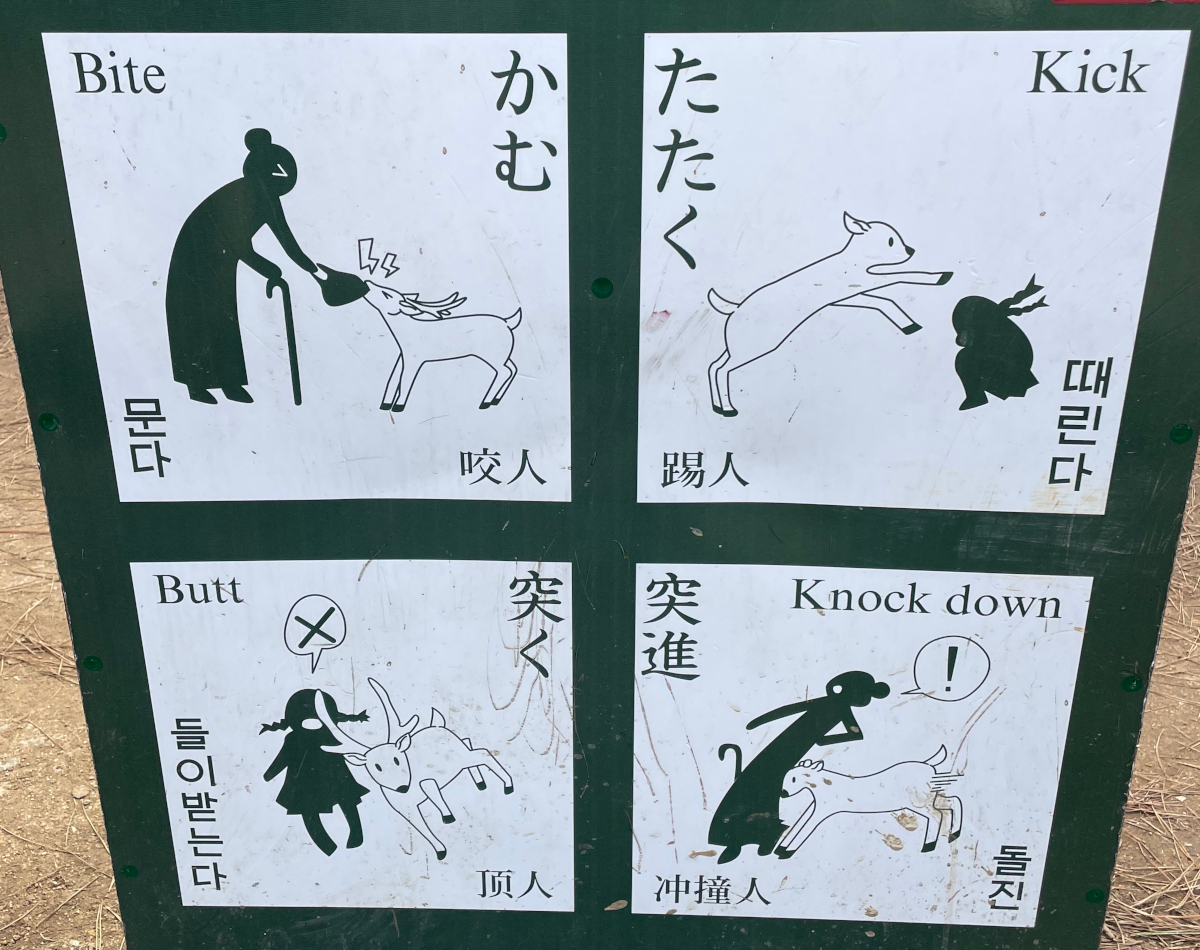

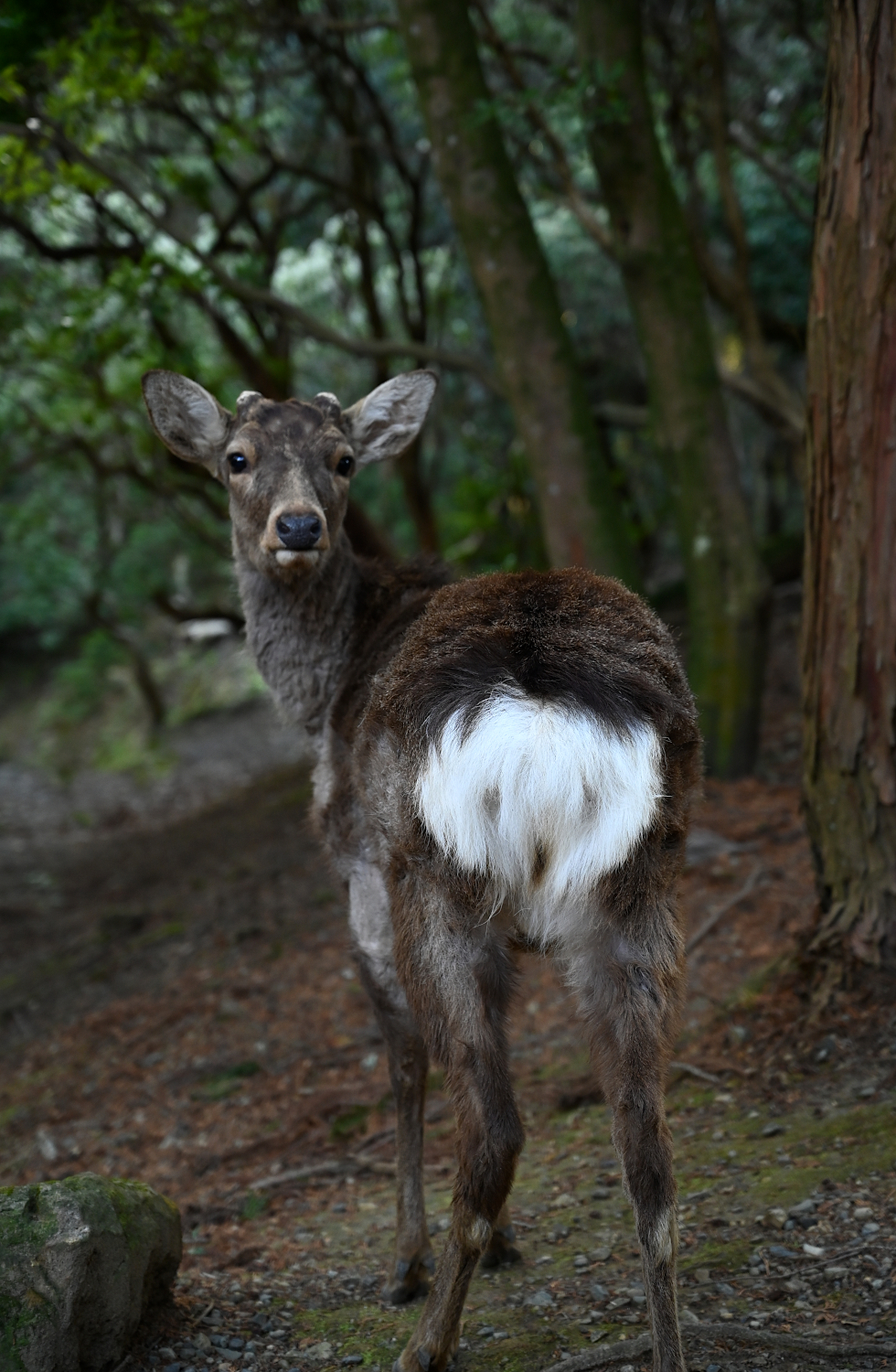

Top left: Shortly after a wet-nose-kiss to the forehead / Top right: a warning sign reminding people the deer are wild
Bottom: Deers and deer butts
Our pockets finally emptied, we wiped the biscuit dust and deer saliva from our fingers and started to move deeper into the park towards the World Heritage Sites. The deer followed us until we showed them the outstretched palms of our empty hands, convincing the mob that we were unarmed, which is another gesture they had been trained to understand and they wandered off to bother someone else. Calm overtook the world as we entered the broad Todaiji temple complex, which is scattered throughout a forested park. February Hall is the grandest of the temples and it’s the focal point of Nara’s annual fire festival, Shuni-e, which just so happened to be occurring during the week we were there. It was only 4 p.m and already people were queuing for their chance to stand underneath the balcony where monks would run around after dark waving torches that they’d set ablaze, because being hit by the flying sparks is said to bring luck for the following year (and it makes for really cool photographs). I was curious about the festival but unwilling to sacrifice half a day to waiting, so instead we got in the much shorter line to collect a goshuin.
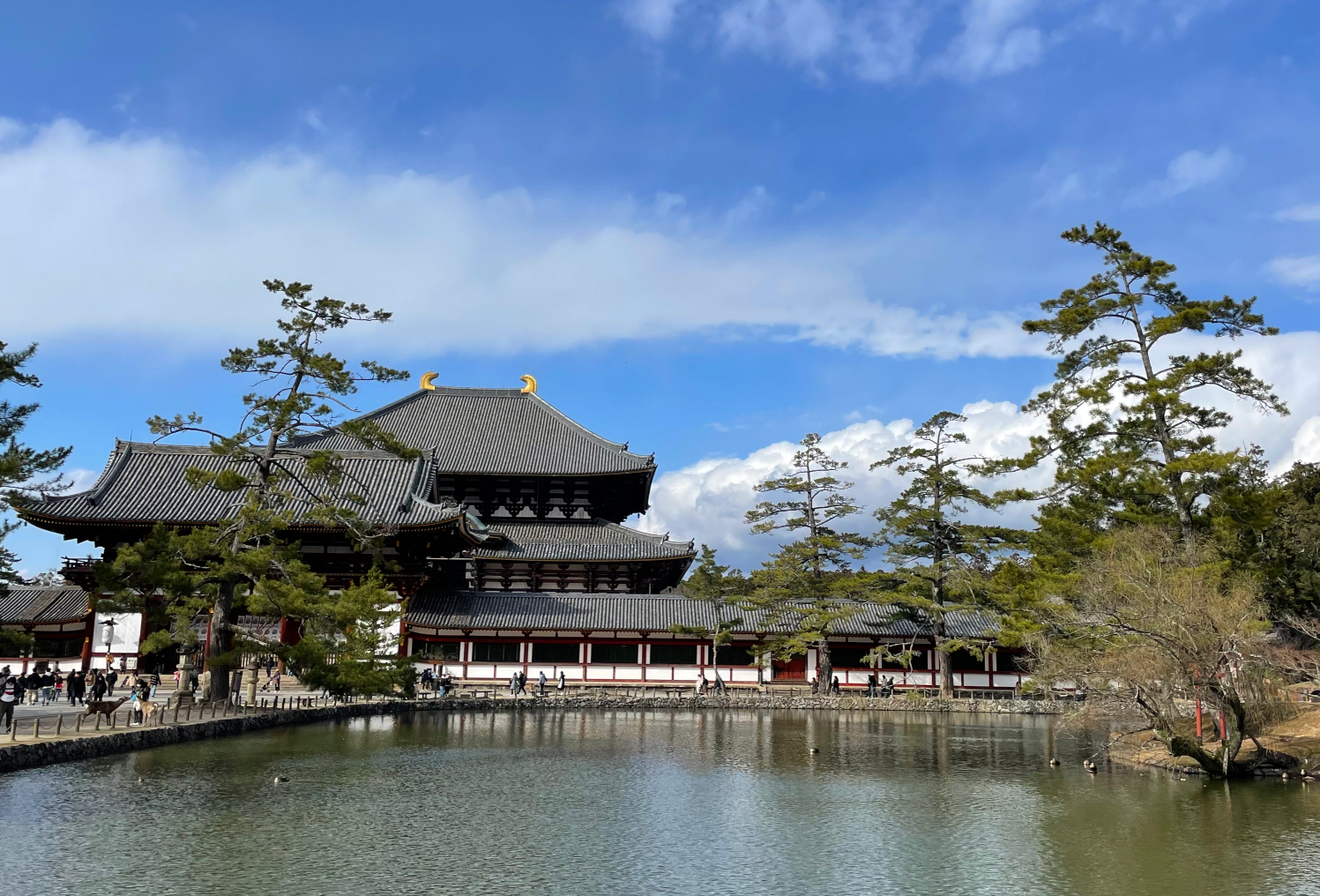

By that point in the trip, the question “is it uphill?” had become both a rhetorical question and a running joke; even in the heart of Tokyo, the streets had occasionally just dead-ended at the foot of a hundred-step stairway. Up in the Nara hills, our path wound ever higher as we headed for Kasuga Taisha, a Shinto shrine buried somewhere in the Mt Kasuga Primeval Forest. Deserted paths led us through the sun-speckled forest for a while until a mismatched parade of stone lanterns appeared and began to funnel us in towards the shrine. Some wary herds of Sika deer lounged amid the lanterns and temples, reminding me of all the stray cats in Turkey who seem to think that 3,000-year-old Greek ruins are their own personal beds.

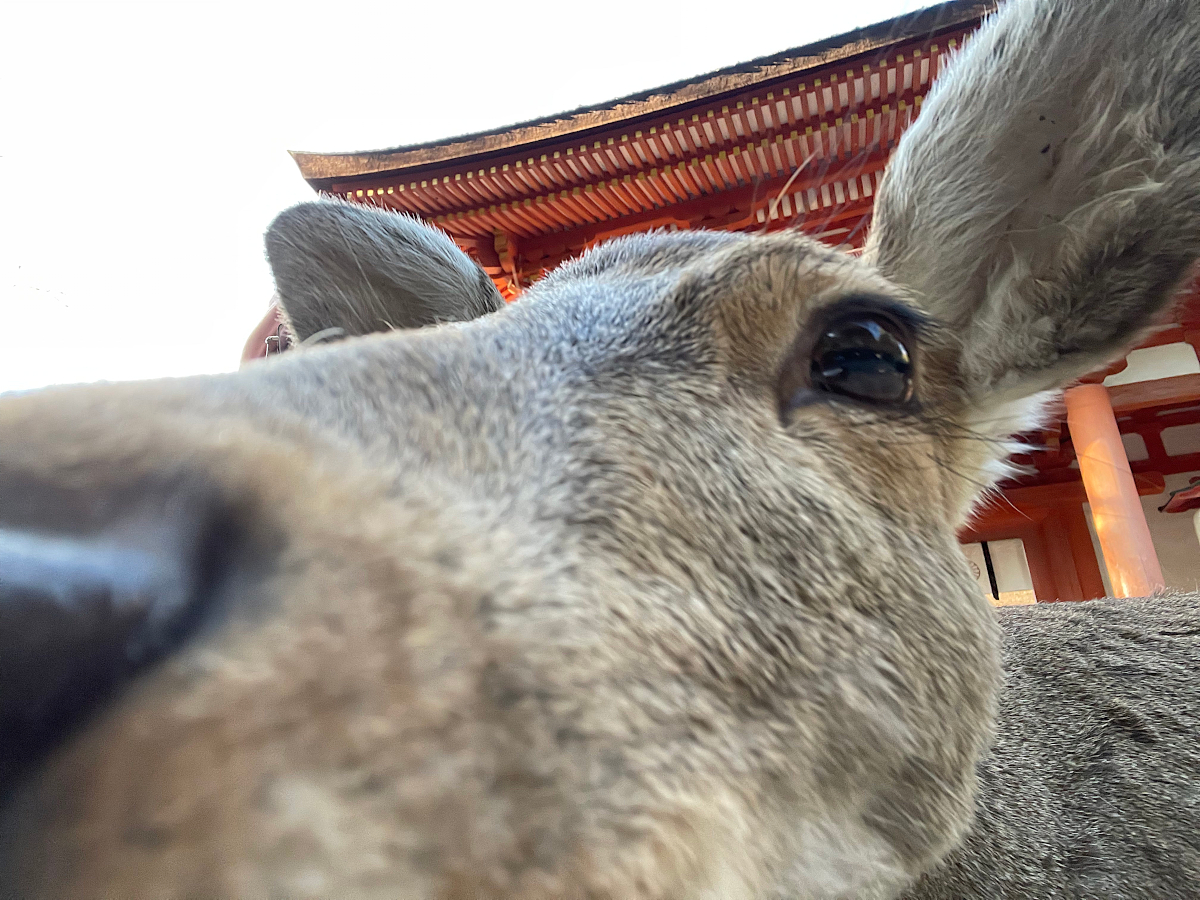


Stone lanterns and lions and some very cheeky deer
Finally the sun set on Nara, and with it our traveling partnership neared its end. The next day would be Yasin’s last on the proverbial Road as he flew out from Osaka, and I would continue on through the Asian continent for another three weeks alone. We battled our way down the street against a biting wind towards a nice izakaya (Japanese tapas) restaurant and toasted our successful trip over tiny shared plates of edamame and tempura. Somewhere close by, out in the dark, the fire festival torches were lit, and the night’s celebrations began.
Osaka
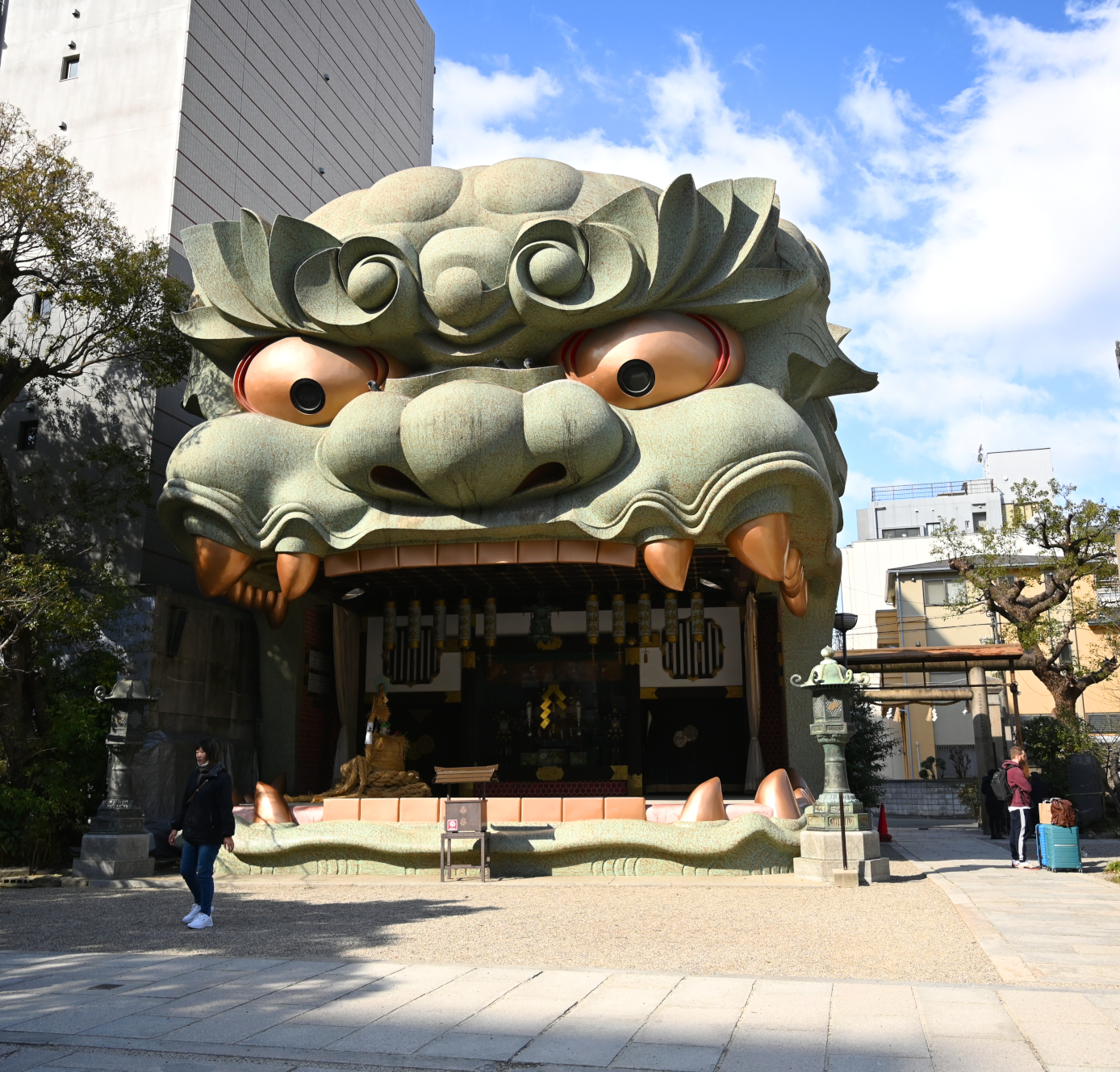
Our whirlwind half-day tour through Osaka left much to be desired, time most especially. Upon arrival at the train station we haphazardly chose a luggage locker and stashed our bags, then spent half an hour extracting ourselves from the metro station because Japanese stations are essentially underground cities and we kept getting either lost or sidetracked (Eki stamp…ATM…bathroom…). Finally topside, we passed beneath the shadows of a Hansel-and-Gretel candy hotel and a sushi-wielding octopus to get to the Namba Yasaka Jinjya Shrine, which is supposedly shaped like a lion’s head but to my uncultured Western eye looks much more like a dragon’s. The sun was on our side at least as we devoted the bulk of our morning to visiting [the outside of] Osaka Castle. It somehow looked both exactly and nothing like I’d expected a “Japanese castle” to look. Somewhere between a fat pagoda and a tiered wedding cake, its layered mint-green copper roofs were accented with jauntily upturned edges and its whitewashed wooden faces were gilded with gold. At any rate it had a much more welcoming vibe than Tokyo’s Imperial Palace and that Sunday it was a buzzing beehive of humanity; mostly tourists, interspersed with herds of local runners using the castle’s jogging route. We finally meandered back near our luggage location by using an AirTag in my bag to orient ourselves. Our final group task was to secure a whole jiggling cheesecake, which was easily the size of my face and piping hot fresh from the oven. For once, the Instagram hype lived up to the experience – the lightly sweet and fluffy cheesecake tasted just as good as it looked. We sat and ate the entire thing on the sidewalk under the sun.



Given the size of the station, I wasn’t expecting my metro departure gate to be immediately next to our randomly-chosen luggage locker. This meant our parting would be even sooner than expected, and maybe that was for the best. I dropped all my worldly possessions to the ground and gave Yasin a tight hug, into which I tried to pour the words of gratitude I couldn’t quite say, heedless of the river of humanity that flowed around us. Then, in what felt like a single fluid motion, I let go and grabbed my bags and turned to slide through the metro turn-style, resolutely not looking back. I knew if I didn’t look back then I wouldn’t start to cry, from either my sadness that we were parting or my fears about continuing on alone through the unknown lands of South Korea and Thailand and Cambodia. I turned the corner out of sight and let the crowd-river carry me and my emotions away, first to Osaka station and then North for one final solo Japanese night in Kinosaki Onsen.
Kinosaki Onsen
I’ll admit it. Sometimes I’m a bougie person. I like a bit of luxury and I will actively seek out places and experiences with fancy vibes even if it’s a bit above my academia-slave budget. Kinosaki Onsen is a lovely 1300-year-old onsen (spa) town tucked into a geothermal valley near the Sea of Japan. It’s far enough away from the Tokyo-to-Kyoto tourist highway that it felt like an exclusive getaway into the authentic Japanese countryside, and it’s surprisingly affordable – a day pass that’s valid for all 7 of its onsen is included free at most local hotels or costs just 1,500 yen (less than 10 Euro/USD). Bougie and affordable, they saw me coming! Anyways, a spa day was exactly what I needed to cap off my fabulous trip through Japan, which had included at least 120 kilometers of walking that, I swear, had been uphill in both directions.
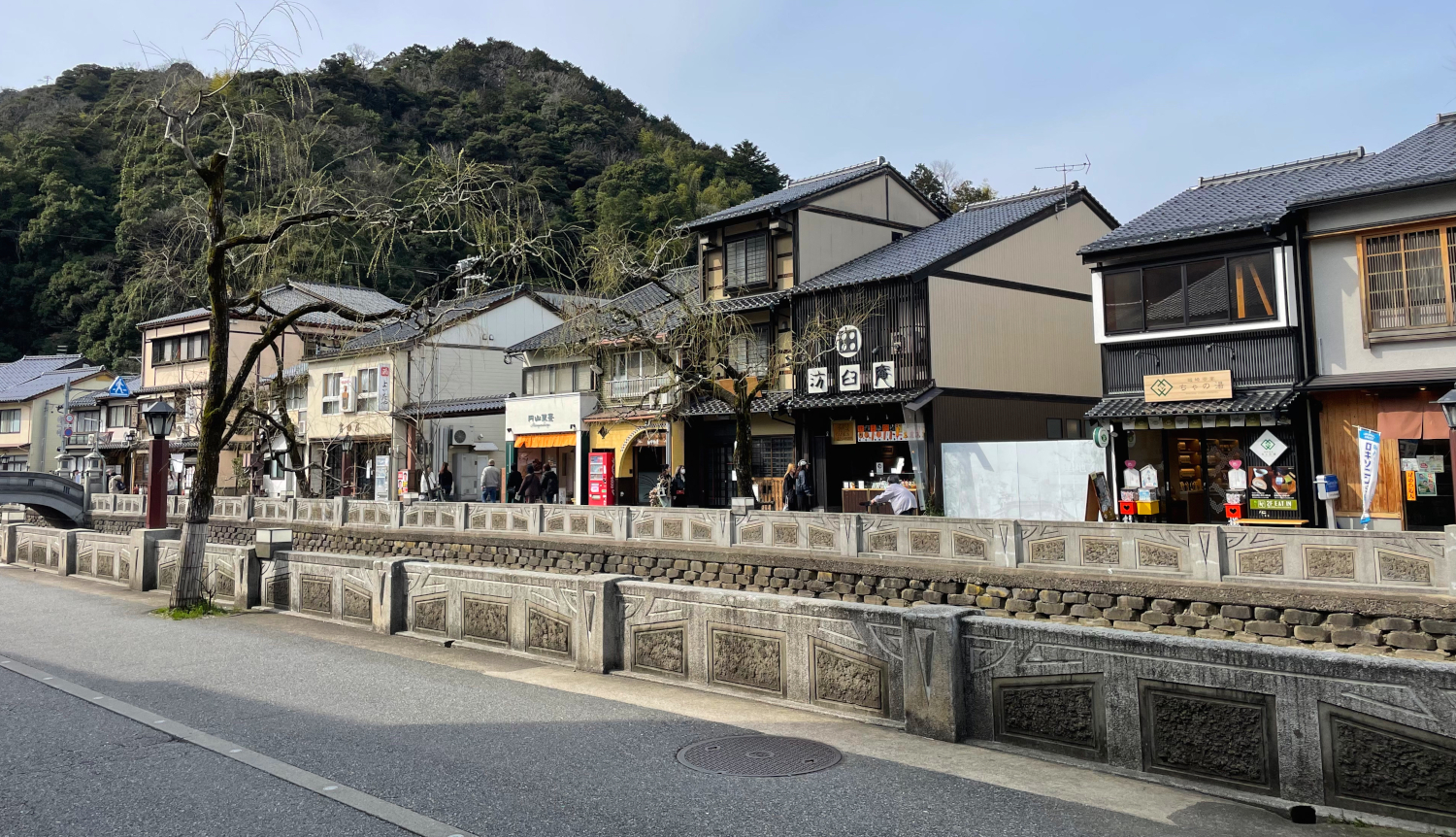
The main drag between the train station and the river met all my expectations of a Japanese almost-seaside town. Gulls wheeled overhead. A faint perfume of fresh brine clung to the town, although I wasn’t sure if it came from the nearby sea or from the parade of seafood restaurants selling lobster and mussels and crab that marched from one end to the other. One restaurant even had a 10-foot-tall crab sculpture clinging to its upper floor, because of course it did. The street was populated by people wearing your global-standard Spring 2024 outfits.
Then I hit the river and everything went sideways, including the river, since it’s perpendicular to the other main drag. The setting sun winked at me from the left, throwing a long golden corridor of light along the waterway. I stood at the edge of the canal, the weight of my backpack forgotten as I gazed at all the willows and onsen and impossibly cute little shops lining both sides of the water. I slowly became aware that a curious clopping sound had filled the air. It sounded a bit like horses, but it was somehow closer to the hollow coconuts that characters in Monty Python and the Holy Grail used to pretend there are horses. The clopping grew louder and I looked ‘round to see a couple who were unironically wearing bright yukata (kimono bathrobes) and geta (flip-flops made from solid planks of wood) in broad daylight. The geta being smacked and dragged along the pavement was the source of the mysterious noise. I followed the cloppers across an arched stone bridge to the other side of the river, where I found even more people unironically clad in a rainbow of yukata designs – later I would learn the designs vary by which hotel has lent them out. I suddenly felt very out of place in my jeans and canvas jacket.


I had picked a quaint female-only hostel that was run by two exceptionally sweet and loquacious local sisters. They took me on a tiny tour through the maze of hallways inside their traditional house, showed me my futon-and-tatami corner of the dorm room, and instructed me on how to correctly put on my very own yukata, which I promptly forgot. It was chilly outside but I wasn’t sure if it was kosher to wear pants underneath the yukata, and eventually I decided to only wear skivvies underneath. The yukata fabric felt very thin as I stepped out of my room. Unsure of which geta I could borrow and seeking assurance that I had put on my outfit the correct way, I rang the service bell at the empty front desk. One sister came out from her ground-floor apartment, literally slapped her hands against her cheeks, and breathlessly exclaimed kawaiiii! (cute), as she beheld me in my uniform for the first time. Granted, she then undid my roughspun coat and redid it the correct way, but to be called cute by an adorable Japanese person was absolutely a high point of my week.
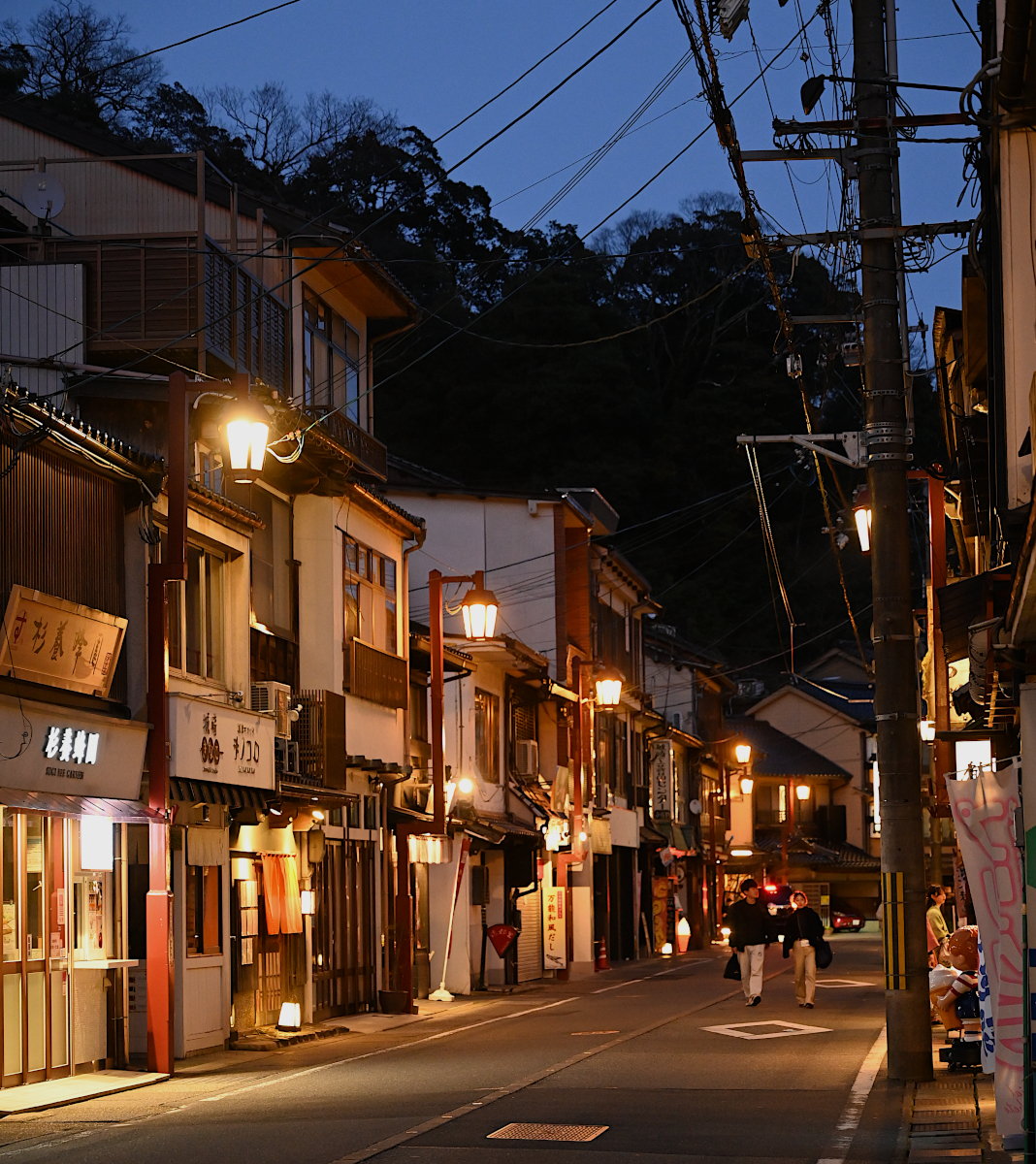
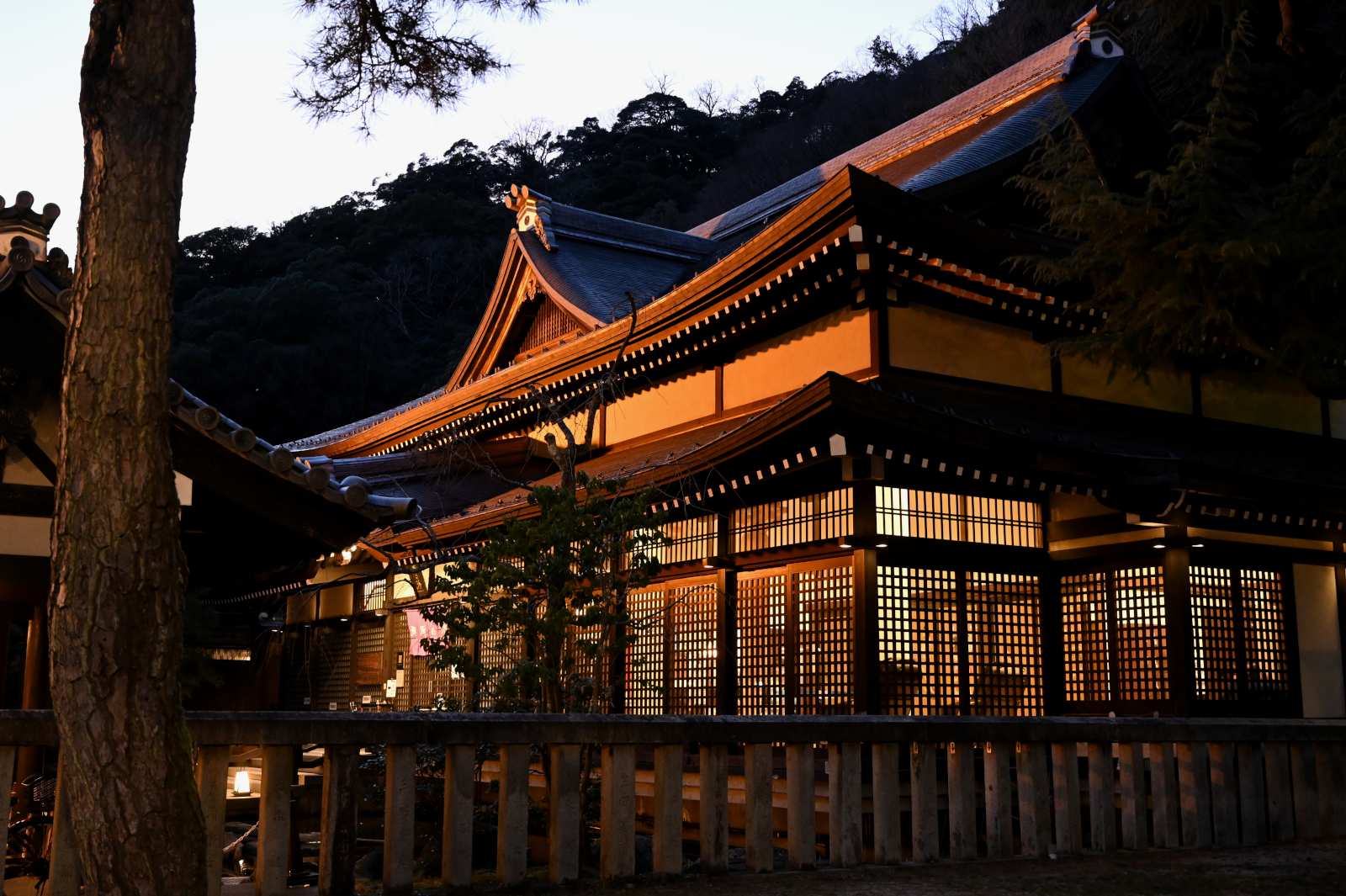
Out in the cold dark alley, my borrowed geta clopped deliciously against the pavement. It was officially late-night by then, but the river street still teemed with people wearing the latest onsen fashion. I kept nervously tugging my yukata closed around my bare legs. For my first spa sojourn I had picked the Goshonoyu Onsen, where they had an outdoor hot spring next to the forest. Using a hot spring is apparently a bit more complicated than using a swimming pool, and there were instructional signs all over the gender-segregated locker room. The signs included both pictographs and English, so the literal messages were clear enough, but the cultural and explanatory translations were missing. Nudity is mandatory and cameras/phones are banned, sure, but will people think I’m creepy if I wear my glasses just so I don’t fall down? Showering first was required, but why did I have to do it sitting down and in front of a mirror, and what were the other women using those giant bowls for? Carrying a small towel with me sounded easy enough, but where should I put it if I was in the middle of the water, and should I somehow sit on it like at a Finnish sauna, and how could I use it to dry off if it was absolutely soaked from being with me in the pool?
The last question was at least partially answered when I emerged squeaky-clean and bespectacled from the shower room and beheld the steaming hot spring. It was nearly empty when I arrived, with just a few dark female heads bobbing in the water, and piled atop those heads were little snow-white towels. It seemed the local women had learned to carry their towels this way, since you’re never supposed to dip your hair into the pools. For one absurd moment, looking at those snow-white piles atop heads floating amid the steam, I thought of the wild snow monkeys that frequent natural Japanese hot springs and sit so motionless that snowfall is able to accumulate in their fur.
Coloured lights cast upon the hillside directly across from the pool revealed a young beech forest shivering in the breeze. I shivered too, and quickly (but cautiously) stuck my toes into the steaming pool, feeling the tingling burn as the volcanic warmth tried to melt off my skin. Long soaks in hot water are usually not my thing since I’m sensitive to heat, but the huge black rocks lining the Goshonoyu Onsen pool proved to be the perfect setup as I tried to thermoregulate between the scorching water and frigid air. I could wedge myself between boulders in such a way that I could completely relax while my whole body except for my feet and head were underwater, or I could sit on a rock with just my feet in, or go for an artful half-in-half-out configuration. The whole time I faced a steaming waterfall and the lit forested hill, and I was mesmerized by the show of a thousand movements made by the water and illuminated leaves. The stress and pain of travel slowly drained from my body, and the furious hamster wheel that usually spins in my mind ground to a halt. Even though it was late on a Monday evening, the population in the pool ebbed and flowed, mostly consisting of younger local women out for a soak with their friends or children.


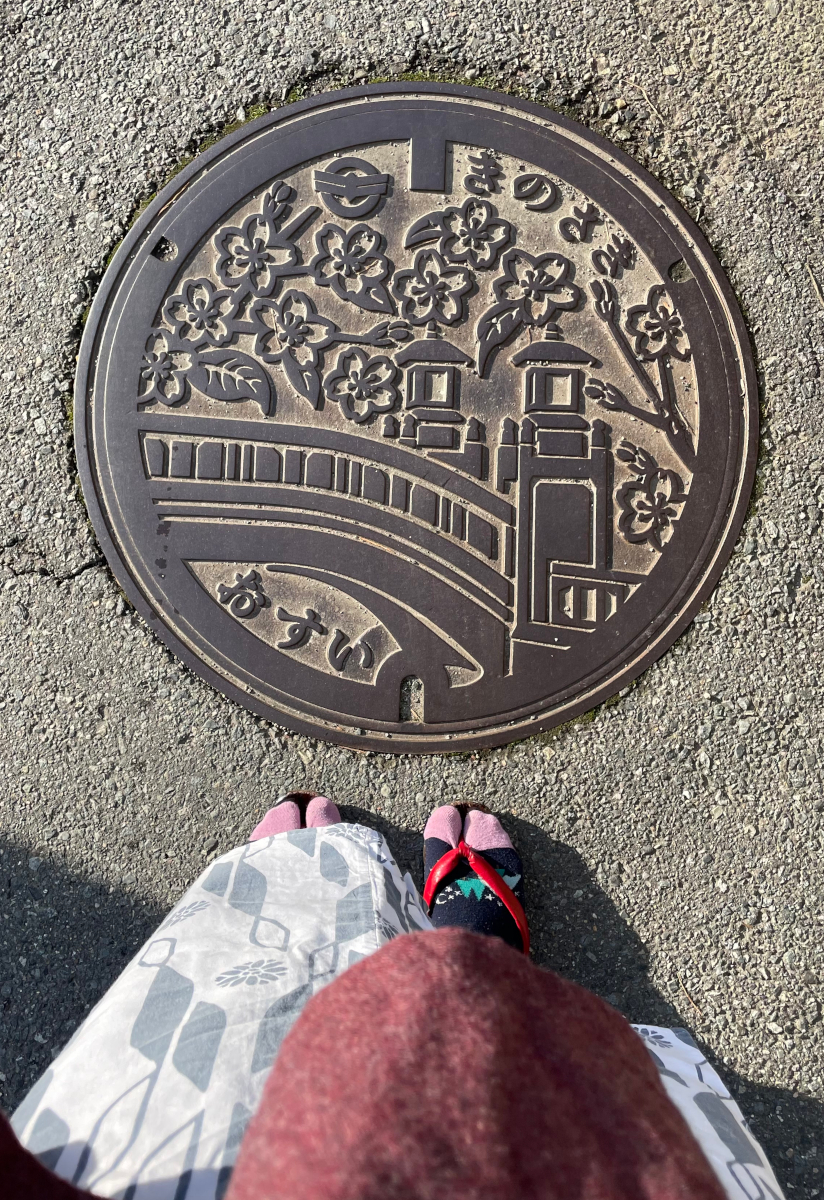
I’d originally chosen to visit Kinosaki Onsen in part because I am a tattoo-bearer, and tattoos remain a quasi-taboo thing in Japan due to centuries of their association with organized crime. Most people today won’t make a fuss if foreigners show their tattoos on the streets, but most onsen still won’t allow anyone with tattoos to enter unless the ink is small enough to be covered with bandages, a criterion that applies to 0/5 of my tattoos. Kinosaki Onsen, however, has perhaps seen the gleaming promise of tourist cash and opened the doors to all 7 of its onsen to tattoo-bearers. Most of the locals seemed inured to tattoos, but their children were another story: they all invariably stared at my ink, completely transfixed.
Boneless and becalmed, I finally left the onsen, but I wasn’t quite ready to sleep yet, so I indulged in the town’s other great pastime: perusing. Slinging the bamboo ring-handles of my onsen purse over one elbow, I perused shops selling perfume and towels. I clopped past a dessert shop and then clopped right back when curiosity got the better of me. I ordered an anmitsu parfait, which was filled with fruit and juice and lightly-sweetened transparent cubes of seaweed-jelly, and I ate it right there in the shop, still pantsless under my yukata. My feet got cold so I briefly stopped to dunk them in a free outdoor public footbath next to the street. I admit there was a certain absurdity to it all, running around late at night in that outfit with a bunch of strangers, but everyone was doing it while they drank beer and ate dessert and bought perfume at 10 p.m. I guess at some point I went “home” to sleep, but almost before the sun had risen I was dressed and repeating the process, clopping down the street in my geta to get a (lol) coffee. I was sat at a cute table meant for one – a Japanese concept I rather like – which had just enough space for a single chair and a single cup and was wedged right up against the plate-glass window with a lovely view of a sunlit square. That morning I’d seen the light and realized that no one was likely to stop me from wearing sweatpants underneath my paper-thin yukata, and also socks to protect my feet from the sticky leather straps of the geta, which had already gifted me with a few blisters the night before. Anyways I had no one to impress, so I committed both wardrobe atrocities for the sake of comfort. The onsen doors had been open since 7 a.m. and I spent a lazy hour soaking in Ichinoyu Onsen, an indoor-outdoor bath whose outdoor section had been fashioned into a fake cave.

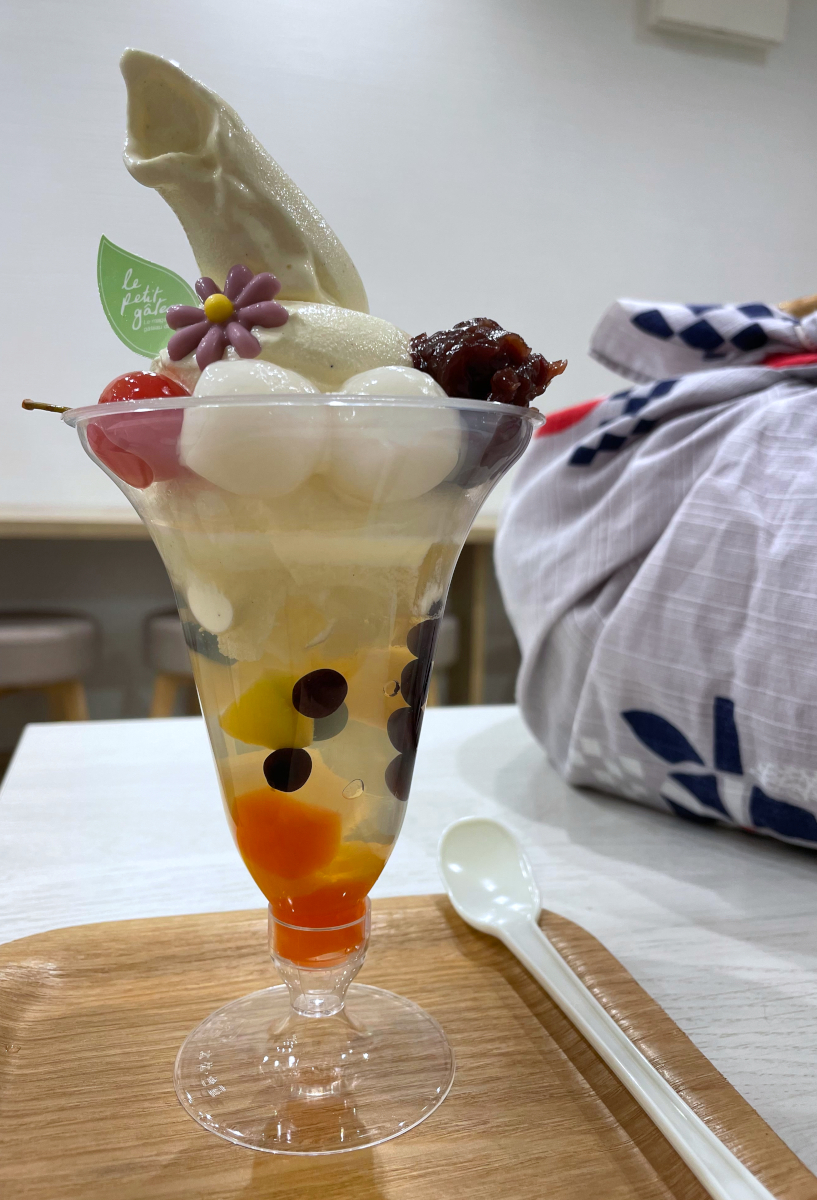

Left: Kinosaki along the river in the morning / middle: anmitsu parfait / right: the free public footbath at Ichinoyu Onsen
Tradition states that, before bathing in Kinosaki’s waters, you must first hike up to the hillside Onsenji temple where the monks first prayed for the hot spring to appear and ask permission to bathe in the springs yourself. You also had to buy a ladle from the temple as proof that you’d completed the quest, and in fact you wouldn’t be let into any of the onsen without a ladle. Obviously I had failed to do this quest first, since modern rules are a bit more lax and the ladle tax is no longer collected. However, I was still on the hunt for goshuin and I wanted to finally experience a real Japanese hike, so I decided to go up anyways. Near the start of the trail was a boulder marking the official hot spring source, where the water gurgles from the ground at a shocking 81 °C. A shallow footbath nearby threatened to cook the feet off my body and I could do little more than rapidly flail my heels in and out of the pool like I was dunking a teabag. Next to the footbath there stood an ice cream shop with an egg-boiling pool where you could buy a few raw eggs and dangle them into the pool using what I can only describe as a red mesh scrotum tied to a wooden lattice. I can’t say I’d ever seen a combination footbath/ice cream/egg-boiling establishment before, but I guess I’d never been anywhere like Kinosaki Onsen before either.

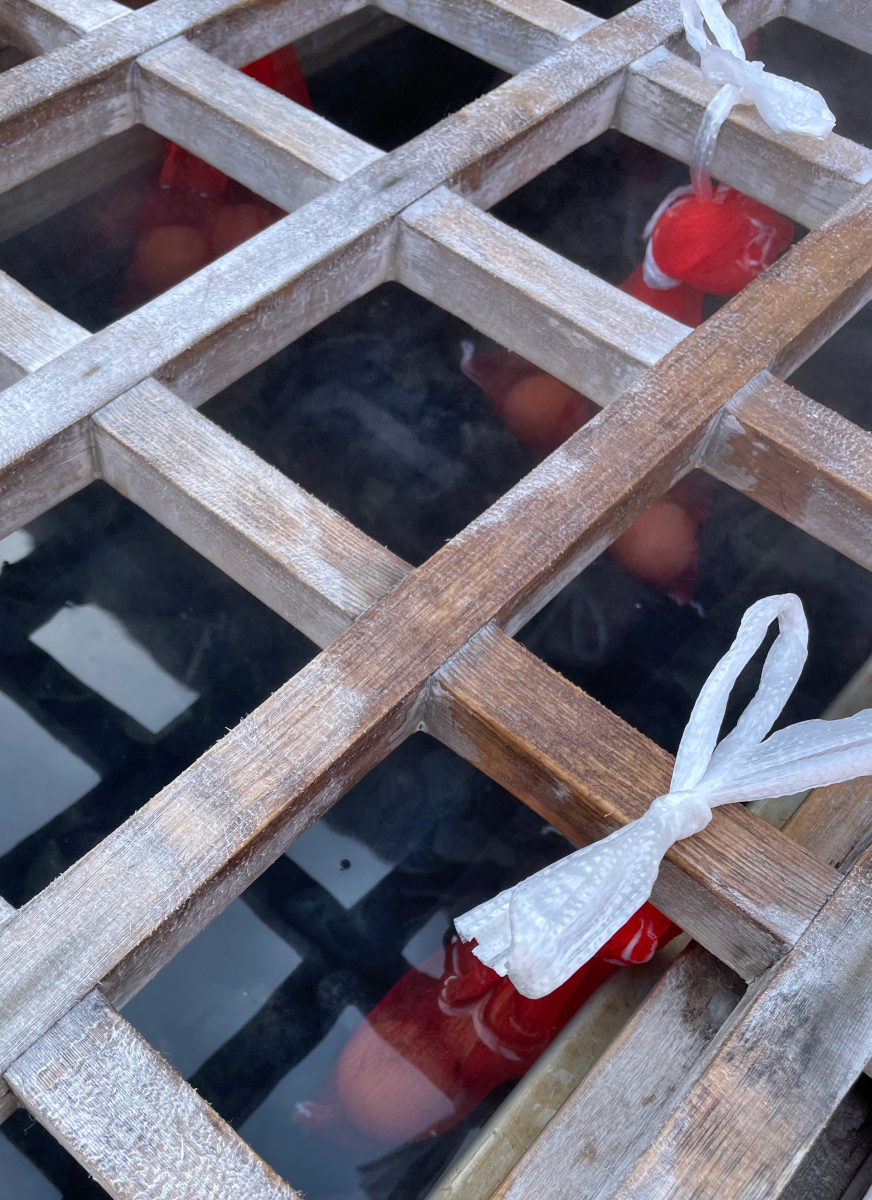
Left: The outdoor footbath at the base of the hike was seriously around 50 °C (see the arrow). Right: The egg boiling pool
Pulling my slow-roasted feet from the pool, I shoved them into my hiking boots and started up the knee-burner path to the temple. Within minutes I’d sweated off my morning onsen soak and I was wheezing from exertion. A random assortment of stone Buddha statues led me up the stairs through the shockingly green early-spring forest. The statues were were in various styles and states of disrepair – some were so old they’d been entirely colonized by lichen, and others had literally lost their heads. Together, they reminded me of an old woman’s beloved (if single-minded) tchotchke collection. When I arrived at the temple it was deserted except for a single monk, who painted my final goshuin. I paid him a few extra yen to enter the temple museum so I could thank the Buddha for his excellent spa town and (belatedly) ask permission to bathe in the waters. A little extra gratitude never hurt anyone. From the mid-slope temple, I continued up to the top of the ridge, paused to enjoy the view over another anmitsu parfait at a cafe attached to the cable car station, and returned to town by an alternate path.
My journey down was infinitely more beautiful and peaceful than the path up, and not only because I wasn’t gasping for air the whole time. For a long way the path followed a knife’s-edge ridge, with views of the surrounding forest and mountains and valleys and sea. A warm breeze skipped along the ridge and I encountered only one other couple on the entire hike; more broken Buddhas were my constant companions instead. Finally I came to a junction where I could choose either a longer path or a shorter one that would take me closer to the start of the trail. I chose the shorter, which was perhaps a questionable life choice since it left me scrambling down a gully that was more a dry riverbed than a hiking trail, but I did find some tiny rocky caves that were filled with singing frogs, so that was alright. It was right after I’d dragged my shaky-kneed self back into civilization when I had the most beautiful interaction with a local. I was walking past the entrance to a temple when I noticed a stooped old woman coming down the road towards me. Out of nowhere, she stopped and offered me a deep bow, along with the traditional greeting of Konichiwa. I was absolutely stunned. I bowed back, rooted to the spot and too humbled to move as she continued on her way into the temple. I was vaguely aware that by Japanese customs I should have bowed first because I was the younger party, but this woman had simply volunteered the gesture to a strange foreigner with a wide and benevolent smile.


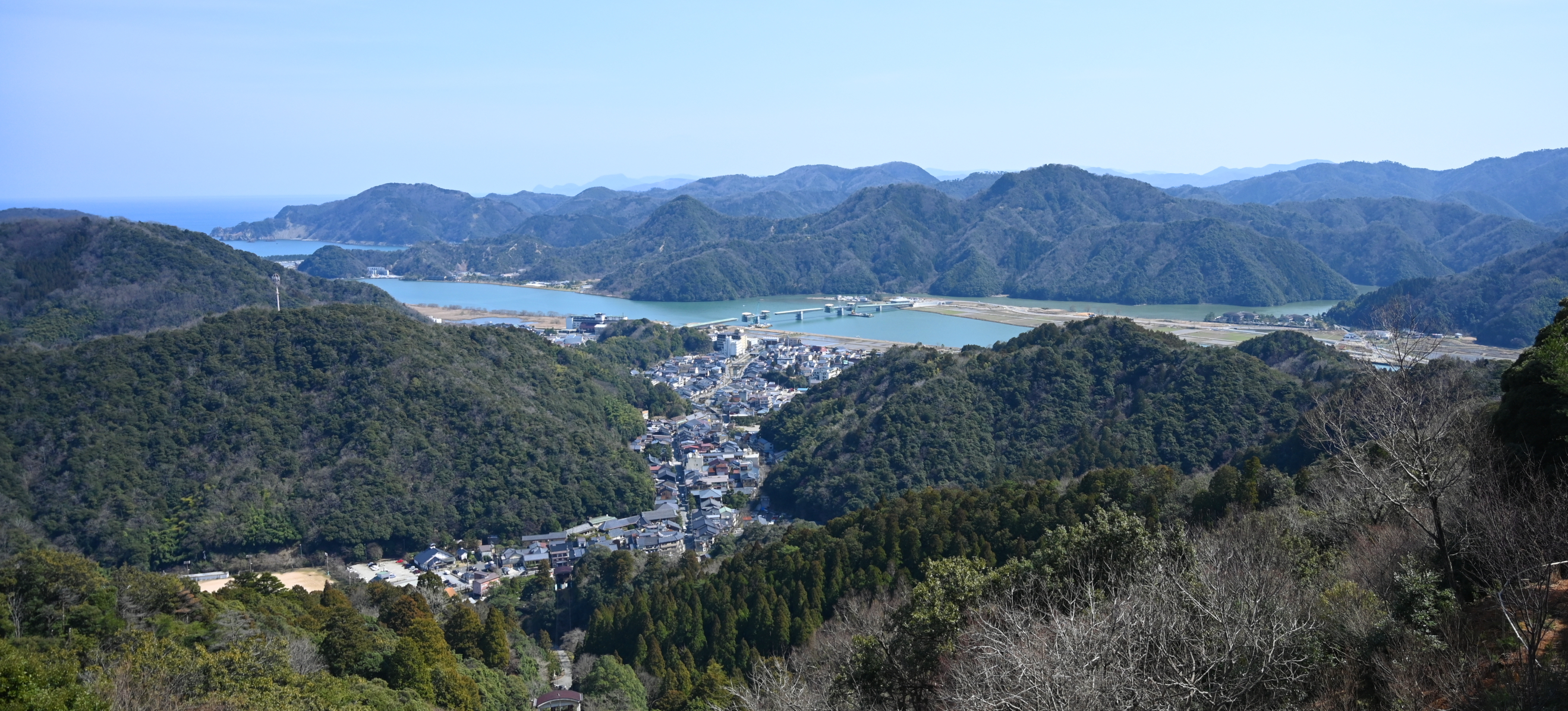
Top: Buddha statues near the trail in the forest and the temple complex at the base of the trail.
Bottom: View of Kinosaki Onsen in its valley, the much larger Maruyama River, and the Sea of Japan to the left
I had just enough time to indulge in a final soak at the Kounoyu Onsen to wash the hike’s exertion from my muscles and then bolt down a delicious crab-cheese-and-rice concoction near the train station before catching my bus back to Osaka. During the ride, I was struck by two thoughts: first, Kinosaki had been one of my favorite experiences of the entire trip and Yasin had missed it, and second, he and I had had wildly different experiences over the last 24 hours: while I had been bonelessly floating in hot healing waters, he had been strapped upright in cattle class airline seats all the way to Europe. Oh dear.
End
My journey from Osaka to South Korea the next morning was a comedy of mishaps. First I got soaked by a cold rain on my walk to the metro station. Then as I stood on a color-coded dot waiting for my train, a peculiar sniffly sensation filled my nose, and right when I stepped onto the metro, my face became a floodplain for a river of blood. I didn’t have a single tissue on me, nor did anyone else notice my problem or step forward, so I just pinched my nose and stood there while facing the opposite door and sweating for an hour, my cheeks inexplicably hot with shame over this ill-timed bodily betrayal. The flow had mercifully stopped by the time I reached the airport – just in time for an hour-long wait to get through security and a two-hour flight delay during which our plane just sat on the Osaka tarmac. By the end of the journey, my planned 1-hour flight had become a literal blood-sweat-and-almost-tears ordeal that lasted 8 hours door-to-door. I couldn’t help but wonder if this was all just Buddha’s Curse, trying to get in a few final jabs before I left the country. A slightly sunnier interpretation is that Japan just didn’t want me to leave, and that was a sentiment I shared. I probably could have spent my entire month of vacation in Japan alone. It also felt like I’d finally just learned enough to have gotten the hang of the place.
So what did I learn during my summer Japanese vacation? LOTS. Some things were just facts, like how it’s considered Year 6 in Japan because their counter resets each time a new figurehead emperor begins his reign, and indeed that they still have reigning emperors at all. Some lessons were practical, like how my chopstick skills improved exponentially, even though the pad of my palm always ached after I finished a big meal. Some things just had to be self-taught rather than learned per se, like my agnostic interpretation of “paying respects” at local religious sites. Then there were the things that I absolutely could not learn in ten days – language chief among them. Arigato (thanks) quickly became a reflex word for me, but Konichiwa (hello) kept getting lost in my head, and more than once I tried to say Hokkaido when greeting someone. I guess it’s because it sounds a bit like “hello,” but I’m sure I would have confused a lot of people by saying the name of a Japanese island or, if you’re German, a kind of pumpkin.
When I left, it still felt like there was so much left to learn, and so many other places to explore. I guess I’ll just have to go back. Part of me knew even at the time that I wanted to keep this option open. I could have easily finished out one entire side of my two-sided goshuincho, but in a fit of symbolism, I decided to leave the last page empty. Not unfinished, just paused: leaving the door open for more Japanese adventures in the future.
 Window Seat Odyssey
Leave a comment