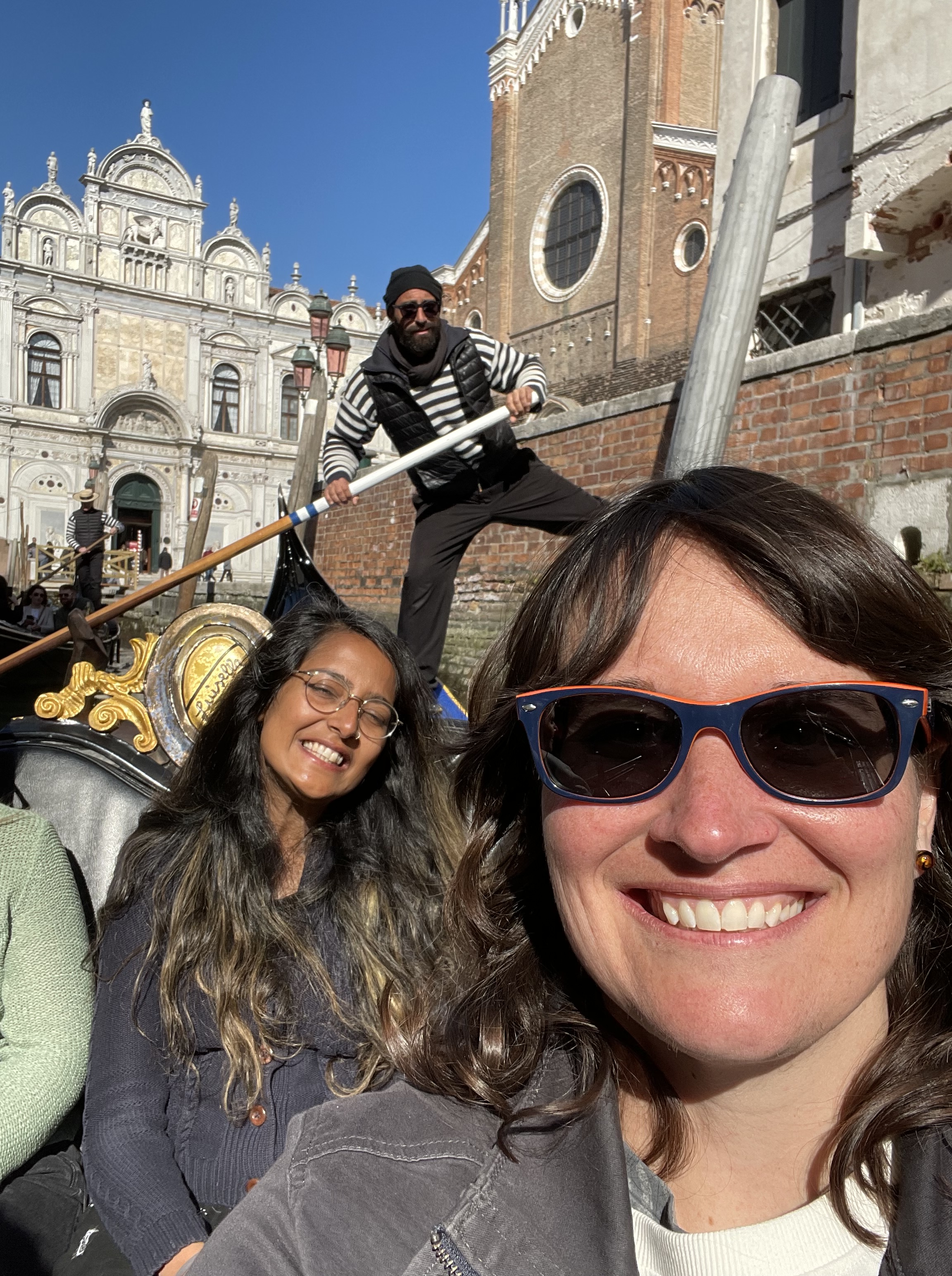
“Is it me you’re looking for?” the gondolier greeted us, his arms spread as wide as the grin that was tucked underneath his impeccable winged moustache. We were, in fact, looking for him, this man who none of us had ever laid eyes on before. Or rather, we’d been looking for someone just like him as we’d rambled over bridges and down alleys, voicing aloud our collective dream for the perfect gondolier: friendly, hilarious, aggressively Venetian, preferably a singer. And then he just appeared before us, like our wishes had conjured him into being.
“My name is Anzolo. It’s a traditional Venetian name,” he began by way of introduction, once it was clear we’d been hooked. We introduced ourselves in turn. ‘We’ were a group of 7 mostly-strangers who had just met during a free walking tour. Two Irishwomen were traveling together: one irate and one sweet. There were the singletons: an Englishman who’d quit his job to experience the world before maybe settling down so he’d “have no regrets later,” a happily single Portuguese woman living in Malta, and a soft-spoken German who wanted to join us for a joyride before she headed off to the quieter island of Murano. Shreya, my drinking-buddy-turned-real-friend from my Master’s degree days in Freiburg, had graciously agreed to tag along with me for a long spring weekend in Venice. And yours truly, how do you do.
We should have taken it as a hint when we were greeted with spread-eagle arms that Anzolo was a hugger. No sooner had we all spoken our names and origins than he moved in for the first bear-hug. “You need to give 5 hugs per day,” he insisted, and I could tell he’d already overdosed on daily hug-drugs by the time we’d come along. He was no taller than I but barrel-chested from the physical labor of gondoliering. I ducked around the stiff sharp brim of his hat and tilted my face towards the sun as I allowed this complete stranger to embrace me, still an odd thing to my Midwestern sensibilities. His trademark striped Merino sweater was kitten-soft beneath my fingertips.
The official price for a 30-minute gondola ride was 80 Euro per boat, but our tour guide had encouraged us to haggle. That’s a game I’ve never been very good at. Fortunately the loud Irishwoman took the lead, invoking Ireland’s financial woes in her bid to get us a cheaper price. Anzolo volleyed, laying on the compliments and then, when that didn’t work, invoking Venice’s pandemic-related financial woes in his bid to extort us. The rest of us awkwardly followed this first-world-problem exchange like it was Wimbledon.
Yet it was the sidelines we should have been watching, for Anzolo had a quiet shadow. A second gondolier leaned against the dock behind him, apparently content to sit back and watch while his gregarious partner both reeled in the tourists and argued with them over money. Our soft-spoken German moseyed over to the shadow. Their heads bent together. In under a minute, she’d negotiated us down to 15 Euro per person. None the wiser, the Irishwoman and the Venetian bickered on.

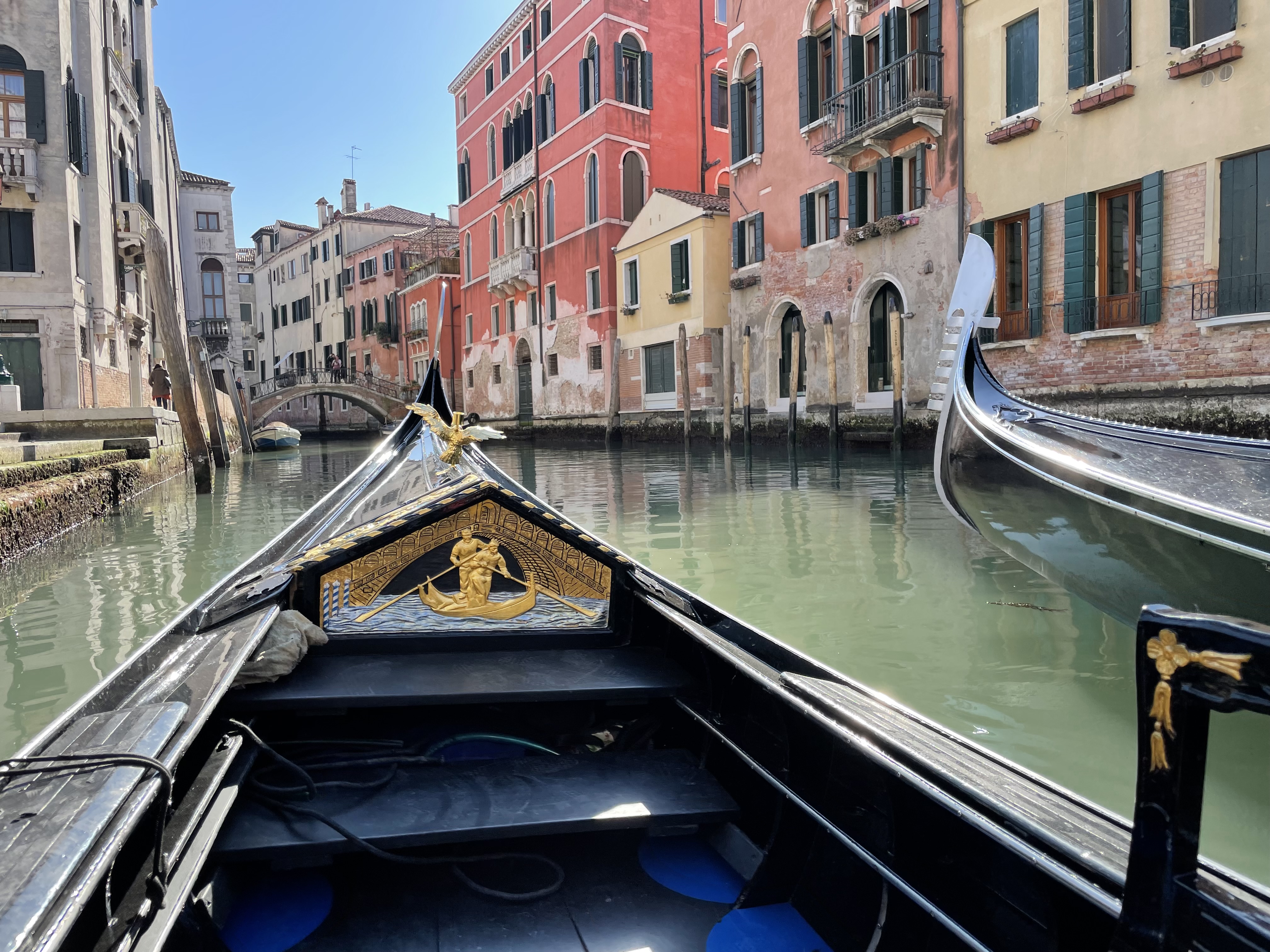
Flat-bottomed gondolas sit impossibly high in the water and the slightest movement causes them to bob and sway. I slithered into the sleek black vessel as low as possible and still almost ended up in the drink. I melded into my tiny chair and vowed to sit as still as possible, swiveling only my wide eyes and head like an owl.
The plaza at eye-level blossomed with springtime travelers walking everywhere and nowhere at once. Venice is an exclusive city: the only terrestrial traveling method is on foot. Wheels are precluded by endless stairs on the bridges, so there are no cars or scooters or bikes, and even wheeled luggage is a pain in the ass. To travel here is to slow down and move under your own steam (or at least the steam of a strapping gondolier). Yet there exists an even-more-exclusive layer, because half of Venice is hidden. Not underwater but on the water, a literal maze of canals quickly twists beyond the eyesight of anyone who is not borne upon a boat. This secret aqueous network holds the lifeblood of Venice, in many ways I couldn’t have imagined before I visited. Behind me loomed one of the world’s most beautiful hospitals, and its fleet of high-speed ambulance boats rocked gently in the Venetian lagoon beyond. Barges churned past them, laden with kegs headed for restaurants or construction materials and cranes. And before me, a line of low rainbow doors flanked the watery street, a term that’s not hyperbole – even Google Maps’ Street View works on Venice’s canals.
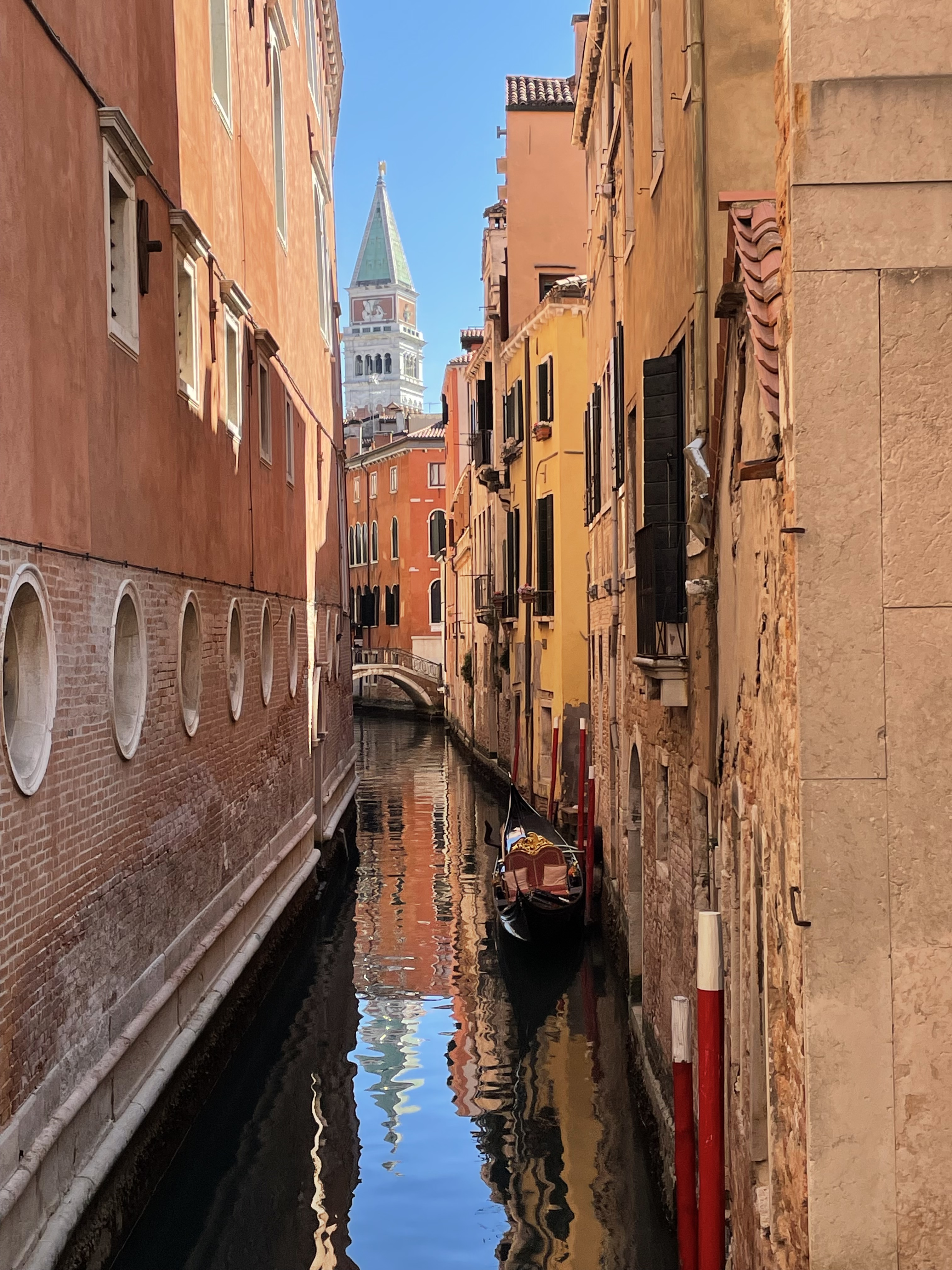
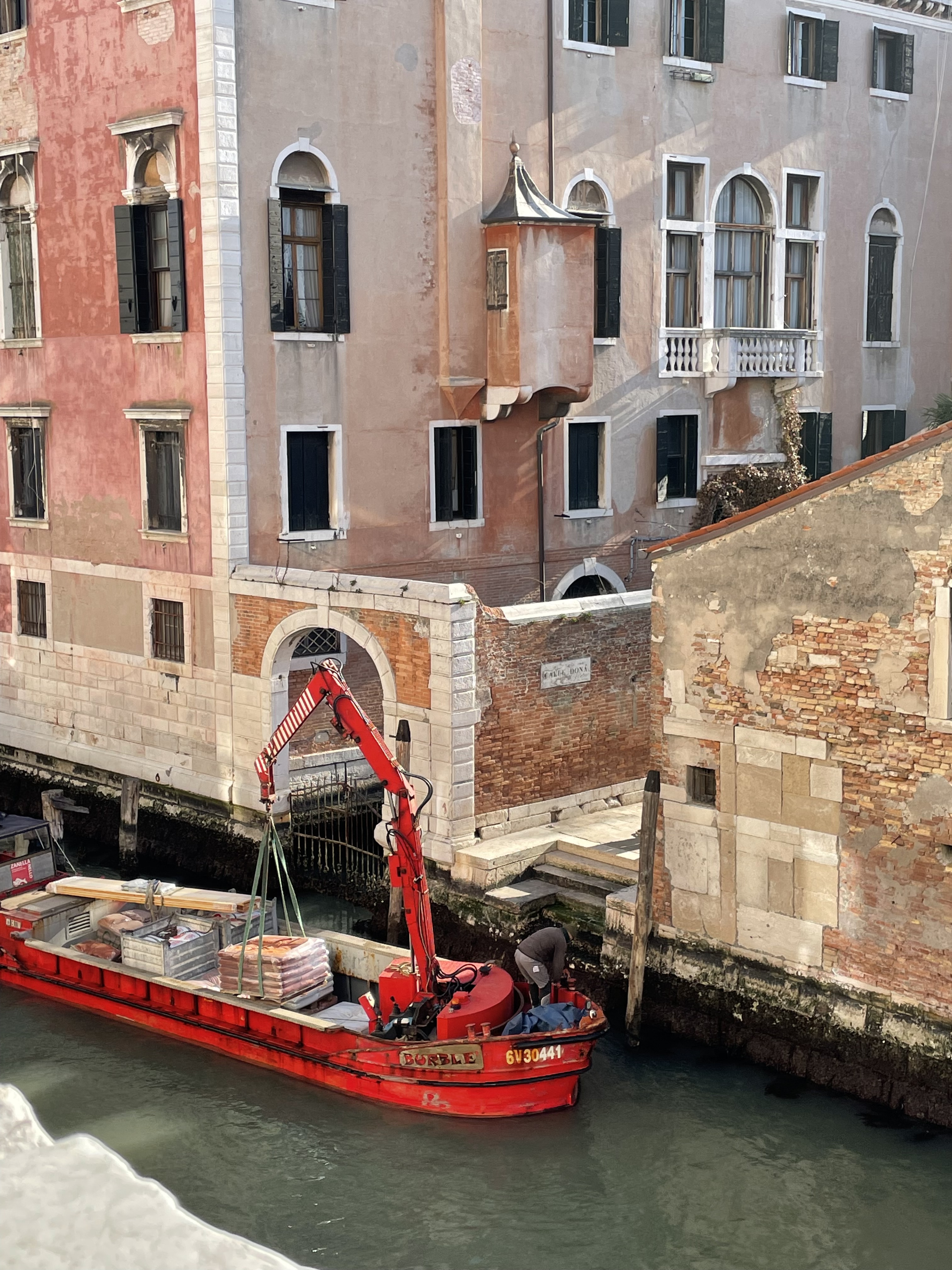
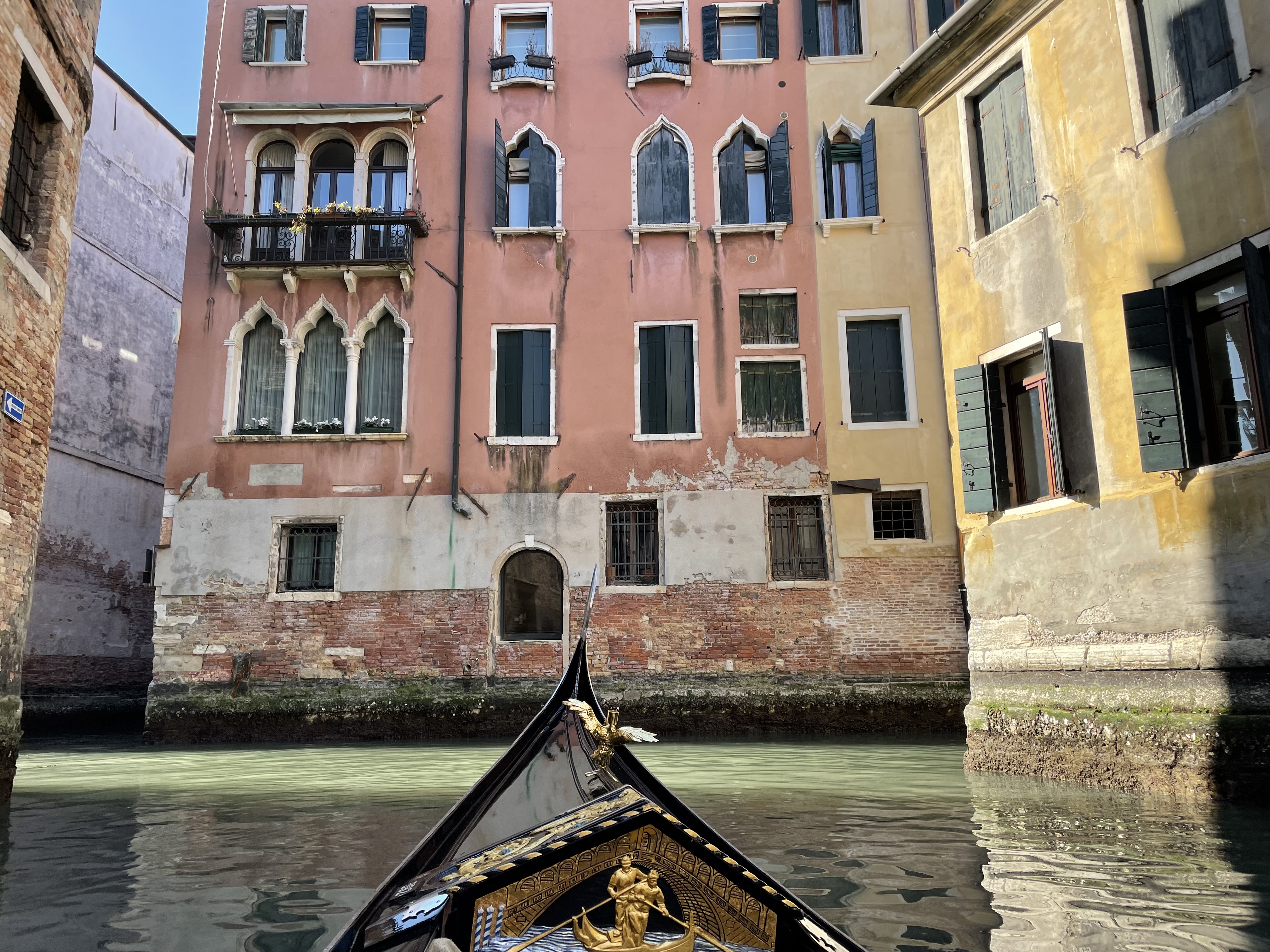
Without so much as a whisper, we slipped away from the dock and into the secret water world beyond. Anzolo pushed the 4-meter oar in one direction while literally kicking off a priceless ancient wall in the other. A finger of sunlight pointed us down to the end of the first canal, but as soon as we turned it was severed and we plunged into midday twilight. Only the tips of the buildings burned orange.
All susurrations of normal human life were swallowed by the narrow walls and sleepy water too.
The world became muted.
At least, until Anzolo began to sing.
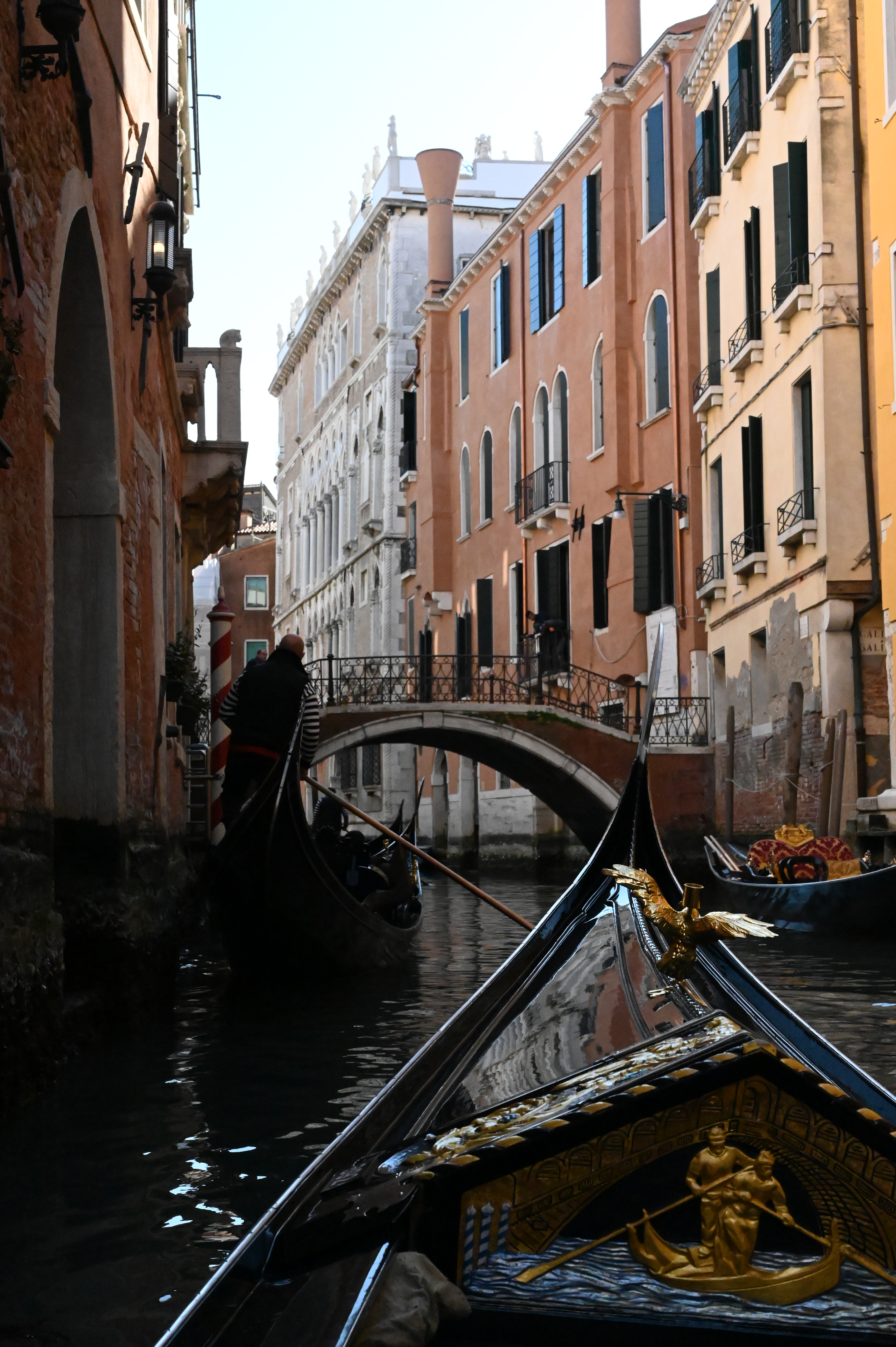
Amplified by the autumn-colored walls, his baritone voice boomed. He plastered the urban canyon with Italian syllables, none of which we could understand and every one of which we adored. Our two boats fell in line behind a third whose gondolier began a duet with Anzolo, the newcomer looking back at us and crooning into the end of his oar. This was all very charming until a ludicrously tight corner loomed ahead of us. I hoped these cowboys of the canals would stop horsing around long enough to course-correct.

Fortunately, every dimension obeys the gondolier’s command. What was theoretically a complicated calculus problem was just a flick of the wrist for these professionals. Each of our 11-meter boats pivoted on a dime. We threaded underneath a series of low-slung bridges. One of them, Anzolo told us, was called the Bridge of War. When we asked why, he was humble enough to respond that he didn’t know – but that maybe after we passed underneath, it would be called the Bridge of Peace. Chamuyero.*
In some places the veil between the terrestrial and water worlds wore thin. An open-edged plaza yawned to my left and the volume of humanity grew to a crescendo. Yet in a world with few engines, there was an unfamiliar depth to the noise: it was built from a hundred voices and yells and laughs, mixed with a thousand words spoken in a dozen languages, and all of it was decorated with a song carried in from the busker on the corner. I could hear the rustle of shopping bags and the swish of the streetcleaner’s broom. Beneath it all, the rhythmic whisper of three oars caressing the lagoon kept time.
Just as quickly, the walls would cuddle back in around us. The juxtaposition was jarring. Only the eyes of a hundred empty windows watched our passage through the canyons, and otherwise we were the only signs of life. An authentic behind-the-scenes feeling greeted us there too, like this part of the city wasn’t putting on a show for us, and was content to just be.
Flitting between these worlds, I was tempted to see them as separate. My narrow human sensibilities wanted to disassemble this environment into distinct black and white pieces. Yet Venice is both and depends on both, in the same way that islands depend on water for existence. Venice’s storied buildings depend on generations of noisy humans, without whom the Venetian islands would still be a marshy paradise for birds. Gondoliers depend on the influx of international tourists, without whom they may either have gone extinct or adapted to locals’ needs by functioning as traghettos, quickly ferrying people across larger canals for a few coins rather than playing Charming Musical Tour Guide for an eye-watering 80 Euro a pop. Whether any of these alternatives would be better than reality is a discussion for another day, but the fact remains: modern Venice is both the noisy terrestrial and quiet hidden world, the color and the twilight, the islands and the lagoon. And the gondoliers are there to guide you through it all, the literal boatmen ferrying you from one side of this world to the next and then back again.
With a gentle bump we reunited with terra firma. I took Anzolo’s hand and stepped through the veil, directly into a patch of simmering sunlight. I toed the edge of the water to stare down to the end of the canal we’d just left. While I couldn’t see beyond the bend, I knew now what waited there. Slices of serenity scattered throughout a bustling thousand-year-old city. One integral part of a complex and interwoven world. The hidden beating heart of Venice.


*Argentine slang for “smooth-talker/bullshitter”
Date of visit: March 2022
 Window Seat Odyssey
Leave a comment