I’m not convinced this place is real.
I thought this so many times during this trip, it became my unofficial motto. There’s an untamed and ancient magic here that bleeds from every landscape we come across, an enchantment that seeps into the air and fills our lungs.
“The Emerald Isle” is a nickname as fanciful as it is inept. There are more shades of green here than could ever be named, certainly more than my eyes can comprehend or my camera can capture. The Inuit have 50-odd words for ‘snow,’ but the Celts would need 500 for ‘green’ to even begin accurately describing the hues of their landscapes. Every curve in the road, every deforested hillside was painted in its own shade of jade or kelly or olive green. The ubiquitous patchwork of fast-moving clouds periodically cutting off the sunlight could even make the same blade of grass change from emerald to lime to teal in rapid succession. And this is not even to mention the colors besides green: the rusty maroon of oxidized volcanic rock, the azure of the crashing sea, the cheery cerulean of the sky that occasionally peeks through the clouds and seems so much brighter here. The hues are so vibrant that they almost have an inherent glow, popping from the landscape even when the sun hides behind the ethereal mists. Ireland is a kaleidoscope of color, and don’t let anyone tell you differently.
Dublin
For a city so often ensconced in grey mists, you would think Dubliners would have chosen a different color for their buildings. But perhaps they’ve come to love the silver and iron hues so much that they wish to see them even on the rare day the sun does shine, like it did on the first afternoon we visited. We spent the morning meandering through the streets of the capital, our cameras’ eyes drawn to the rare splashes of color in street art and wildly colored pub fronts.


Before leaving I had asked suggestions from a few different contacts who knew Dublin well, and their general advice was “See the Temple Bar then get the hell out of Dodge.” But we found a few worthwhile things to do, the best of which was – of course – the Guinness factory. It was a fair hike out of town, but the sun came out while we were having our first Irish beers in a pub and we took it as a good omen. We skirted the mysterious walls of the factory, walking for what felt like half an hour around solid brick walls three meters high, presumably so tall because they had to contain the secrets of how that precious ruby-red liquid is made (contrary to popular belief, Guinness isn’t actually black). I felt a bit like Charlie Bucket after he found his Golden Ticket, staring at this behemoth factory from the outside.


The museum itself is a seven-story building literally shaped like a pint glass, filled to the brim with Guinness history and brewing information, but the real draw was the tastings. I’ve always had kind of a dubious relationship with Guinness, so I wasn’t expecting much when I was handed a diminutive glass filled with the famous stout. They quickly taught us the proper technique for drinking it (breathe in, take a sip, swallow and breathe out) before allowing us to drink. And let me tell you, all the things they say about Guinness being better in Ireland are an understatement. In that tiny dark room filled with strangers, I had a religious experience. It was liquid satiny chocolatey goodness spreading across my tongue, carrying none of the awkward hoppy bite that it carries when it comes out of a can. In ten seconds flat I became addicted, and for the rest of the week I was constantly seeking it out, doing my best not to prostitute myself on street corners in exchange for the delightful stuff. Our entrance fee also included a free pint (best museum ever!), which we learned to pour ourselves with the help of an expert and then enjoyed high above the skyline of Dublin.


It is much harder to find trad (traditional Irish music) in the heart of Dublin than one might think. We passed countless awkwardly-named pubs (The Hairy Lemon? Seriously?) packed to the gills with tourists, but the live music spilling out of their open doors was always disappointingly mainstream. We wandered aimlessly, slowing to a mosey when we heard promising melodies, sometimes taking a couple of side steps closer, like the music was a hook loaded with a juicy worm and we were hungry fish, but we always eventually passed them by.
We were at our second-to-last option, lost down a wide pedestrian street filled with people, when a door opened and the sharp whine of a bagpipe poured out, chased closely by the rapid notes of a fiddle. We glanced wide-eyed at each other and dove through the open door. Three musicians, the oldest of whom looked barely able to hire a car, sat wedged in a corner of the dark bar, a scant three feet from the audience. They were more motion than men, playing so fiercely that their fingers appeared blurry even to the naked eye. The entire bar raised their voices to sing along to the choruses of well-loved Irish songs about fishmongers and Belfast (I joined in for a few of them – thanks, Gaelic Storm). The absolute highlight of the evening was when a young man pulled a septuagenarian woman onto the tiny dance floor and swung her around; a smile of pure joy lit up her face and spread infectiously to everyone in the room who watched them spin and laugh.


Belfast
I haven’t driven a vehicle in about ten months, but Ireland has this wonderful meandering tangle of roads through unspoiled landscapes, so I made the enlightened decision to hire a car. You know, in a country where they drive on the left. My second mistake was picking up the car in downtown Dublin, a city that – like most in summer – has so many construction craters in the street that it looks like it was recently hit by an alien war of Avengers-like proportions, and where pedestrians utilize the entire road as their own personal crosswalk. Initially there was much screaming from both of us and fighting of instincts to turn into the wrong lane, but thanks in no small part to the obliging nature of the Irish drivers who suffered my mistakes, we made it to Belfast.


Belfast is a rather small and plain city, but the weather was fine and there was some history to be learned in the form of “The Troubles,” an understated name for territorial violence and terrorism that gripped Ireland for thirty years. The strife eventually became so dire that fourty-foot (11 meter) metal walls were erected through the heart of Belfast to stop neighbors from killing each other. Some of the walls still stand, lost in a far-flung corner of Belfast that felt almost abandoned save for the groups of wild teenagers kicking footballs down the uneven streets. The walls have been tagged by countless street artists, but what stands out are the messages of peace scrawled in marker on top of the paint by countless thousands of visitors. I walked the wall for half a kilometer, rapidly scanning the words, quotes from John Lennon and Bob Marley intermingled with vague messages of hope and warnings to not let such atrocities happen again (and, I admit, quite a lot of messages about Trump). I walked through a double-layered vehicle barricade topped with razor wire, abandoned-looking but somehow devoid of rust, and I was struck by its recentness: only 19 years have passed since the end of the Troubles, in a country that today is the height of civility.


We rounded out our stay with another trad session, and although this time we had a lead from our hostel, it took us forever to find the damn place. Finally, after much wandering around and cursing out Google Maps for being wrong, I asked the doorman at the address it was meant to be at. He good-naturedly winked, grabbed my elbow and led me inside, asking me as he did: “How good’s yer eyesight?” Lo and behold, the Fibber Magee bar (yes, really) was inside this other bar. By the time we pushed through the hinged double doors a duet called the Buckmad Bhoys had already started playing, composed of a diminutive ginger wielding a guitar and a lanky blond with a fiddle and a truly impressive set of lungs. Together they whipped the bar into a frenzy, playing everything from traditional songs to original, and then throwing in some Celtic-ized versions of Like a Virgin and the ilk. Two women in the crowd began traditional Celtic dancing, reinforcing my belief that I need to learn this skill immediately, which led to a full-blown dance party that broke like a spell when midnight struck.
Causeway Coastal Route
“Now THIS is Ireland,” Lorenza sighed as we rounded a wide bend in the road and were greeted by the sight of sunlit emerald hills flowing gently into the sea. We’d finally found the Causeway Coastal Route, a road that is touted as one of those you must drive before you die. After three days of grey city life it was a welcome change. Each bend in the road revealed a new tiny white village, nestled into gentle folds in the landscape; a soft oceanic scent tinged the air. The road was 130 kilomters, but we only ever made it about 11 before I had to slam on the brakes again and turn into a tiny unmarked pulloff so we could take photographs.


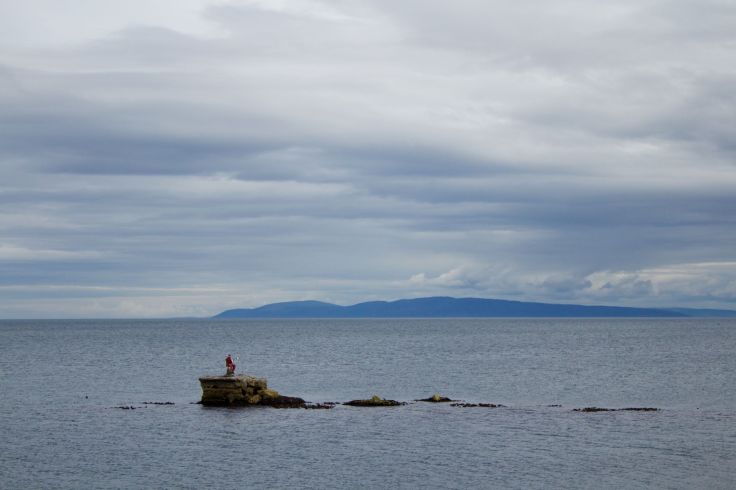
We also made a few dedicated stops. The first was a short rope bridge high above the sea that led to a small island off the coast, allowing us to view the cliffs back on shore. The second was the Dark Hedges, a boulevard lined with centuries-old beech trees whose branches twisted and turned like the roads we’d driven in on. The last was the UNESCO-listed Giant’s Causeway, an oceanside geologic site with hexagonal volcanic rocks. It was pouring when we arrived at the latter but I decided to get out regardless, solely because I’d come all that way and didn’t want a little bit of rain to stop me.


Two avid photographers traveling together makes for an interesting dynamic. We were endlessly engaged in a game of leap-frog, one of us stopping to take a picture while the other went on ahead, until she in turn found something worth photographing and was passed by the other. Occasionally one of us would find a view or a plant so beautiful that we both had to stop for it. The results of these rendezvous were particularly interesting because we could be standing in exactly the same spot but see completely different things. Lorenza was forever looking up, fascinated by the ropes of clouds and colors produced by the sky, while I was obsessed with the contours of the ground and the multitude of things covering it. The upshot of all this was that it took us at least twice as long to get anywhere, but at least we had fun, and we weren’t concerned about annoying our companion by constantly stopping for pictures.


Connemara and Galway
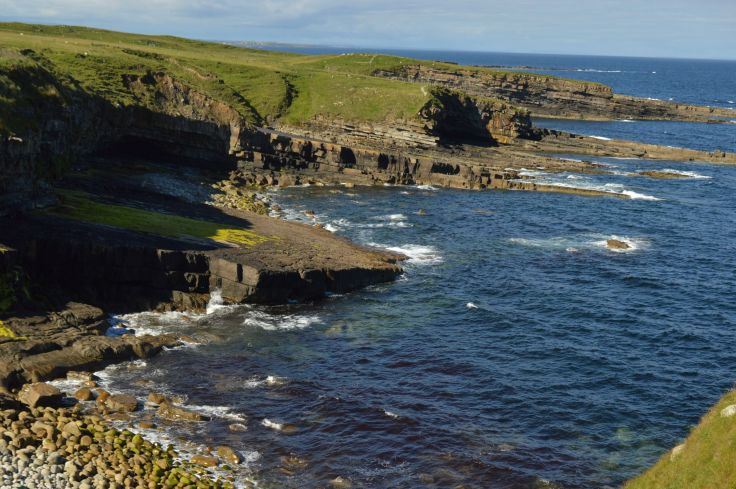
Our driving routes were largely dictated by our whims and the decisions of our infuriating GPS unit, which nearly drove Lorenza and I into homicidal rage by having a terribly insensitive screen and by beeping cheerily every single time I exceeded the speed limit by even 1 kmh. We were delighted by the names of the towns rolling past our windows: Ballyboffy, Killinaboy, and Flaggy Shore, to name just a few. When we woke to blinding sunshine in Bundoran, we decided to head to the coast on a lark, where we found a tiny castle perched on the edge of the world (pictures above and below). Then we swung inland and headed for Carrowmore monolithic cemetery, a prehistoric anthropological site with fairy-like rings of boulders that reminded me of a tiny and less impressive version of Stonehenge. In Lorenza’s words, visiting this ancient burial site made one feel confusingly both more and less connected to these ancient people.


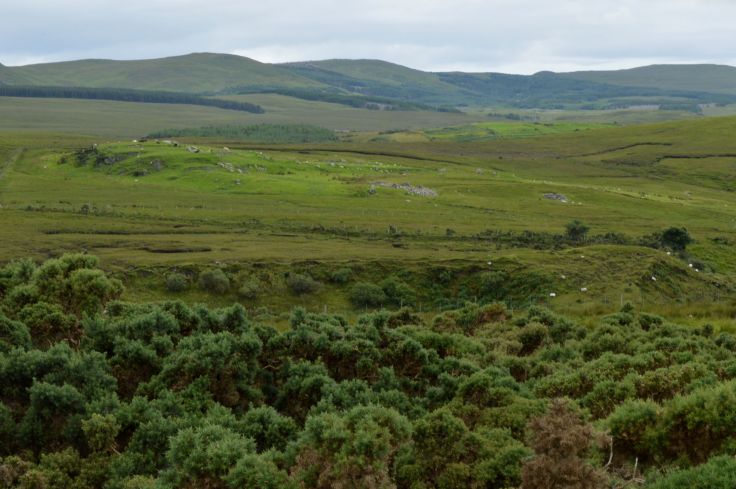
Although we’d been touring the stunning Irish coast for days, it wasn’t until we reached the hills of Connemara that I lost track of my breath. The road twisted through sprawling valleys flanked by enormous sheep-covered hills. At times we found ourselves utterly alone. The wildness of it shocked me, after many months living in a country that’s so orderly that even the trees seem to abide by human laws. My gaze wandered ceaselessly, glancing at the road just long enough to determine which way it was going to swing next before I returned to looking up to the sky or the dancing ridges of the hills.


It seemed that every time I became comfortable with Irish roads, they decided it was high time to throw a new obstacle at me. I acclimated to driving on the left, so the speed limits switched from kmh to mph with absolutely no indication (I’m sorry, everyone, for going 60 kmh when I should’ve been going 100). Then the roads began to shrink and wind, the lanes varying wildly between the exact width of our Toyota Yaris and little more than a two-track, always abruptly parenthesized by living walls of green that reduced visibility to a few hundred yards at best. At one point I was barreling down the 10-foot-wide road at 80 kmh, which was a solid 20 kmh shy of the limit but felt like nothing short of lightspeed, when an enormous blue tractor suddenly appeared around the bend. I squeaked, nuzzling the side of the car into the hedge and coming to a full stop, repeating “nope…nope…nope…hnnngh” as it narrowly squeezed by me. By the time we got to Connemara, the loose sheep had appeared, bounding comically down the street in search of greener grass or taking a nap not a foot from the asphalt. And, as a side note, the fact that there are at least 30 roundabouts in between Londonderry and Galway is nothing short of preposterous.
After dodging a few lochs and wayward freshly-sheared sheep we found a hiking trail that led us high into a bog, water filtering slowly through the centuries-old peat. Tiny pink flowers ringed shallow pools of crystal-clear water. A chorus of far-off sheep’s baaa-ing rang off the rocks, some of their voices high pitched and sweet while others made noises resembling an ogre puking after too much Guinness (trust me, I know what these things sound like).


The Aran Islands (Inis mor)
We’d watched the weather all week with apprehension, hoping that the doomsday forecasts were wrong, but we woke to a grey and squally day with intermittent rain lashing down in sideways curtains. We stubbornly decided to carry on with our plan regardless. Our ferry rolled on confused seas, 10-foot slate-grey waves sliding past our windows and shooting salty spray to the top of the plate-glass windows. The good-natured crew passed out handfuls of cheerily-striped green barf bags, which combined with the rollercoaster-like motion to make the whole affair seem like a carnival, but mercifully few people were actually sick.
Our boat docked in a “town” comprised of a handful of squat colorful buildings, looking for all the world like a gathering of weathered old men hunkered down against the wind that relentlessly gusted in from the west. We rented bikes and joined the small tourist horde that was cycling up the hill towards the middle of the island. Town gave way quickly to open verdant fields punctuated by endless miles of dry stone walls, crisscrossing in tight geometric patterns as far as the eye could see. Ephemeral mists descended on and off mercurially, lasting just long enough for us to dig our raincoats out of our bags and zip them up before the air cleared again. Eventually we forwent them entirely when we realized the mists were barely heavy enough to cover us in a fine layer of pearly dew.


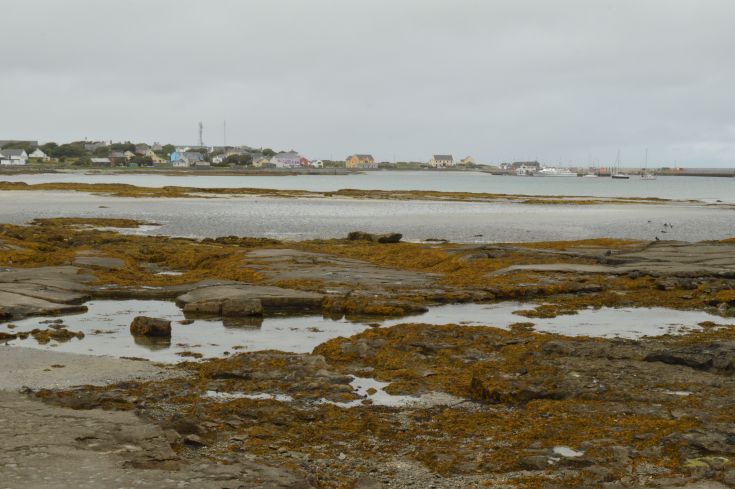
The landscape was entirely foreign, stretching out like an uneven batch of sugar cookie dough that’s been only partially rolled out. There wasn’t a single tree, something that our forester brains couldn’t accept. There were few indications that we were even still in the twenty-first century besides straggly powerlines stretching to lonely houses and the occasional meandering car. We stopped and bought the obligatory Aran Islands knitted sweatshirts, even though we never saw a single sheep on the island (and it upset us greatly). We rambled over karstic rock pans so flat that they looked like lakes from far away and hiked up to Dun Aonghasa, a prehistoric triple-rainbow-shaped fort perched on a clifftop in such a way that I initially thought half of it had been devoured by the sea. My ceaseless sense of curiosity led me to belly up to the cliff face, literally laying on my stomach and slithering forward like a slug until I could look over the edge at the surging sea far below.


The boat ride back was quieter and calmer, the sun finally bursting through the clouds and turning the ocean into molten silver. A bright flash of white caught my eye outside the window and I saw a diminutive seabird take flight from the crest of a wave, arcing high into the sky before wheeling back to race parallel to our boat, its elegant and tiny wings somehow keeping pace with us before it disappeared behind the next gently rolling wave. Watching it twist and dive, I felt wild and fierce, my heart temporarily leaving its cage to skip across the crests of waves in pursuit of this tiny creature.
That night on the drive to Doolin, the sky put on an incredible light show. The soft typical blues of late evening clashed together with an orange of the setting sun, which filtered through the clouds in an such an eerie way that it set both of our teeth on edge every time we looked at it. It infused both of us with an unshakable sensation of foreshadowing to some terrible event. I drove the harrowing and darkening roads extra carefully, stopping every now and then to admire the views created by this uncomfortable light.


Cliffs of Moher
Trusting the advice of our scatterbrained hostel manager, we parked our car on a narrow side street to avoid paying parking fees and walked through a cow pasture on the edge of the world to the Cliffs of Moher. The sun was finally out in full force, bringing out the electric hues of the grasses and exposed rock as we scrambled down hills and around fences and finally over barbed wire to get to the real trail. Coming in from an unorthodox direction allowed us to meet the cliffs one-on-one, not having to deal with the hordes of tourists we’d find further down the trail.


I’ve seen oceanic cliffs a few times – the most memorable being in southern Australia, but they never cease to amaze or scare the bejeesus out of me. We climbed up to the pinnacle and I once again became intimate with the bare rock face, staring 700 feet down to the Atlantic (yes, really) and hugging the rock in an attempt to fight the irrational fear that it would give way and send me plummeting to my death. If you ever have the urge to feel incredibly mortal and insignificant, lay on a cliff face at the edge of the world. (The pictures below are me on the edge (left), and a picture showing where I was laying (right)).


The deeply-rutted and terribly slippery path passes within a few feet of the cliff face sometimes, a fact I largely ignored except for a few times when I accidentally glanced over and felt the world spin with vertigo.


Our last stop on the way back to Dublin was at the Burren, an enormous hill made of the same karstic limestone as the Aran Islands that lay just offshore. We actively looked for it and couldn’t find it, but on the way back to Dublin we quite literally stumbled across it; just one more example of the magic that this island exudes.

I absolutely loved Ireland. It’s everything I ever wished it would be. It rapidly climbed to the top of the list of countries I want to return to someday (joined in the unranked top three by Croatia and Turkey). The culture, music, colors, landscapes, language and friendliness combined into an incredible adventure, and I encourage everyone who’s ever wanted to visit to go as soon as humanly possible.
**Special thanks to Lorenza for being a fabulous travel buddy and for providing some of these pictures!**
 Window Seat Odyssey
Leave a comment