Big cities and I have a complicated relationship. Despite my desire to like them, we’ve never gotten along. I know many people who love cities and are drawn to their vibrancy, centering entire vacations around thriving metropolises and then encouraging me to do the same. I always try desperately to make it work: eating the local specialties, seeking out the things that make it unique from the others, making an effort to see the culture for the people. But every time I end the trip feeling burnt out and underwhelmed. New York, Houston, Melbourne, Paris, London: three continents’ worth of major cities and it’s always been the same.
I expected Istanbul to be much the same. We’d been hearing all week from other foreigners about how Istanbul was a zoo, with tourists and locals everywhere, relentless salesmen who would hound you nonstop with clever sales tactics, and long lines to get into the major sights. The closer our flight to Istanbul came, the more apprehensive I felt. But the plans were set and I was ready to try it again, hoping maybe Istanbul would be the one, so I got on the plane and didn’t look back.
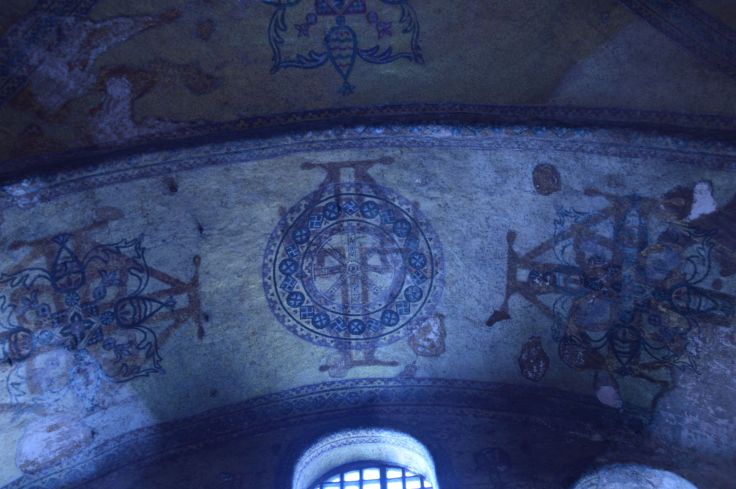
We introduced ourselves to Istanbul in a gentle way, walking the short jaunt from our hostel to the Hagia Sofia. This strong but beautiful building has a long and colorful history, almost none of which I retained besides the fact that it was originally built as a Christian church and then converted into an Islamic mosque and now stands as a museum guarding the history of both. Its innards are contradictory, gleaming with gold in one corner and brooding in darkness in the next; some walls are tiled, some painted, some faced in rose marble.


I’m not religious, but chills raced up my spine as I stood like an ant on the uneven marble floor, staring upwards long after my neck had started to protest. Those lofty domes were lined in beautiful looping swirls of Arabic, quotes from the Qaran almost hugging enormous frescoes of angels and Jesus. One beautiful thousand-year-old building encompassing two faiths. Why is it so hard for our world to emulate this building? I wondered as I slowly wandered around, letting the cool marble balustrades steal warmth from my fingertips. What is the point of all this fighting?
Just as we emerged from the cool inside of the museum, an enormous maroon minaret above us crackled to life. A beautiful echoing duet ensued between Hagia Sofia and her baby brother the Blue Mosque, which glittered at us from across the lush square. One would call and the other would answer, like a sibling’s conversation encased entirely in song.
We followed the Blue Mosque’s summons, two tiny American fish swimming upstream against the tide of Muslim worshippers streaming out from the mosque’s doors, their service just having finished. We somehow had not stepped socked foot into a mosque yet despite being in Turkey for an entire week, so the entry rites were still entirely foreign to us. I was instructed to wrap my auburn hair in a powder blue scarf with the words “Property of the Mosque” stamped onto it and slip into a floor-length skirt of the same material over my fitted jeans. We followed the herd of tourists to a tiny room smelling of feet, where we also removed our shoes, before crossing the threshold into the cavernous house of worship.


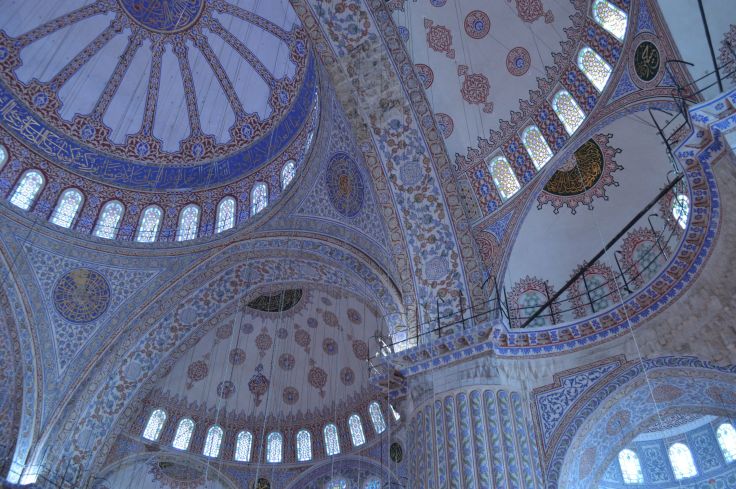
The carpet was lush under my loudly patterned socks (thanks Mom), lending some small comforts to the few men still performing their prayer on the spacious floor, the kneel-bow-kneel-stand repetitions slightly reminiscent of Salutation to the Sun. But the thing that immediately drew the eye and refused to let it go was the vaulted ceiling, covered in countless tiled mosaics and paintings of every possible color.


Istanbul literally bridges the gap between the European continent and the Asian, taking up so much space it feels impossible to even scratch the surface on everything it has to offer. We did our best in the short time we had, hopping a brief ferry to the Asian side and exploring its banks and fish market, freezing on the upper deck of a Bosphorus Straight cruise, eating baklava and kebap at every chance, spontaneously meeting other travelers and exploring the electric streets of the Taksim area with its lively crowds and Bourbon Street vibe. We dove into the belly of Istanbul, wandering around the Underground Cistern. We relaxed in our hostel’s rooftop terrace, sipping local beer while staring out at the window-framed Hagia Sofia, her proud domes and minarets standing tall over the rooftops.


Our penultimate activity in Istanbul was a whirling dervish performance. In this traditional ritual, Muslims of a certain religious order (dervishes) literally spin their way into deep mediation. They twirl in unison upon one foot, propelling themselves with the other, their heads tilted and arms raised, one hand pointing to the ground while the other reaches for the sky. Flowing skirts of heavy white material orbit their waists as they spin, rippling through the air and giving brief flashes of their effortlessly coordinated feet, almost mechanical in their precision. Total inner peace renders their expressions blank; their eyes are closed and they’re seemingly deaf to the haunting tune echoing through the small brick chamber, live music played and chanted by seven male musicians who would blend into the wall if not for their remarkable white hats. Watching the dervishes, the quick tap – turn – tap – turn of their feet, the hypnotizing flashes of their blissful faces, I feel the tumultuous sea of thoughts that always crashes about in my head becalm itself. Their peace became my own in that intimate room.


After recuperating from our vicarious-meditative experience, we decided to go out with a bang on our last night in Turkey, meeting up with some friends of a friend for dinner and drinks on the town. Being natives, they effortlessly led us through the convoluted maze of cobbled streets, which were already congested with reveling locals and tourists alike despite the early hour. Our hosts ushered us down a dark alley and into a thin hole-in-the-wall restaurant, completely empty save for a few bored waiters, a chef, and the heavenly smells of the meat cooking in a meter-wide wok. As far as I could tell there wasn’t even a menu; a ten-second conversation was all it took to order for all four of us. We sipped our drinks and waded through the shallow seas of small talk while we waited, feeling out the dynamics of this friend-of-a-friend situation and seeing how we fit together.
What arrived on our table was something almost – but not quite – exactly unlike a burrito. It involved a tortilla and meat, but there the similarities stopped; this concoction was swimming in tangy yogurt and tomato sauce, spiced to perfection and served with a strange selection of optional toppings including hot peppers and cilantro. I learned once what it was called but the foreign-tasting word immediately slipped out of my brain, leaving only the memory of nameless deliciousness behind.
Our bellies full yet again (trust me, we have not starved on this trip), we slipped back into the night, ducking down a sidewalk that was lined on both sides by tables squished so tightly together there was hardly any room to move. Every chair was filled with men and women in various states of inebriation, the woven fabric of a thousand conversations knitting itself together around our ears in the cold night air. We managed to find a table in the center of a cramped attic above one of the streets, and there we ordered an entire bottle of rakı.
Rakı is a Turkish anise-flavored liquor, faintly reminiscent of black jelly beans (and similar to Greek ouzo), but it is much more than just a spirit. Turks get together for dedicated rakı nights in specific bars (you don’t order anything but rakı in such places if you know what’s good for you), using it to bond over celebrations or break ups or bachelor parties or Tuesdays. Every table in the joint had at least one bottle of rakı proudly sitting in center stage, witnessing firsthand all these moments in all these lives, fueling tears from a beautiful dark-haired girl in the corner as she discussed troubles with her friend, and lending spirit to a gangly drunken dancing man whose head flirted dangerously with the low ceiling. A troupe of three red-faced musicians furiously belted out traditional Turkish music on instruments whose names I couldn’t even begin to pronounce, the bar’s patrons singing along with varying degrees of musical talent. We had to shout over the ruckus to be heard, some of our words getting lost in the din as we discussed hunting and travel destinations and countless other things I have since forgotten thanks to the rakı glass that somehow kept refilling itself. Sitting in that crowded room across from new friends who had been strangers just hours before and watching the silver flash of a musician’s fingers flying over the strings of his harp-like instrument while sipping my pearlescent liquor, I lost myself in the present. The regrets of my past and the worries of my future disappeared as I was swept up in the overwhelming feeling of humanity embodied in that room.


When I was planning this trip, an overwhelming number of people questioned my decision to visit this country. “Why Turkey?” they wanted to know, which was almost always followed by “Aren’t you worried about the violence?” The first question was easy to answer: for some reason Turkey has always called to me from across the Atlantic, whispering promises of little-known Roman ruins and culinary delights. I’d always heard it was a beautiful place full of a stunning array of landscapes, housing an ancient civilization that was built up over millennia, where the cultures of two seemingly disparate continents have blended into one hospitable people.
The second question always tripped me up, but I quickly learned to dispel these well-wishers’ fears with platitudes, even though I was quietly wondering what I was getting myself into. But, as with most things, my apprehension turned out to be unfounded. On my second day, while waiting on the thin concrete wall that served as a train platform in Selcuk, I was rubbing shoulders with over 50 locals who were smoking or listening to music on their phones or working on renovating the train station to improve tourism prospects for the town, and I was struck by an overwhelming sense of familiarity. These people spoke a different language and ate different foods and practiced a different religion than most of the people I know, but underneath those layers of superficial variations they were fundamentally the same as me. Turks are a fiercely proud people, almost as patriotic as Americans (I’ve never seen another country fly as many flags as we do). Not to mention that not a single person I talked to condoned their neighbors’ fighting; some even had children who are serving compulsory military service in some of the most dangerous areas on Earth.


Although I’ve always wanted to go to Turkey, the lofty expectations I’d built up ended up being surpassed. Less than a day into my trip I got the sense that I’d been swept up in a love affair that may very well last my entire life. There were certainly aspects about Turkish culture I didn’t like – the misogyny, for one, and the gauntlets of insistent salesmen who were always willing to gobble up significant chunks of your time if you gave them even so much as a “Merhaba” – but the enthralling blend of familiarity and foreignness evoked things in me I’d always sought from travel but never managed to find before.


I also experienced moments of true discomfort there, not from a personal safety standpoint but from actually seeing or hearing things firsthand I never had before: groups of old women who lived in extreme poverty (but seemed happy regardless), and Muslim women forced to pray in a small unseen corner of the Blue Mosque. But this is also when I feel like I gain the most from traveling. This is when I remember why I temporarily left behind my comfortable life: to leave my prejudices and incorrect notions at the door like worn-out shoes in need of replacement, to step through the threshold with an open mind ready to receive more never-ending lessons about the world in which I live but know so little about.
I left Turkey reluctantly, with whispered promises of a future reunion, looking forward to my future travels while tucking my freshly minted memories into a pocket of my mind where I hoped they’d be preserved forever.

 Window Seat Odyssey