In the morning we took a packed train from Selcuk to Denizli, a three-hour ride through surprisingly verdant fields framed by towering cliffs and snow-capped mountains. Every seat was filled and it was boiling inside the car, but we were inexplicably the only ones sweating. A man walked down the aisle, carrying a tray piled a foot high with fragrant freshly-baked bread called “simit,” only ever making it one or two rows before someone stopped him to buy one.
About halfway through our journey, an adorable old woman who couldn’t have been taller than five foot, boarded the train and sat down next to Julie. She sat quietly for a few minutes before trying to speak to us in Turkish, her deep brown eyes sparkling in her leathered face, until she realized we couldn’t understand her. Julie and I quickly exhausted our meager supply of Turkish vocabulary and then we all three fell silent, watching each other awkwardly, the wish for communication evident on all of our faces. But there came a moment when the woman simply raised her wrinkled hand and brushed the back of it against Julie’s cheek twice, breaking down barriers of age and language with nothing more than touch. She turned and smiled at me, holding my gaze for ten full seconds, and I immediately fell in love a little bit and wished I could adopt her as my grandmother.
There’s a surplus of adorable old people here, although I can’t put my finger on what about them makes me squeak with delight every time I see one. They tend to meander the streets in single-sex packs, focused more on their conversations than on their destinations (or often lack thereof). Their dress is almost always impeccable, grey tweed suits on the men while the women are wrapped almost completely head-to-toe in cloth, colorful dresses and head scarves covering everything but their cute weathered faces. There are of course the few who look like they’d chase you out of the house with a broom, but they’re few and far between.
We left the train and the adorable old woman in Denizli. The only reason we stopped there is because it is home to Pamukkale, which is Turkish for “cotton castle.” Hot mineralized water seeps out of the rock there, and has been slowly depositing snow-white calcium carbonite onto the cliff face for untold eons. The meter-thick layer of white calcite spreads out as far as the eye can see, making it look like a volcano filled with vanilla ice cream had erupted all over everything. At first glance it’s reminiscent of Mammoth Hot Springs in Yellowstone, but it has one important distinction: here you’re allowed to walk on the rock (barefoot, of course).
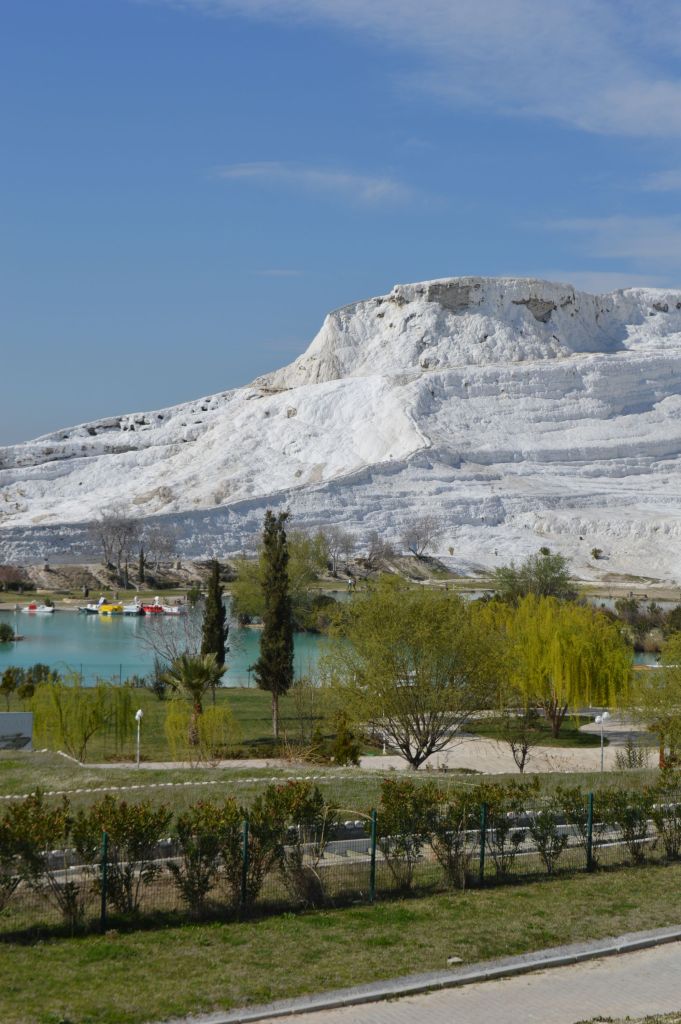
We hiked up the steep incline, stopping abruptly when we met the lip of the white rock. “NO SHOES PAST THIS POINT,” a sign nearby shouted in three languages, also providing shade for a bored-looking security guard whose job was to enforce the rule. I slipped off my trusty Tevas and stepped experimentally onto the rock, feeling the tiny smooth ridges grip the soles of my feet. We walked slowly up the path, exploring the warm surface with our fingers as well as our toes. Different sections of the living stone resembled everything from frozen cumulonimbus clouds to the delicate frills that hide underneath a mushroom’s cap.


The lower section was chalky and dry as a bone under our bare feet, but water soon began to flow over the gently rippled surface. Each step was an adventure, the water temperature varying unpredictably between frigid and warm. Pools that had been engineered by humans nestled up against the sheer white cliff face, trying and failing to stop the turquoise water from spilling over their edges. A few people swam in these pools, but we resisted, instead saving our swimming adventure for the Antique Pool that waited for us at the top of the hill.


Romans thought this place was so beautiful that they built a citadel and entire city on the hillside above Pamukkale. Hierapolis, as it’s known, wasn’t initially the big reason I wanted to see Pamukkale; once you’ve seen enough columns and arches and Greek inscriptions, they all start to look the same. So we half-heartedly perused the ruins, climbing onto ancient broken walls that would have been off-limits in many other countries. But it wasn’t until we reached the main street that my breath momentarily caught in my throat and a “wow” involuntarily poured out of my mouth. The undulating street was entirely deserted save for us, spreading out in either direction and painted gold by the late afternoon sun. A tree just off to my right dripped in singing birds, perched close enough that I could make out their crimson masks and stout bills with my naked eye. A steady stream of paragliders hooted and hollered as they flew just fifty meters over our heads, riding the gentle breeze over the ruins and down into the valley.


Our last stop was the Antique Pool, a thermal mineral bath at the base of the amphitheater. An earthquake long ago had toppled some nearby marble columns into the pool, and those lazy Romans decided to just leave them. They’ve rested in the same place for hundreds of years, lurking just under the surface of the crystal-clear water. We waded into the warm waters and immediately beached ourselves on the first columns we could find, much to the amusement of some tourists on a nearby bridge. The water is said to have healing powers, so naturally I drank some, finding the taste sweeter than plain water but not unpleasant.


We made our way slowly around the pool, stepping from column to column if they were close enough, trying to touch every last one of them. In the deepest part of the pool lay a column that was propped up to form an underwater tunnel for those brave enough to dive. We had to fight against the strangely increased buoyancy to get to the bottom, and I opened my eyes to ensure I didn’t run facefirst into the marble. My eyes immediately started to burn but I stubbornly kept them open for a moment, wanting to see the sunlit navy waters and eerie resting columns. I felt my way through the tunnel with my hands, surfacing with a rush of air on the other side.

It was near closing time when we arrived and the few other swimmers slowly trickled out, until we were all alone in that peaceful place. I floated effortlessly face-up just inches above one column, my head resting on its edge. I stared at the sky for awhile, a cloudless blue eye ringed by palm trees, then I shut my own blue eyes and released all tension from my muscles, sinking bonelessly into the water’s warm embrace. Tiny bubbles formed on every square inch of my skin, occasionally growing so large that they detached and made a break for the water’s surface. They raced along my scalp, from the nape of my neck to the back of my ear, making me shudder with the strangeness of it.
We came back down to reality just as the sun was melting into the horizon, coloring the stone terraces pink and violet. I stopped to take some pictures and leaned too close to one of the waterfalls, ending up with a pocketful of warm water before I realized what had happened. The rock face had cooled dramatically since our walk up, numbing our feet, although it was a bit of a relief since they were so raw from walking around barefoot. Floodlights illuminated the path and made the calcite shine, which combined with the frigid temperature and tricked our minds into thinking we were walking on a melting glacier.


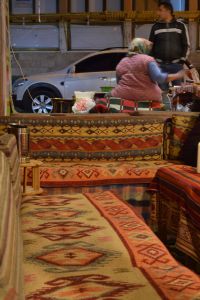
At the base of the trail there waited a gauntlet of restaurants, each with an insistent salesperson out front waiting to hustle us into their establishments. We were starving so we allowed the second woman to reel us in, enticed by the smells and the hot griddle resting just off the ground in front of the shop. We ordered two pides, which is basically Turkish pizza, some tea to warm our bellies, and künefe, a strange fried desert that had been recommended by a Turkish friend. A combination of phyllo dough, lots of sugar, and yellow cheese, it tasted delicious – but only once we got past the foreignness of it.
 Window Seat Odyssey
Leave a comment