We’re driving down a narrow two-track, windows cracked to let in the warm air that’s spiced with a foreign scent I can’t quite place. The road is parenthesized by life, the silver-green of olive leaves on one side and carefully spaced rows of stunted peach trees dripping pink flowers on the other. Conversation in the front seat drifts back to me, two voices discussing life in Selcuk: one spiced with a Turkish accent and the other tinged with a Texan twang. Then the car stops abruptly and we are ushered into a ramshackle building by our host, who tells us as he opens the door: “This is Turkish fast food, like our kind of McDonald’s.” Whatever low expectations we have after hearing that sentence are immediately shattered as we enter the dim room. Three women sit cross-legged on the floor, one peeling potatoes while the others deftly knead and roll dough into thin crepe-like pancakes. Chopped spinach lies on every table, piled three inches deep to dry. An enormous meter-wide open-fronted oven stands in the center of it all, a glowing fire flickering in its belly. And that’s when it hits me: I am not in Kansas anymore.
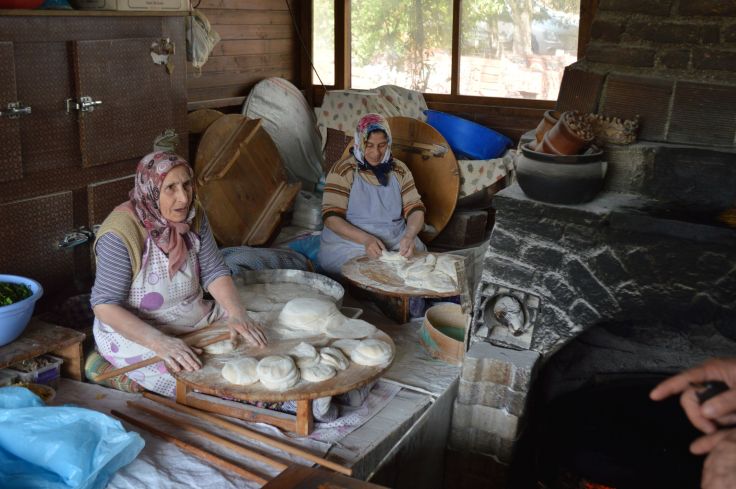
For whatever reason, it always takes me awhile for me to realize that I’m in a new country. I’ve never been able to suss out if it’s because I’m so tired from traveling or if I’m so shocked that vacation is finally really happening instead of still in the planning stage. We’d been in Turkey a full day already, struggling with the language barrier, learning how to use those “squatting toilets,” and trying to figure out what kind of meat was in all the foods we were eating. But it wasn’t until that beautiful car ride to a nondescript “fast food” restaurant on the side of the road that I truly understood that I was in Turkey.
But let me go back. Our first day, which we spent in Selcuk, started with some intense culture shock. We disembarked the train from Izmir onto a temporary platform, then spent a confused moment trying to figure out how to cross the train tracks before realizing with slight horror that the locals were all walking 100 meters down the middle of the tracks and then crossing. My German training screamed against this practice, but I followed suit because it was the only option. Hesitantly we started off down the tracks, stepping tie-to-tie while keeping a paranoid eye out for trains. We were halfway there when suddenly a loudspeaker crackled to life on the nearest minaret, and a haunting voice resonated out across the deserted tracks to call people to prayer.


We felt distinctively out of our element by the time we got to our hotel, but our hotelier Erdal immediately took us under his wing and gave us our first Turkish teas, a drink that quickly became a thrice-daily staple and will probably be a hard habit to kick. He then dedicated the rest of his day to driving us to the major sights in town in his personal car. Our hypothesis for this exceptional but baffling level of service was threefold: one, he really was a hospitable person; two, we were the only guests in the hotel because tourism is down and he was bored; and three, like most of the people in this country, he really wanted to sell us something from his shop (carpets, naturally). But regardless of the reason, we were eternally grateful for his friendly conversation and eagerness to share his town with us.
After he took us to the “fast food” restaurant, he dropped us and our pancakes off at Ephesus, which is arguably Selcuk’s main claim to fame. Ephesus, or Efes, is an ancient Roman city that was built over 2000 years ago and then beaten down mostly by earthquakes and time, although the marble thievery certainly didn’t help. As we bought our tickets we were approached by a friendly calico cat, mewing so pitifully that I had to sit down and pet it. I looked away for a split second to answer a question from Julie, and when I looked down again, that single cat had multiplied into seven, every one of which was eyeing our bag of delicious-smelling food. By the time we actually found a table and dug in, we were surrounded by a flock of fifteen felines and one bemused-looking yellow dog, all of whom eventually got a stray fragment of spinach-meat-onion or walnut-honey pancake as reward for their tenacity.


This was only the start of our “Turkey is apparently a giant petting zoo” experience. Every time I kneel to take a picture, a friendly stray materializes to rub against my face or arm or leg. We sit down to a meal of kebap or pide and a turf war for our scraps breaks out at our feet. And it isn’t always domesticated animals. When we patronized the ruins of St. John’s Basilica, we stumbled upon a bold tortoise, so inured to human interaction that it continued hauling its cumbersome body across the rubble even when I stuck my camera lens 10 inches from its scaly face.


But I digress.
We wandered wide-eyed down the uneven road at Ephesus, trying unsuccessfully not to trip as we stared at the remains of the once-great city. There’s something bewildering and awesome about imagining the lives of the people who walked the same path 1500 years ago. You wonder: What did they actually do with their lives? Were they happy? How were their daily routines different from mine? Could I relate to them if I could converse with them?…


The craftsmanship these people possessed was no less unfathomable than their lives. Patterned columns and buildings and statues carved from solid rock waited around every bend in the road, things I probably couldn’t make even if I had access to the most advanced masonry technologies available. And yet these people did it over a millennia ago, building an entire city complete with plumbing and libraries and amphitheaters using nothing more than their bare hands and a few simple tools.


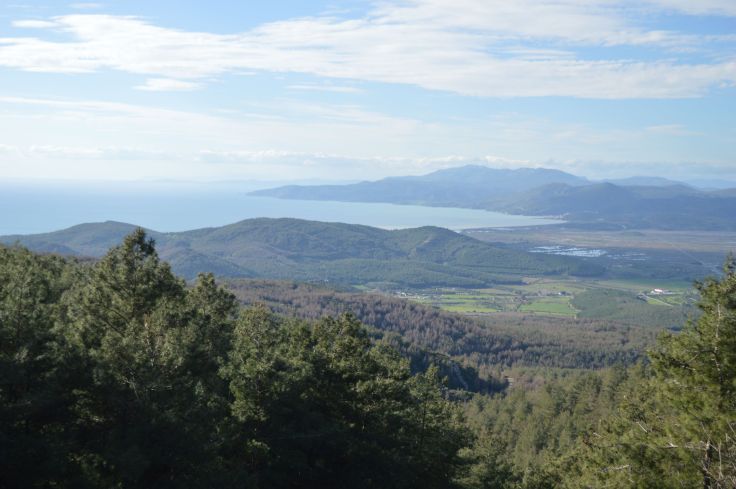
After three hours of baking in the sun, we continued our tour of Selcuk, visiting the ruins of St. Paul’s Basilica, the one lonely standing pillar at the Temple of Artemis (one of the seven wonders of the ancient world), and winding our way up into the surrounding mountains to visit a house that is said to have once been the Virgin Mary’s refuge. People still use this site as a holy pilgrimage destination, often walking the long winding road up the mountain. They come to pray, to wash their hands in the spring below the house, to tie scraps of toilet paper or written prayers onto a wooden lattice already plastered with a thousand more. Against all expectations, although we’ve been in Turkey for five days, we have yet to visit a mosque; in fact, most sites we’ve visited have had ties to early Christianity. Although I’m not religious, I’m floored by the sheer weight of history that clings to these ruined places.


 Window Seat Odyssey
Leave a comment